
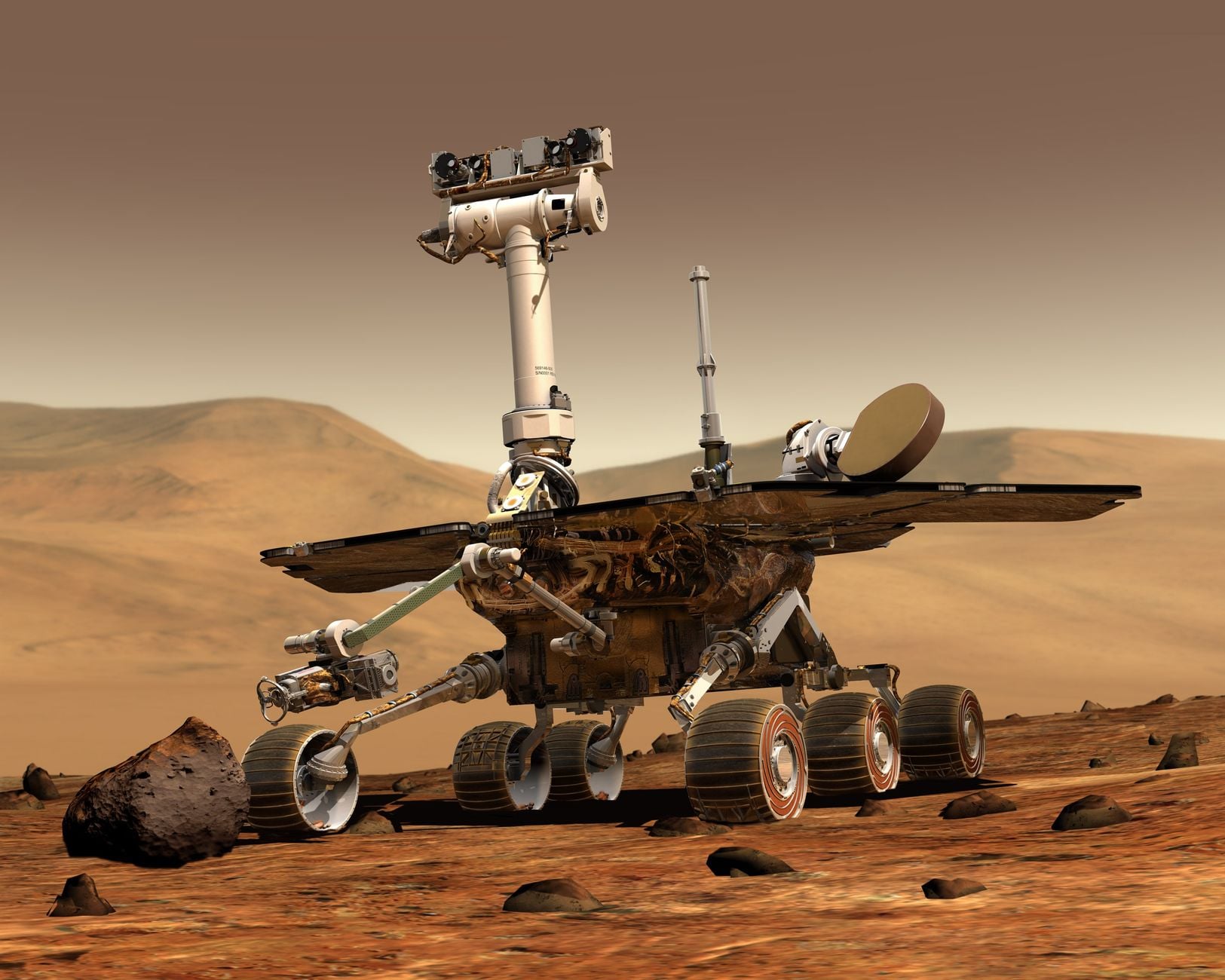
On the edge of an ancient river valley in Jezero crater, at an outcrop the mission team named Bright Angel, NASA’s Perseverance rover ran its instruments across the rock and kept finding the same thing: the signal of complex, carbon-based molecules, hundreds of times, in two different stones. The researchers describe it as the only detection of macromolecular carbon on a natural rock surface on Mars.
It is a genuine find.
It is also, on its own, not a sign of life, and the people who made it are careful to say so.
What was found, and where
Bright Angel is a band of pale mudstone in Neretva Vallis, the valley that once fed water into Jezero. The two rocks are called Cheyava Falls and Walhalla Glades. Using an instrument called SHERLOC, which reads the chemistry of a rock by shining an ultraviolet laser on it, Perseverance detected what scientists call macromolecular organic carbon: large, complex molecules built around carbon, the element life on Earth is based on.
The signal turned up across hundreds of measurements, on patches the rover had ground flat. In one rock the carbon sat alongside silicate minerals, in the other alongside carbonate and sulphate. The work, published in the journal Science Advances, is the first time this kind of carbon has been found in a Martian mudstone outside Gale crater, where the Curiosity rover detected organics years ago.
Why the phrase “natural rock surface” matters
The careful wording in that claim is doing real work. Curiosity’s organic detections at Gale came from drilling rock into powder, heating it in an oven and analysing the gases that came off. SHERLOC does something different: it reads the carbon directly off the surface of the rock, without destroying the sample, and maps where the molecules sit.
That is why this counts as a first of its particular kind. The complex carbon was found in place, on the rock as it lies, rather than coaxed out of a sample by cooking it.
Carbon is not life
This is the part the more excitable headlines tend to skip. Macromolecular carbon is a building block, the sort of material that living things are made from, but it is not evidence that anything lived.
Complex organic molecules form perfectly well without biology. They turn up in meteorites, in ordinary geochemical reactions, even in interstellar gas. What the Bright Angel detection establishes is that the raw ingredients were present, and were preserved, in sediments laid down in an ancient lake. That is a necessary condition for life, and a long way from a sufficient one. SHERLOC can find the carbon. It cannot say whether chemistry or biology put it there.
Why it matters anyway
The finding strengthens a picture that has been building for years, that early Mars had what life would have needed. There was water, since the mudstones formed at the bottom of a lake. There were the right minerals. And there was organic carbon, now shown to exist beyond the single crater where it had been seen before, which suggests it may have been widespread rather than a local accident.
It also marks out which rocks are worth the trouble of bringing home. Cheyava Falls, the same rock that carries separately reported features that some scientists have flagged as a possible biosignature, is among the samples Perseverance has already sealed for return.
What to watch
The question of origin will not be answered on Mars. Telling biological carbon from the geological kind takes instruments far larger and more sensitive than anything a rover can carry, which means waiting for the cached samples to reach laboratories on Earth, under the much-delayed Mars Sample Return programme.
Until then the honest summary is narrow, and worth stating plainly. The building blocks are there, detected directly on the rock.
What made them is still unknown.
