
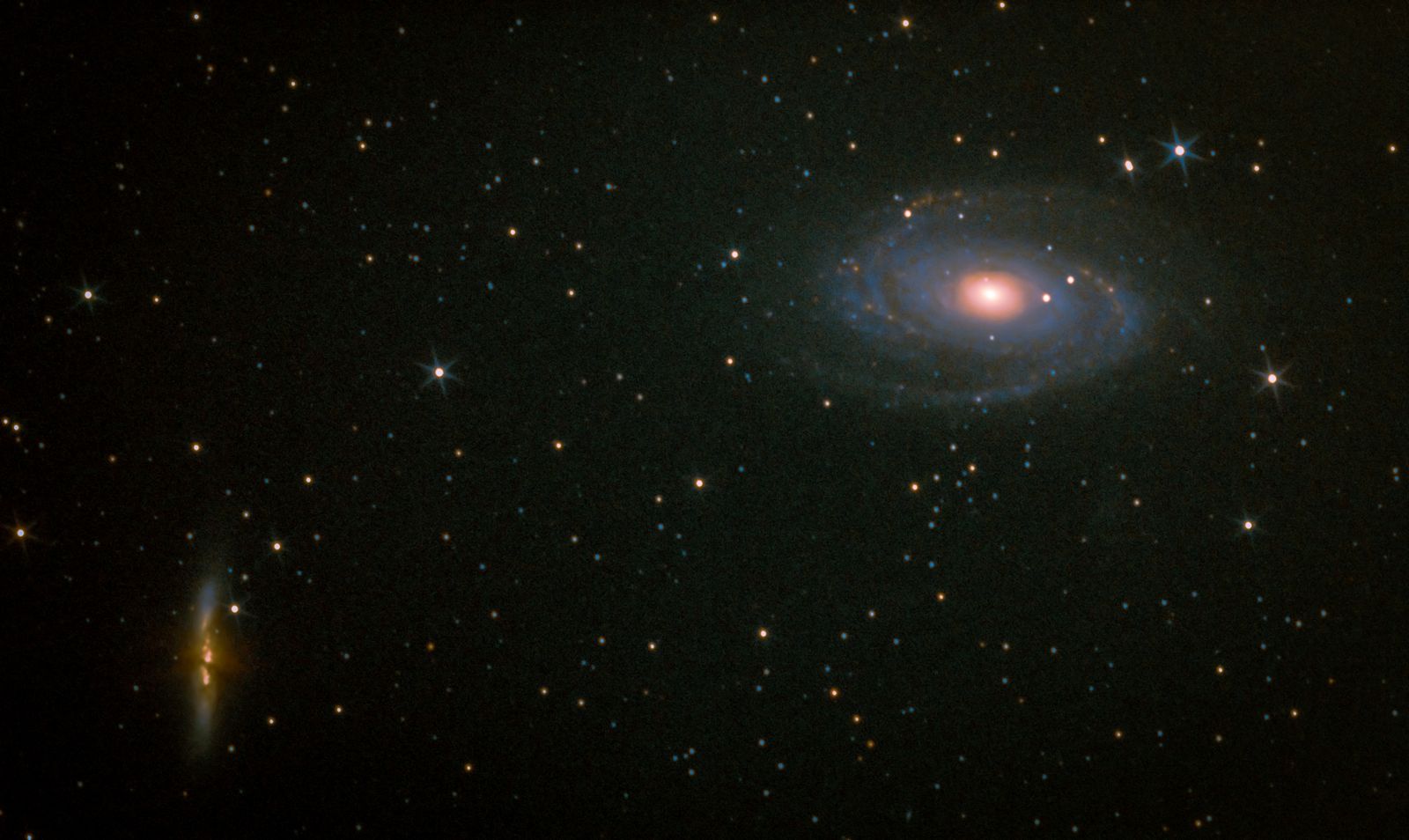
The universe is expanding, and the expansion is speeding up. Run that forward far enough and the consequence is bleak: one by one, every galaxy beyond our own immediate neighbourhood will be carried so far away that its light can no longer reach us. The astronomers of that distant era would look up at an almost empty sky, and they would have no way, from observation alone, to ever discover that the Big Bang happened.
This is not idle speculation. It is the conclusion of a serious cosmological argument, and it says something uncomfortable about the limits of what any observer can know.
How the sky empties
Dark energy is pushing the universe apart at an accelerating rate. The more distant a galaxy, the faster the expanding space between us carries it away, and beyond a certain distance, the cosmic horizon, that recession is effectively faster than light can close the gap. Light leaving such a galaxy now will never arrive.
As the acceleration continues, that horizon draws inward. Over roughly the next hundred billion years, and decisively over trillions, the galaxies we currently see will redshift, dim, and slip past it for good. What stays behind is our Local Group, the Milky Way and its gravitationally bound neighbours, which are held together tightly enough to resist the expansion. In time they will merge into a single galaxy, sitting alone in a black and apparently endless void.
Why they could not find the Big Bang
Our confidence that the universe began in a hot, dense state rests mainly on three pillars of evidence. The far future erases all three.
The first is the redshift of distant galaxies, the observation that they are all rushing apart, which is the direct fingerprint of an expanding universe. With every other galaxy gone from view, there is nothing left to measure that motion against. The second is the cosmic microwave background, the faint afterglow of the early universe; by then it will have been stretched and diluted so far that it falls below any hope of detection. The third is the precise ratio of light elements like hydrogen and helium left over from the first minutes, and after countless generations of stars have processed that material, the primordial signal will be buried.
The physicists Lawrence Krauss and Robert Scherrer worked this through in a 2007 paper bluntly titled The Return of a Static Universe and the End of Cosmology. Their conclusion is that a future astronomer, doing careful and honest science with everything still visible, would reasonably decide they lived in a single, eternal, static galaxy. The evidence for anything more would simply be gone.
The part that should unsettle us now
The argument is not really about the far future. It is about the reliability of observation itself.
If a whole era of intelligent observers could be doomed to a confident, well-reasoned, and completely wrong picture of the universe, then the obvious question is what we have already lost. Information from the earliest universe has been crossing our own horizon throughout cosmic history. We may be living in a privileged window, late enough that intelligence exists, early enough that the evidence of our origins is still in the sky, without any way to know how much has already gone dark.
One caveat worth keeping
This rests on an assumption: that dark energy goes on behaving as it does now, as a steady cosmological constant. If it weakens or changes character, the timeline shifts, and the story could be different. The scenario is the careful extrapolation of current physics, not a certainty.
It is also worth saying that the future astronomers would only be blind if their knowledge had to be rebuilt from scratch. A civilisation that kept good records could still know about the Big Bang the way we know about events we cannot witness, on the strength of evidence gathered while it lasted. That, in the end, is the quiet lesson. We happen to live at a moment when the universe will still tell us where it came from, and that will not always be true.