
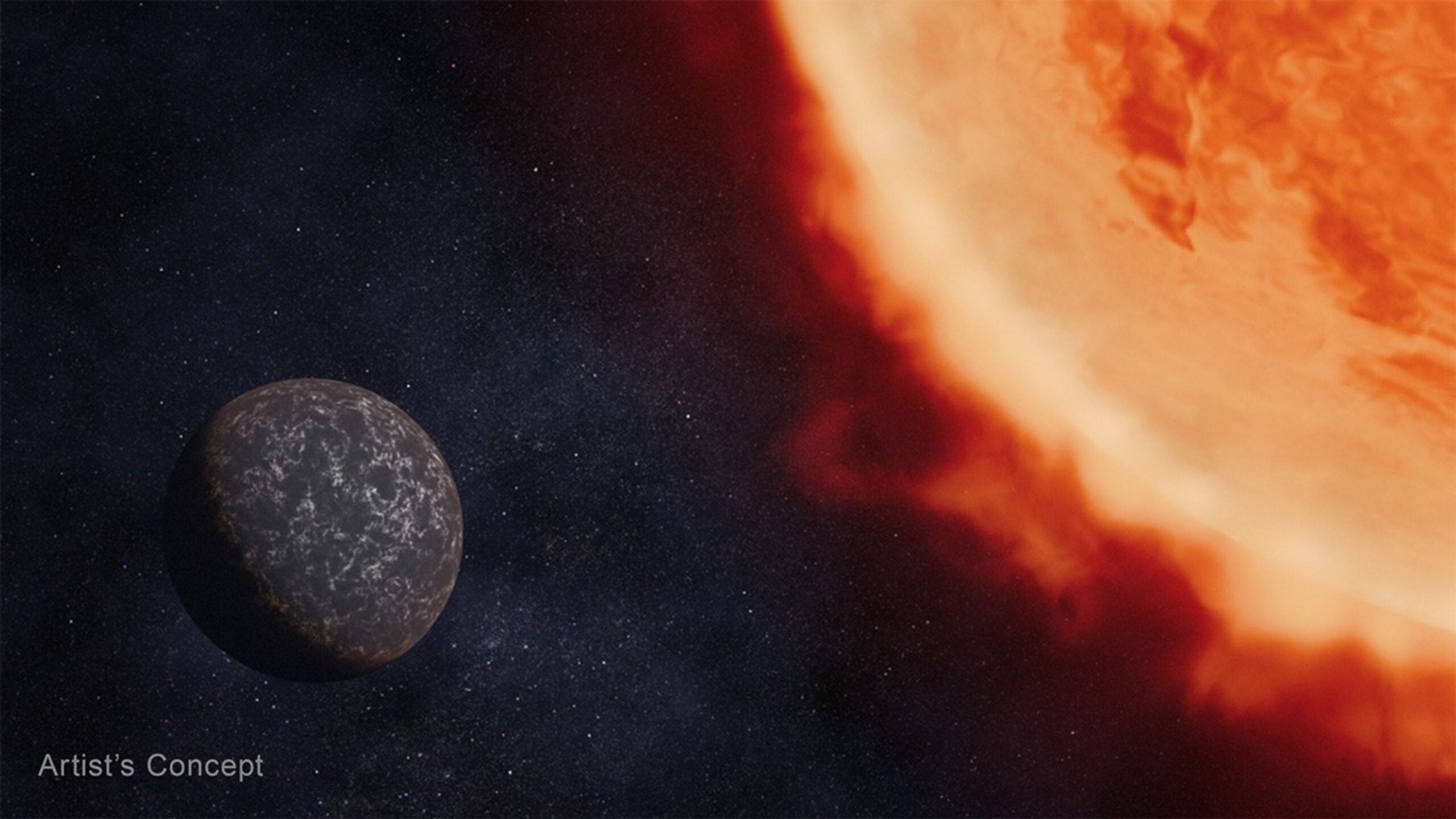
GJ 251 c is the kind of planet astronomers have been trying to find for decades: nearby, relatively small, in a temperate orbit, and separated from its star just enough that future telescopes may not have to infer its existence only from a wobble.
The planet, reported by a team including UC Irvine astronomers in 2025, orbits the red dwarf GJ 251, a star about 5.5 parsecs from Earth. That is roughly 18 light-years, close enough to place it among the Sun’s near neighbours. In ordinary human terms that distance is unreachable. In exoplanet astronomy, it is almost local.
The new candidate matters because it combines two traits that rarely arrive together. It is in the star’s habitable zone, where the amount of starlight could allow liquid water on a suitable rocky surface, and it may be accessible to direct imaging by the coming generation of giant ground-based observatories.
That does not mean anyone has seen oceans, clouds or life. It does not even mean the planet has been photographed. GJ 251 c was found through radial velocity measurements: the planet’s gravity tugs on its star, causing a small back-and-forth motion in the star’s light. From that wobble, astronomers can estimate the planet’s orbital period and minimum mass.
For GJ 251 c, the signal points to an orbit of about 53.647 days and a minimum mass of about 3.84 Earth masses. That places it in the super-Earth category: larger or more massive than Earth, but smaller than ice giants such as Uranus and Neptune. The authors describe it as “plausibly terrestrial”, because its minimum mass falls below the five-Earth-mass threshold they used for a rocky-world regime.
The caveat is important. A radial velocity detection usually gives a minimum mass, not a radius. Without a transit across the star or a direct measurement of size, astronomers cannot yet know the planet’s density. A world of roughly four Earth masses could be rocky, but it could also hold a thick atmosphere or volatile-rich layers that make its surface conditions very different from Earth’s.
A nearby red dwarf with a useful geometry
GJ 251 itself is an M dwarf, a small, cool red star. Such stars are the most common in the Galaxy, and because they are dim, their habitable zones sit much closer in than Earth’s orbit around the Sun. GJ 251 c takes just under 54 days to complete one orbit, yet it can still sit in a region where surface temperatures might be moderate if the planet has the right atmosphere.
The system already had a known inner planet, GJ 251 b, with an orbit of about 14.237 days and a similar minimum mass. The 2025 analysis combined new radial velocity data from the Habitable-zone Planet Finder and NEID instruments with archival measurements from HIRES, CARMENES and SPIRou. That gave the team more than two decades of stellar motion to work with, from 1997 through 2024.
That long baseline matters because red dwarfs can produce signals of their own. Starspots, magnetic activity and rotation can all imitate or distort planetary wobbles. The researchers tested more than 50 models and used colour-dependent activity analysis to separate likely planet signals from the behaviour of the star.
The result is not just another dot in an exoplanet catalogue. In the paper’s words, GJ 251 c is currently the best candidate in the Northern Sky for direct imaging of a terrestrial habitable-zone planet.
Why direct imaging is such a hard prize
Most known exoplanets have never been photographed. They are detected indirectly, usually because they dim their star during a transit or tug on it through gravity. Direct imaging is much harder because planets are faint and close to stars that are enormously brighter.
For young giant planets far from their stars, direct imaging has already worked. Those planets are large, hot and widely separated enough to pick out from the glare. A temperate rocky planet is a different problem. It shines mostly by reflected starlight, and it sits much closer to the star from our point of view.
GJ 251 c is interesting because the system is nearby. A planet orbiting a close star has a larger apparent separation on the sky than the same orbit would have around a distant star. That wider angle makes it easier, though still extremely difficult, for a telescope and coronagraph to block the star’s glare and look for the planet beside it.
The study points toward the next generation of extremely large telescopes, including the Thirty Meter Telescope, the Giant Magellan Telescope and the European Extremely Large Telescope class of observatories. These instruments are being built or planned around mirrors far larger than today’s biggest optical telescopes, with adaptive optics designed to correct for the blurring of Earth’s atmosphere.
If they can image a planet such as GJ 251 c in reflected light, astronomers would gain access to far more than a point on a chart. Repeated observations could eventually constrain its orbit, brightness, colour and possibly atmospheric properties. In the long run, direct imaging is one of the main paths toward studying non-transiting nearby rocky planets.
Habitable zone does not mean habitable planet
The habitable-zone label should still be read with care. It means the planet receives an amount of energy from its star that could, under the right conditions, allow liquid water. It does not tell astronomers whether water is present, whether the atmosphere is stable, or whether the surface is even exposed.
Red dwarf planets also carry extra uncertainties. Many orbit close enough to their stars that tidal forces may affect their rotation. Some red dwarfs produce strong flares and high-energy radiation, especially when young, which can erode atmospheres. GJ 251 c’s host star is nearby and comparatively accessible to study, but the planet’s climate remains unknown.
A super-Earth mass can also be ambiguous. More gravity may help a planet hold onto an atmosphere, but it may also allow it to retain a deep envelope of gas or volatiles. A thick carbon dioxide atmosphere could warm an otherwise cold surface, while a thin or missing atmosphere could leave the planet frozen. The same orbit can lead to very different worlds.
That is why the direct-imaging possibility is so important. For many habitable-zone planets, astronomers can say where they are and how massive they may be, but not much else. GJ 251 c may sit close enough, and far enough from its star in angular terms, to become a real observing target rather than only a statistical example.
The discovery also underlines a shift in exoplanet hunting. The first era found planets in large numbers. The next phase is about finding the few nearby worlds where deeper questions can actually be tested. A planet 18 light-years away around a small star is not close in the sense of travel, but it is close in the sense that future instruments may begin to pick it apart.
For now, GJ 251 c remains a candidate world with a promising set of measurements, not a confirmed second Earth. Its mass is a minimum, its radius is unknown, and its atmosphere has not been detected. But its orbit, proximity and likely rocky regime make it one of the more practical nearby targets for the next stage of exoplanet science.
If the coming giant telescopes can actually separate its faint light from the glare of GJ 251, the result would mark a different kind of discovery: not merely knowing that a nearby habitable-zone super-Earth exists, but beginning to see what kind of world it really is.
Sources
- Beard et al., Discovery of a Nearby Habitable Zone Super-Earth Candidate Amenable to Direct Imaging
- Stock et al., The CARMENES search for exoplanets around M dwarfs: Three temperate to warm super-Earths
- Ould-Elhkim et al., Wapiti: a data-driven approach to correct for systematics in RV data
- NASA Science: Rocky Exoplanet Orbiting a Red Dwarf Star artist’s concept
