
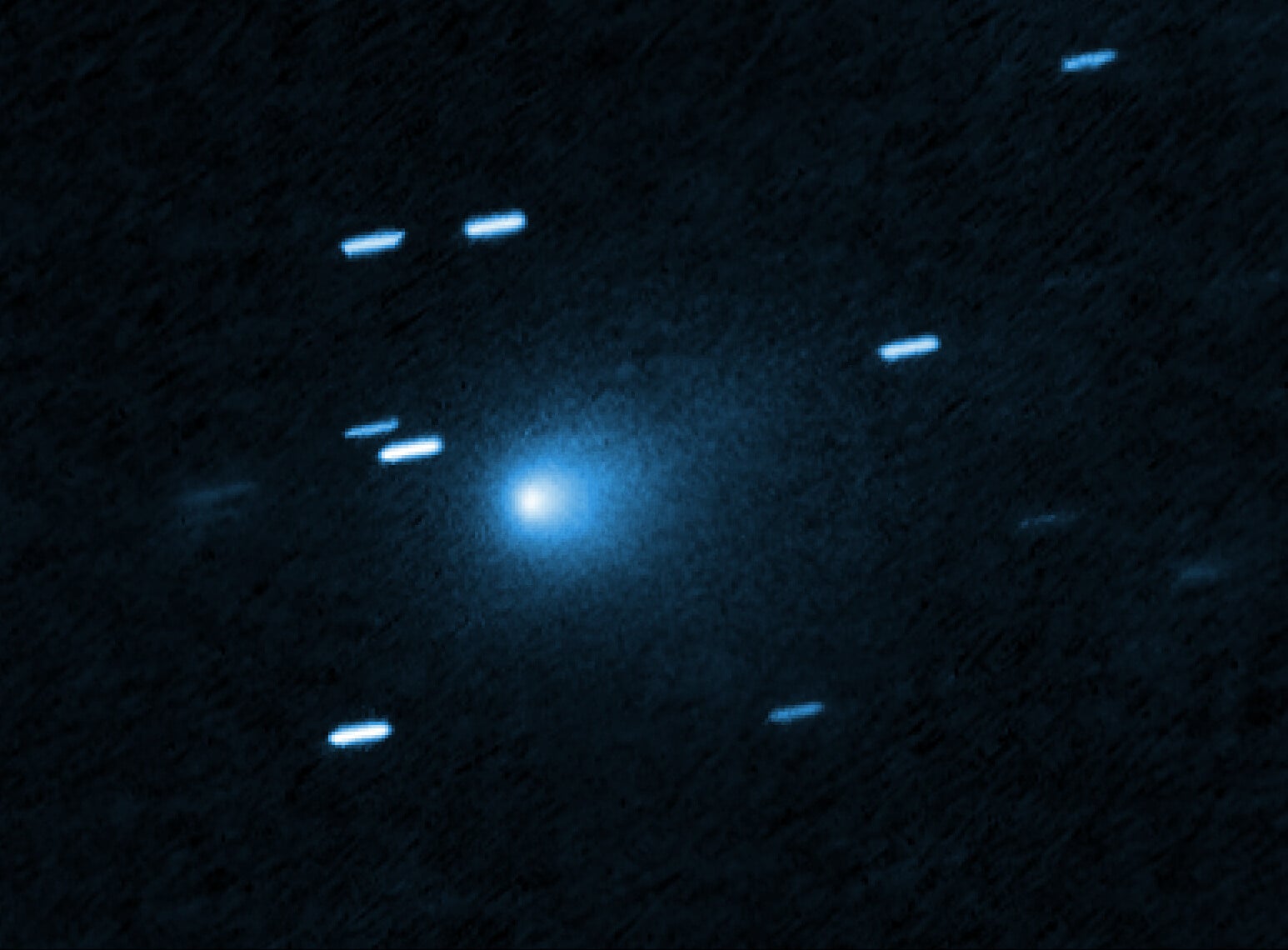
On July 1, 2025, the ATLAS survey telescope in Rio Hurtado, Chile, reported a faint moving object to the Minor Planet Center. At first, it looked like another small body being picked out of the crowded background of the sky. That is what surveys like ATLAS are built to do: find moving points of light before they become surprises.
But follow-up calculations changed the category of the object quickly. The path was not a closed orbit around the Sun. It was hyperbolic, meaning the object was moving fast enough that the Sun could bend its trajectory but not keep it. NASA later identified it as 3I/ATLAS, the third known interstellar object found passing through our solar system, after 1I/ʻOumuamua in 2017 and 2I/Borisov in 2019.
The speed helped make the case feel less ordinary. ESA/Hubble later described 3I/ATLAS as travelling at roughly 210,000 kilometres per hour, or about 130,000 miles per hour, the highest velocity recorded for a solar-system visitor. That number is not just a flourish. It is part of why astronomers treated the object as an arrival from outside the Sun’s gravitational family.
This was not a danger story. NASA states that 3I/ATLAS posed no threat to Earth, with its closest approach to our planet about 1.8 astronomical units, or roughly 170 million miles. Its importance lay elsewhere: for only the third time, astronomers had a confirmed piece of another planetary system moving through ours while still within reach of telescopes and spacecraft.
Why the orbit mattered
Most comets known to astronomers are bound to the Sun. Some take a few years to return. Others spend thousands or millions of years in long, cold orbits before falling inward again. Their paths may be stretched, tilted and difficult to observe, but they are still solar-system objects.
3I/ATLAS was different because the geometry did not close. When NASA describes the orbit as hyperbolic, it is saying that the object follows an open path. Trace that path backwards and it does not lead to a distant solar orbit. It points outside the solar system. Trace it forward and the comet leaves again.
That is why the first orbit calculations mattered so much. A faint discovery image alone cannot tell the full story. The object had to be observed repeatedly, its position measured against background stars, and its motion fitted to an orbit. Once enough observations were gathered, including pre-discovery detections from other ATLAS telescopes and Caltech’s Zwicky Transient Facility extending back to June 14, 2025, the interstellar interpretation became much firmer.
The name carries that conclusion. The “3I” designation means it is the third confirmed interstellar object. “ATLAS” points to the survey team that first reported it. Its comet designation, C/2025 N1 (ATLAS), reflects its cometary nature and discovery timing.
What ATLAS saw
ATLAS stands for Asteroid Terrestrial-impact Last Alert System. It is a NASA-funded survey designed primarily to find near-Earth objects, especially those that could approach our planet. The same wide-field, repeated scanning that makes it useful for planetary defence also makes it good at catching unusual moving objects.
3I/ATLAS was faint when first reported. Later NASA material describes the first-sighting image as an observation from July 1, 2025, by the survey telescope in Chile, with the object identified as originating from interstellar space. The discovery did not require a dramatic visual appearance. It required careful detection and fast follow-up.
That is often how important small-body discoveries happen. A survey flags motion. Other observatories add measurements. Archival images are searched for earlier appearances. The orbit is refined. Only then does the story become clearer.
In this case, the clearer story was that the object was not coming back. The Sun would warm it, observatories would study it, and then 3I/ATLAS would continue outward, carrying its material history away again.
It behaved like a comet
An interstellar object is not automatically a comet. ʻOumuamua, the first confirmed interstellar visitor, looked unusual and did not show a conventional cometary coma in the way many observers expected. Borisov, the second, was more clearly comet-like. 3I/ATLAS joined that cometary side of the ledger.
Hubble observations on July 21, 2025 showed a teardrop-shaped cocoon of dust coming off the comet’s solid, icy nucleus. ESA/Hubble reported that the telescope also captured a dust plume from the Sun-warmed side of the comet and a hint of a dust tail streaming away from the nucleus. In other words, the object was not merely a rock passing through. Solar heating was driving activity, much as it does in many comets born inside our own system.
That resemblance is scientifically useful. If an interstellar comet behaves in broadly comet-like ways, astronomers can compare its dust, gas, activity and nucleus size with comets formed around the Sun. Similarity is information. Difference is information too. Either way, the visitor becomes a sample of another environment, studied from a distance.
Hubble could not directly see the solid nucleus inside the dust. It could, however, help narrow its possible size. NASA later summarised observations indicating an upper diameter limit of 3.5 miles, or 5.6 kilometres, while leaving open the possibility that the nucleus could be much smaller, about 1,444 feet, or 440 metres, across. ESA/Hubble gave a similar upper limit and noted that the solid heart of the comet remained hidden inside the surrounding dust.
A fast object, but not an impact object
The speed of 3I/ATLAS made it compelling, but it also made careful framing necessary. A comet moving at about 130,000 miles per hour through the solar system sounds alarming if detached from its trajectory. The orbit is what matters.
NASA’s overview says the comet remained far from Earth. Its closest approach to the Sun came around October 30, 2025 at about 1.4 astronomical units, just inside the orbit of Mars. Its closest approach to Earth was much farther away than the Moon, farther even than Mars at many oppositions. The object was notable because it was unbound, not because it was threatening.
That distinction is important for another reason. ATLAS exists in part to protect Earth by finding objects that could approach us. A discovery like 3I/ATLAS shows the value of that system beyond the narrow category of impact risk. A planetary-defence survey can also become an interstellar-object detector.
Why the third one matters
Three known interstellar objects is still a tiny sample. It is not enough to make confident claims about the full population of bodies travelling between stars. But it is no longer a sample of one. ʻOumuamua, Borisov and 3I/ATLAS together suggest that interstellar visitors are not purely theoretical and not impossibly rare.
The challenge is that they are hard to catch. They are faint, fast and temporary. Many may pass through unnoticed, especially if they arrive from dense star fields or never come close enough to be bright. Better surveys mean more chances to find them while there is still time to observe them.
3I/ATLAS arrived with better infrastructure watching than the first two interstellar objects had. NASA lists observations by Hubble, Webb, TESS, Swift, SPHEREx, the Perseverance Mars rover, Mars orbiters, MAVEN, Europa Clipper, Lucy, Psyche, Parker Solar Probe, PUNCH and ESA/NASA’s SOHO. That range of assets matters because no single instrument can answer every question. A comet is dust, gas, ice, orbit, chemistry and time-dependent behaviour all at once.
For a few months, then, a piece of another star system became a moving target across our own. It was not captured by the Sun, and it was never going to stay. But it passed close enough for modern surveys and spacecraft to turn a faint July detection into an interstellar case study.
That may be the most useful way to read 3I/ATLAS. It was not a visitor in any human sense. It was debris from elsewhere, following physics. The rare part was that we noticed it in time.
