
In July 2025, a telescope built to warn Earth about dangerous asteroids found something it was not specifically hunting for: an object that did not belong to the Solar System at all.
The instrument was part of ATLAS, the Asteroid Terrestrial-impact Last Alert System. Its job is practical and urgent. It scans the sky for moving points of light, looking for near-Earth asteroids that might one day matter for planetary defence. But the same habit that makes it useful for danger also makes it good at surprise. Anything moving oddly through the sky can enter its data stream.
On 1 July 2025, that is what happened. The NASA 3I/ATLAS page says the NASA-funded ATLAS survey telescope in Rio Hurtado, Chile, first reported observations of comet 3I/ATLAS to the Minor Planet Center that day. The name later told the story: the “I” marks it as interstellar, and the “3” marks it as the third known interstellar object, after 1I/’Oumuamua and 2I/Borisov.
The ATLAS project, developed by the University of Hawaii and funded by NASA, describes itself as an asteroid impact early warning system with telescopes in Hawaii, Chile, and South Africa. It automatically scans the sky several times each night for moving objects. 3I/ATLAS was not a threatening asteroid. It was a rare visitor from beyond the Sun’s gravitational family, caught by a system designed to notice motion before it becomes dangerous.
A discovery made by watching for risk
Planetary defence is often imagined as a future emergency: a large asteroid, a warning, a deflection mission, a clock counting down. Most of the real work is quieter. It consists of surveying, measuring, reporting, checking old images, and building enough warning time that an object can be understood long before it becomes urgent.
ATLAS is built for that routine. It does not need an object to be famous or strange. It only needs the object to move. A near-Earth asteroid, a comet, a piece of space debris, or an interstellar body can all appear first as a point shifting against background stars. The difference comes later, when follow-up observations turn a line of positions into an orbit.
That is what made 3I/ATLAS stand out. Its path was not just elongated, as some long-period comets are. It was unbound. Instead of tracing a closed orbit around the Sun, it was travelling on a hyperbolic path, fast enough to pass through and leave again. In practical terms, the Solar System was not its home. It was a crossing point.
NASA notes that observations made before discovery were later gathered from three ATLAS telescopes and the Zwicky Transient Facility, extending the record back to June 14, 2025. That is a familiar pattern in modern astronomy. The discovery is the moment someone notices, but the object may already be hiding in archived images, waiting for its past positions to be linked.
The third interstellar object
Before 2017, no confirmed interstellar object had been observed passing through the Solar System. Then came 1I/’Oumuamua, a small body with an unusual shape or brightness pattern and no clear coma. In 2019, astronomers found 2I/Borisov, a comet that looked more familiar, with gas and dust around an icy nucleus. 3I/ATLAS became the third member of that small list.
Three objects are not enough to describe an entire population with confidence, but they are enough to show that interstellar visitors are not fantasy. Planetary systems can eject small bodies into the galaxy, and some of those bodies will eventually pass near other stars. Most are too faint, too fast, or too badly placed for us to see. A few arrive while our surveys are watching.
That is why 3I/ATLAS mattered immediately. It was not simply another comet with a long orbit. It was material from another planetary system, preserved in ice and dust, crossing a region where Earth-based and space-based telescopes could study it before it disappeared.
The discovery also came at a time when survey astronomy is becoming more powerful. ATLAS, Pan-STARRS, Zwicky Transient Facility, and the Vera C. Rubin Observatory are all part of a changing sky-watch infrastructure. The more often the sky is searched, and the deeper those searches go, the less likely rare visitors are to slip past unnoticed.
Why it will not return
Many comets are repeat visitors. Halley’s comet, for example, is bound to the Sun and returns on a roughly 76-year cycle. Long-period comets can take thousands or millions of years, but they still belong to the Sun if their orbits are closed.
3I/ATLAS is different. Its trajectory is hyperbolic, which means the Sun bent its path but did not capture it. The comet came in from interstellar space, moved through the planetary region, and will head back out again. This was not one loop in a very long cycle. It was a one-time passage through our neighbourhood.
That does not mean its path is simple. Before entering the Solar System, it may have travelled around the Milky Way for billions of years, nudged by stars, molecular clouds, and the galaxy’s gravity. After leaving, it will continue into that wider traffic. But from the Sun’s point of view, there is no return appointment.
This is part of what makes interstellar objects scientifically valuable. A sample-return mission is not available. A slow flyby is unlikely unless an object is discovered much earlier or happens to pass near a spacecraft already in position. Astronomers must use the observing window they get, sometimes only months, before geometry and distance close it.
Older than the Solar System?
The idea that 3I/ATLAS may be older than the Solar System comes from modelling its motion through the galaxy. In a 2025 paper, Matthew Hopkins and colleagues placed 3I/ATLAS in the context of the Otautahi-Oxford interstellar object population model. The model uses Gaia data along with planet-formation chemistry and galactic dynamics to estimate likely properties of interstellar objects.
The paper reports that the object’s velocity predicts an age of more than 7.6 billion years. That would make it older than the Solar System, which is about 4.6 billion years old. The claim is not that scientists have held a piece of 3I/ATLAS in a laboratory and dated it directly. It is an inference from motion, population modelling, and where such an object most likely came from.
That distinction matters. “Older than the Solar System” is not a decorative phrase here. It is a hypothesis with uncertainty, built from the comet’s speed and direction and from models of where different populations of stars and small bodies live in the Milky Way. If the inference is right, 3I/ATLAS may be a relic from a period of planetary formation that predates the Sun by billions of years.
Even if the exact age changes with better modelling, the broader point remains. Interstellar comets are not bound to the chronology of our own system. They may carry ices and dust formed around stars older, younger, richer, or poorer in heavy elements than the Sun. Each one is a messenger from a different planetary nursery.
A planetary-defence telescope as a discovery machine
The accidental quality of the discovery is easy to overstate. ATLAS was not looking for interstellar comets in the way a dedicated comet mission might. But it was doing exactly what makes such a discovery possible: repeatedly scanning the sky for motion and reporting uncertain objects quickly enough for others to follow up.
That is the quiet overlap between planetary defence and basic science. A telescope built to improve asteroid warning time also builds a record of the changing sky. It can find asteroids that matter for safety, comets that matter for Solar System history, and rare objects that began around other stars.
3I/ATLAS also shows why speed matters in reporting. Interstellar objects do not wait. Once one is found, astronomers need positions, brightness measurements, spectra, and archived detections. Each observation narrows the orbit and helps decide what it is, where it came from, and how long it will remain observable.
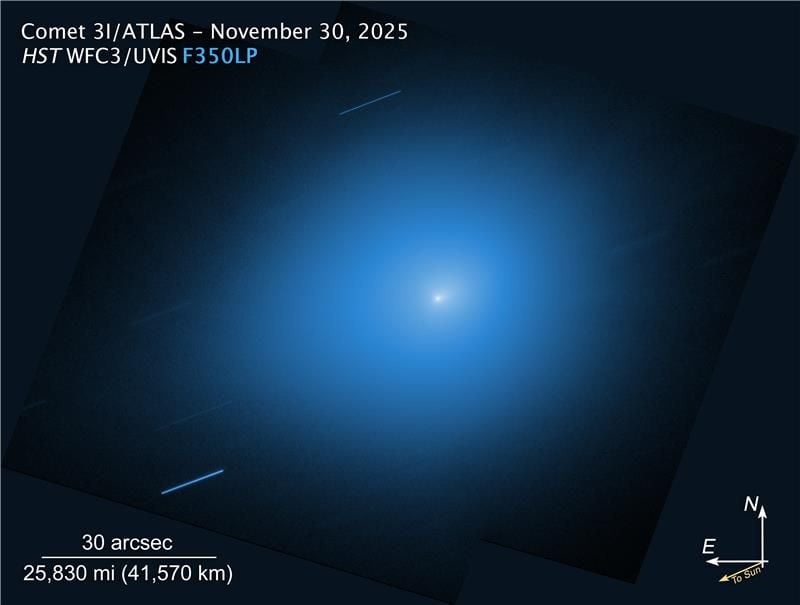
The Chilean ATLAS station caught the moving point first. Other observatories helped confirm its nature. NASA and other agencies then turned multiple assets toward it, from Hubble to Webb and other spacecraft. A warning system had opened a scientific campaign.
A visitor passing through
There is something almost modest about the way 3I/ATLAS entered the record. It did not announce itself as a large object blazing across the sky for everyone to see. It appeared as data: a faint point, a series of positions, a path that refused to close around the Sun.
From that path came the deeper implication. This comet was not stored in the Oort Cloud. It was not a leftover from the Sun’s own birth. It had been travelling between stars before it crossed the field of view of a telescope in Chile designed to protect Earth from nearer hazards.
Its visit will not repeat. It will not become a familiar comet in human calendars. The value of 3I/ATLAS lies in the fact that it passed once, was noticed, and left behind measurements. Those measurements connect planetary defence, survey astronomy, galactic history, and the chemistry of worlds that formed around other suns.
For a telescope built to watch for danger, that is a remarkable side effect. By scanning for objects that might one day threaten Earth, ATLAS caught one that could not threaten us at all, but could tell us something about how old and varied planetary debris can be beyond the Solar System.
