
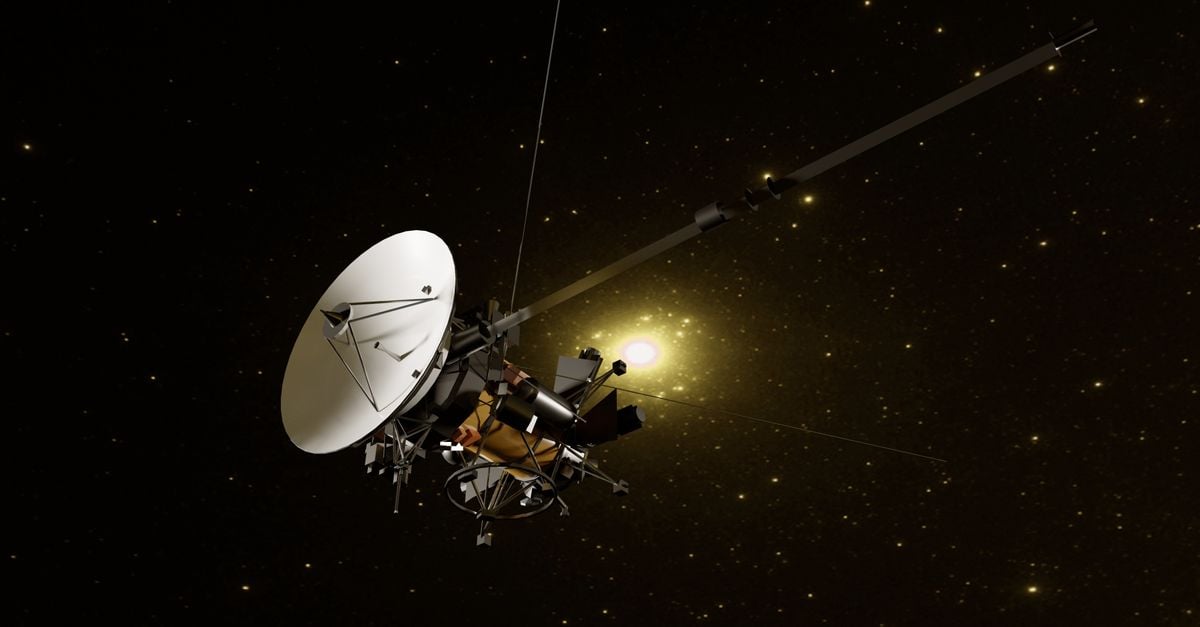
On 25 August 2012, at about 121.7 astronomical units from the Sun, Voyager 1’s particle detectors registered a jolt. The count of galactic cosmic rays, the high-energy particles that come from the wider galaxy, jumped suddenly, while the lower-energy particles that belong to the Sun’s own domain nearly vanished. By that measure, the spacecraft had just stepped outside the bubble the Sun blows around itself.
Then the magnetometer refused to agree. The direction of the surrounding magnetic field barely moved. And that mismatch, between particles saying one thing and the field saying another, is what turned a clean crossing into a genuine puzzle.
What the detectors saw
Voyager 1 carries instruments that count charged particles by type and energy. Through 2012 they had been picking up a slow change, but the shift on 25 August was abrupt. Galactic cosmic rays rose to a new, higher level and stayed there. At the same time, the flux of lower-energy ions produced inside the heliosphere, the Sun’s huge bubble of solar wind, dropped away almost to nothing.
That is exactly the pair of signatures you would expect on leaving the Sun’s territory. Inside the bubble, the solar wind holds much of the galaxy’s cosmic radiation at bay and fills the surroundings with its own particles. Outside it, the galactic cosmic rays arrive unimpeded and the solar particles are gone. Voyager 1 saw both flips happen at once, sharply, on the same day.
The field that would not turn
The reason this did not immediately settle the question comes down to magnetism.
The textbook picture of the heliopause, the outer skin of the Sun’s bubble, held that a spacecraft crossing it should feel the magnetic field swing to a new direction. Inside, the field is wound into a spiral by the spinning Sun. Outside, it should follow the separate magnetic field of interstellar space, pointing a different way. A sharp change in direction was supposed to be the unmistakable sign that you had crossed.
Voyager 1’s magnetometer, whose data were analysed by Leonard Burlaga and colleagues and reported in the journal Science, saw the strength of the field increase as expected. But the direction stayed almost exactly where it had been, still lined up with the Sun’s spiral field. The rotation that was meant to mark the boundary did not arrive.
So the mission had two instruments telling different stories. The particle counters said Voyager 1 was in interstellar space. The magnetometer said the field was still the Sun’s. For roughly a year, that contradiction left the team unwilling to declare that the crossing had happened, because by the old rules it had not clearly happened at all.
How the argument was settled
The tie-breaker came from an instrument that measures the density of the surrounding plasma, and from a piece of luck.
In March 2012 the Sun had thrown off a large eruption. More than a year later, in the northern spring of 2013, that disturbance washed over Voyager 1 and set the thin gas around it ringing. The spacecraft’s plasma wave instrument, led by Donald Gurnett, picked up the pitch of that ringing, an oscillation near 2.6 kilohertz. The frequency of that tone depends directly on how densely packed the surrounding electrons are, and it pointed to a density around 0.08 particles per cubic centimetre. That is far denser than the solar wind at that distance and matches what is expected of interstellar space.
Running the clock backward, the team concluded Voyager 1 had in fact entered interstellar plasma on or about 25 August 2012, the very day the particle detectors had flipped. Gurnett’s group published the finding in the journal Science, and NASA announced the result in September 2013. The particles had been right all along.
What it actually revealed
The lesson was not simply that Voyager 1 had crossed. It was that the boundary is built differently from the simple model.
The old expectation of a clean magnetic wall, with the Sun’s field on one side and a plainly rotated interstellar field on the other, did not survive contact with the data. Instead the field kept nearly the same direction across the boundary, as though the two magnetic domains were connected rather than sharply divided. In the months before the crossing, Voyager 1 had already passed through a transition zone the team nicknamed the magnetic highway, where particles could leak in and out along field lines that linked the inside and outside of the bubble. The edge of the Sun’s realm turned out to be layered and porous, not a single sharp surface.
This is why the crossing was announced with care rather than fanfare. The most quoted signature of the heliopause, the magnetic direction change, was the one that did not behave, and the researchers had to lean on the particle and plasma data instead while acknowledging that the models had not captured the boundary correctly.
The check that came later
Voyager 2 gave a second look in 2018, and it too found that the magnetic field direction changed only a little across the boundary, even though its working plasma sensor made for a sharper measurement of the crossing itself. Two spacecraft, six years and a different part of the boundary apart, both found the field oddly reluctant to turn.
That leaves the shape and behaviour of the Sun’s magnetic edge as an open problem rather than a solved one. The particles told Voyager 1 where the line was in August 2012. Why the magnetic field seems to reach across it is a question the two probes have posed more clearly than they have answered.
