

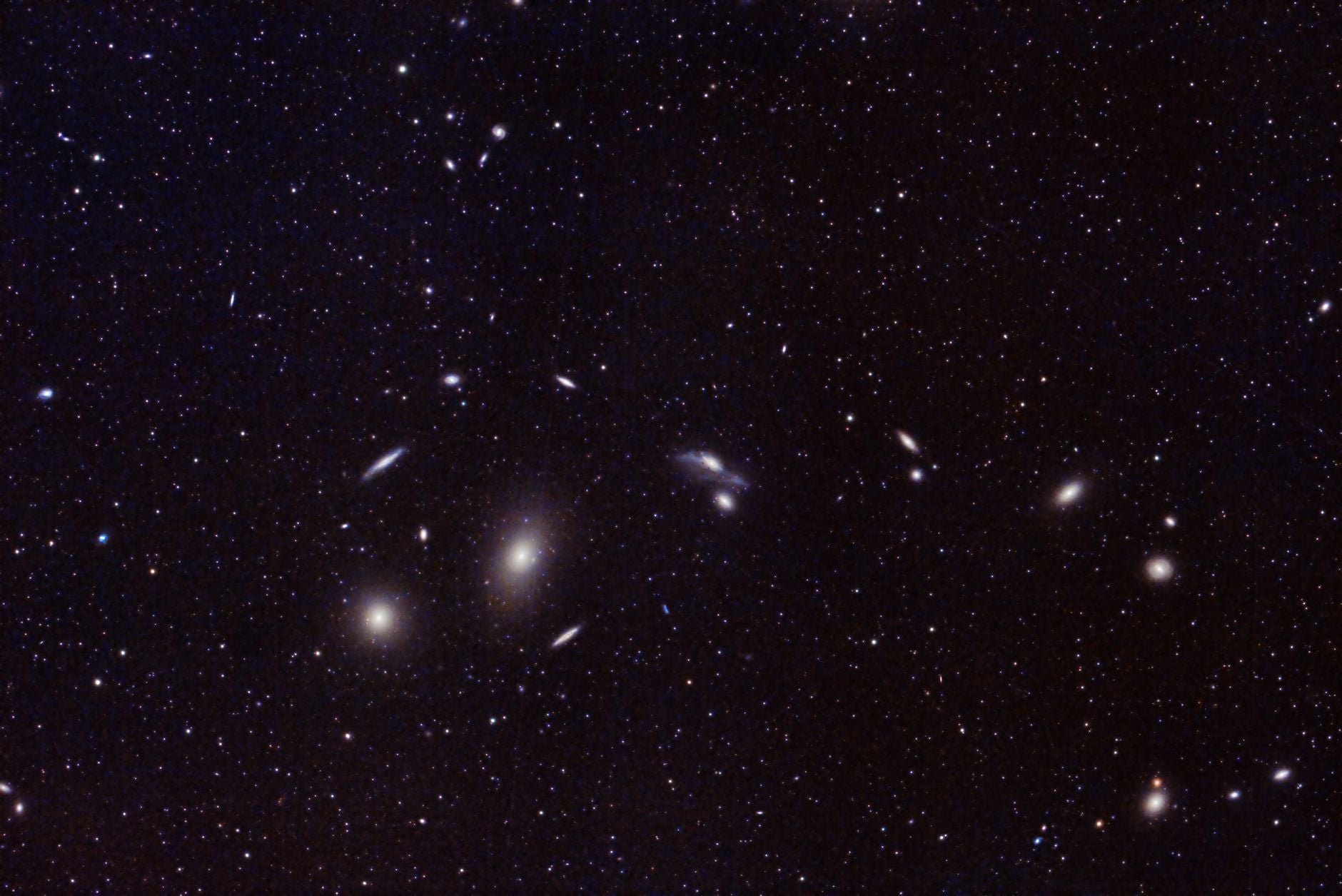
In 2025, astronomers reported one of the largest rotating structures ever found: a cosmic filament some 50 million light-years long, holding close to 300 galaxies, with many of them turning in step with the filament as a whole. The coordinated motion is difficult to reconcile with the way galaxies are thought to acquire their spin.
It is a genuine and surprising result.
It also needs unpacking, because the word “spinning” carries the wrong picture at this scale.
What was found
The universe is not smooth. Matter is drawn out into a vast web of filaments, threads of gas, dark matter and galaxies that connect the dense clusters together. The filament in question lies about 140 million light-years away, stretches roughly 50 million light-years, and contains more than 280 galaxies, among them a strikingly thin line of hydrogen-rich galaxies running through it.
The evidence that it rotates is in the galaxies’ motions. Those at one end of the filament are moving in one direction, those at the other end in the opposite direction, which is the pattern you would expect if the whole strand were slowly turning. The team behind the work, an international group including researchers at Oxford and Cambridge, put the rotation speed at around 110 kilometres a second.
What “spinning” means here
That sounds fast, and in everyday terms it is. But the structure is so enormous that the speed hardly matters. At 110 kilometres a second, a filament tens of millions of light-years across would take far longer than the entire age of the universe to complete a single turn.
So this is not a wheel whipping around. It is the slow, coherent drift of hundreds of galaxies, all leaning the same way, read from their velocities rather than watched directly. Calling it rotation is fair, so long as the timescale is kept in mind.
Why the synchrony is the puzzle
The interesting part is not that the filament turns, but that the galaxies inside it appear to turn with it.
Galaxies are thought to get their spin early, through what is called tidal torque: as matter collapses under gravity, the uneven pull of its surroundings sets it turning. On that picture, a galaxy’s spin is shaped mostly by its own local patch of the universe, and there is no obvious reason for hundreds of galaxies, spread across tens of millions of light-years, to share a single coordinated rotation tied to the filament around them.
That they seem to do so suggests the large-scale structure imparts or aligns their spin more strongly, and for longer, than the standard models expect. That is the sense in which the find challenges current theory.
How firm it is
The result sits on top of a real but young line of work. In 2021, a team led by Peng Wang and Noam Libeskind reported the first statistical evidence that cosmic filaments rotate at all, which was itself unexpected. The 2025 discovery is a striking individual case of it, with the added twist of the galaxies moving in concert.
It is, though, one filament, and its rotation and synchrony are inferred from galaxy motions rather than seen as a single sweep. Whether it overturns the theory of galactic spin or merely stretches it is not yet settled. The observation is solid. The explanation is open.
What to watch
The way to tell is to look at many more. Surveys that map filaments and the spins of the galaxies within them will show whether this kind of synchrony is common or a rarity, and simulations will be pushed to see whether they can reproduce coordinated rotation on these scales at all.
The question underneath is an old one, which is where galaxies get their angular momentum. This filament has not answered it, but it has handed the problem a large and awkward new clue.