
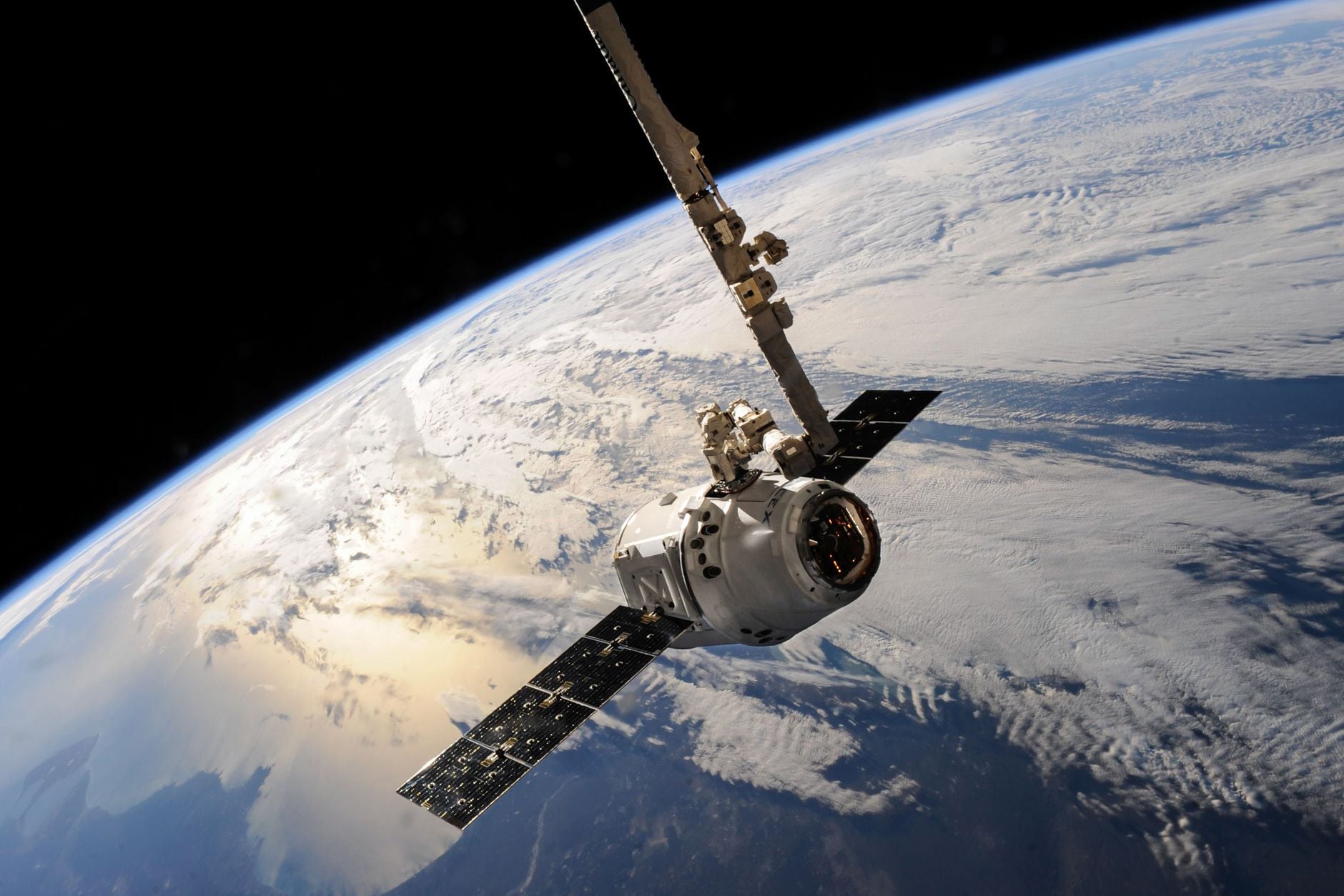
The most important number in low Earth orbit may not be the number of satellites overhead. It may be the amount of time left if the system that keeps them apart suddenly stops working.
In a recent arXiv preprint titled An Orbital House of Cards: Frequent Megaconstellation Close Conjunctions, Sarah Thiele, Skye R. Heiland, Aaron C. Boley and Samantha M. Lawler propose a metric they call the CRASH Clock. The name stands for Collision Realization And Significant Harm, and the idea is simple enough to be unsettling: estimate how long it would take for a potentially catastrophic orbital collision to occur if satellites could no longer dodge one another, or if operators lost the situational awareness needed to know where objects would be.
The finding is worth taking seriously, but it should not be read as the final word. This is a preprint, not a peer-reviewed consensus statement. It is also a model of a stressed scenario, not a prediction that a collision is due in ordinary operations. But the comparison at the heart of the paper is stark. The authors calculate that, in 2018, the CRASH Clock stood at 164 days. By their current estimate, after the rapid growth of megaconstellations, it had fallen to 5.5 days.
That change is the story. Not because 5.5 days is a magic threshold, and not because satellites are helpless. They are not. Operators routinely track conjunctions and perform avoidance manoeuvres. The point is that the safety margin has become thinner. Low Earth orbit now depends more heavily on continual coordination, accurate tracking, functioning communications and the ability of many different spacecraft to move when needed.
What the CRASH Clock is measuring
A clock can be misleading if it is read too literally. The CRASH Clock is not a schedule. It is a way of measuring orbital stress through time. If a serious disturbance prevented satellites from manoeuvring, or made their future positions difficult to estimate, how long would the system have before a damaging collision became likely enough to matter?
The authors frame this around two broad failure modes. One is the absence of collision avoidance manoeuvres. The other is a severe loss of situational awareness, where operators cannot reliably forecast close approaches. Both matter because collision avoidance is not only about propulsion. It is also about knowing where thousands of objects are, where they will be, which conjunctions are dangerous, and which manoeuvres reduce risk rather than create new uncertainty.
In the pre-megaconstellation era, there were still plenty of hazards. Defunct satellites, rocket bodies and debris already occupied low Earth orbit. But the number of active spacecraft was far smaller. The modelled buffer was therefore measured in months. By 2025, the authors argue, orbital density had changed enough for the same kind of failure scenario to be measured in days.
That is why the paper’s most useful contribution may be conceptual. It gives a compressed way to describe what congestion does to an environment that is often imagined as nearly empty. The orbital region may be physically large, but the usable lanes are not infinite. Many satellites share similar altitude bands and inclinations because those orbits are valuable for communications, Earth observation and other services. When more spacecraft occupy similar shells, the number of close approaches can grow quickly.
The rise of megaconstellations changed the arithmetic
Megaconstellations are not just large constellations. They are a different operating pattern: many satellites launched rapidly, often into similar orbital shells, with regular replenishment as older spacecraft are retired or deorbited. SpaceX’s Starlink is the most visible example, but it is not the only planned or operating system. Amazon’s Kuiper and multiple Chinese broadband constellations point toward an orbital economy where thousands or tens of thousands of spacecraft may become normal.
The services can be valuable. Low Earth orbit broadband can reach places where fibre, towers or undersea cables do not. Earth observation satellites can support weather forecasting, disaster response, climate monitoring and security. The question raised by the CRASH Clock is not whether satellites are useful. It is whether the shared environment that makes them useful is being treated as if its collision margin were unlimited.
The paper’s answer is no. A drop from 164 days to 5.5 days does not mean every operator has become careless. It means that more spacecraft in similar orbital volumes reduce the time available to recover from a system-wide disruption. In a sparse environment, a few days of degraded operations may be survivable. In a dense environment, the same disruption can eat through the available margin much faster.
Solar storms are one reason the scenario matters
The authors point to solar storms as one plausible trigger for a broad loss of control or awareness. A strong geomagnetic storm can increase atmospheric drag in low Earth orbit, causing satellites to drift from predicted paths. It can also affect communications, navigation and power systems. Even when spacecraft remain functional, their trajectories may become harder to forecast during and immediately after the disturbance.
That detail matters because collision avoidance relies on prediction. A satellite is not moved away from where another object is now. It is moved away from where that object is expected to be at the moment of closest approach. When uncertainty grows, the decision-making problem changes. Manoeuvres may become more frequent, less certain or harder to coordinate across operators.
This is one reason the CRASH Clock should not be read as a theatrical disaster timer. It is better understood as an environmental margin. A five-day margin does not mean disaster arrives on day six. It means the system has less room for bad data, delayed communications, software faults, missed warnings and weather in space than it once did.
Debris makes the problem harder to reverse
Low Earth orbit is not populated only by working satellites. NASA’s Orbital Debris Program Office notes that even small debris can be dangerous at orbital speeds, and that its work includes measurement, modelling, protection and mitigation of the debris environment. The agency’s public material describes hundreds of thousands of marble-sized debris objects and more than 100 million smaller objects estimated in Earth orbit.
That background matters because a collision is not a single isolated accident. The 2009 collision between the active Iridium 33 satellite and the defunct Russian Kosmos 2251 spacecraft remains the standard example of what one high-speed impact can do. It destroyed both spacecraft and produced a long-lived debris population that other satellites then had to avoid.
The problem is cumulative. Each serious fragmentation event can create objects too small to manoeuvre but large enough to damage or destroy something else. Some debris falls back quickly. Some remains aloft for years or decades, depending on altitude, size and solar activity. An active satellite can respond to a warning. A dead satellite, a spent rocket stage or a small fragment cannot.
The paper does not prove a cascade is imminent
The tempting overstatement is to say that low Earth orbit is days away from a chain reaction. The paper does not show that. It does not say that normal operations have failed. It does not establish the precise moment at which a Kessler-type cascade would begin. It proposes a metric for stress under a specified loss-of-control or loss-of-awareness scenario.
That distinction is important. The CRASH Clock depends on modelling choices, object catalogues, assumptions about collision severity and how close approaches are counted. The authors themselves present it as a tool for quantifying stress, not as a perfect forecast. The useful question is therefore not whether 5.5 days is exact to the hour. It is whether the direction and scale of change are telling us something real about the operating environment.
On that point, the comparison is hard to ignore. A system that once had months of recovery time in the model now has less than a week. Even if later work adjusts the exact value, the underlying pressure comes from a visible change: low Earth orbit now carries many more active spacecraft, many of them concentrated in high-demand altitude bands.
Orbit is becoming infrastructure
The CRASH Clock also changes the way the public story of satellites should be told. Spacecraft are often discussed as individual products: this satellite provides broadband, that one maps crops, another tracks weather, another images conflict zones. But low Earth orbit is becoming infrastructure in its own right. Like airspace, shipping lanes or radio spectrum, it has to be coordinated to remain useful.
The difficulty is that no single operator owns the whole environment. Every new spacecraft consumes a small part of a shared safety margin. Every collision avoidance system depends on data quality outside its own spacecraft. Every dead object left in a crowded shell becomes someone else’s problem for as long as it remains there.
This does not make megaconstellations inherently illegitimate. It does make their scale an environmental fact, not just a business plan. The number that matters is not only how many satellites can be launched, but how much operational slack remains if the system is stressed.
That is the quiet force of the 164-days-to-5.5-days comparison. It takes a crowded orbital environment and turns it into time. In 2018, the model says, there was still room to recover from a broad failure over months. By 2025, the same kind of margin had narrowed to days. Low Earth orbit has not stopped working. But it now works because many moving parts keep working together, constantly, in a region where one bad collision can leave behind consequences that do not simply go away.
