
In December 1995, the Hubble Space Telescope spent ten days looking at a part of the sky that had been chosen because it seemed so empty. The target lay near the handle of the Big Dipper, in the northern constellation Ursa Major, far from the bright plane of the Milky Way and away from obvious foreground clutter.
To the human eye, there was nothing there. That was the point. Robert Williams, then director of the Space Telescope Science Institute, used Director’s Discretionary Time to ask a simple and risky observational question: what appears if a repaired Hubble stares for long enough at a patch of dark sky?
The answer became the Hubble Deep Field. NASA’s January 15, 1996, release says the image was assembled from 342 separate exposures taken with Hubble’s Wide Field and Planetary Camera 2 over ten consecutive days between December 18 and 28, 1995. The field covered only a narrow keyhole view, described by NASA as about the apparent width of a dime 75 feet away.
Early NASA language counted at least 1,500 galaxies in the first release. Later standard descriptions of the Hubble Deep Field often put the number of detected objects at roughly 3,000, with almost all of them galaxies. The useful point is not the exact count at first glance, but the scale of the reversal: a place selected because it looked empty turned out to be crowded with galaxies.
Why choose an empty patch?
The field was not selected at random. The Hubble team needed a region that would not be dominated by nearby stars in our own galaxy, bright foreground objects, dust, or a massive galaxy cluster that might complicate the view. The patch near the Big Dipper gave the telescope a relatively clear line of sight out of the Milky Way.
NASA’s release describes it as a “peephole” out of the galaxy. That word is useful because it keeps the scale honest. Hubble was not photographing the whole universe. It was looking down one narrow column of space and time, collecting photons that had crossed enormous distances before reaching a mirror only 2.4 metres wide.
The choice also depended on Hubble’s orbit. The target sat in the telescope’s continuous viewing zone, a region where Hubble could observe for long stretches without Earth repeatedly blocking the view. That mattered because deep imaging is not a single long exposure in the everyday photographic sense. It is a patient accumulation of many exposures, later combined and cleaned.
The separate frames helped reduce the damage caused by high-energy particles hitting the detector. Astronomers could remove artifacts, align the images, combine light gathered through different filters, and gradually reveal objects too faint for any one exposure to show cleanly.
A repaired telescope asks a quiet question
The Hubble Deep Field is also part of a recovery story. Hubble was launched in 1990, but its primary mirror had a small flaw that blurred its early images. The 1993 servicing mission installed corrective optics and turned the telescope into the instrument it had been meant to be.
By 1995, Hubble could do something ground-based optical telescopes could not do as cleanly: stare above the atmosphere, free from atmospheric blurring and airglow, and separate faint galaxy shapes with unusual clarity. The Deep Field used that advantage in the most direct way possible. It did not point at a known bright target. It pointed at apparent absence.
That made the project controversial in spirit, if not in the theatrical sense often attached to science stories. Telescope time is valuable. Spending a large block of it on a blank field meant not spending it on known objects with clearer immediate returns. The wager was that the absence itself could become data.
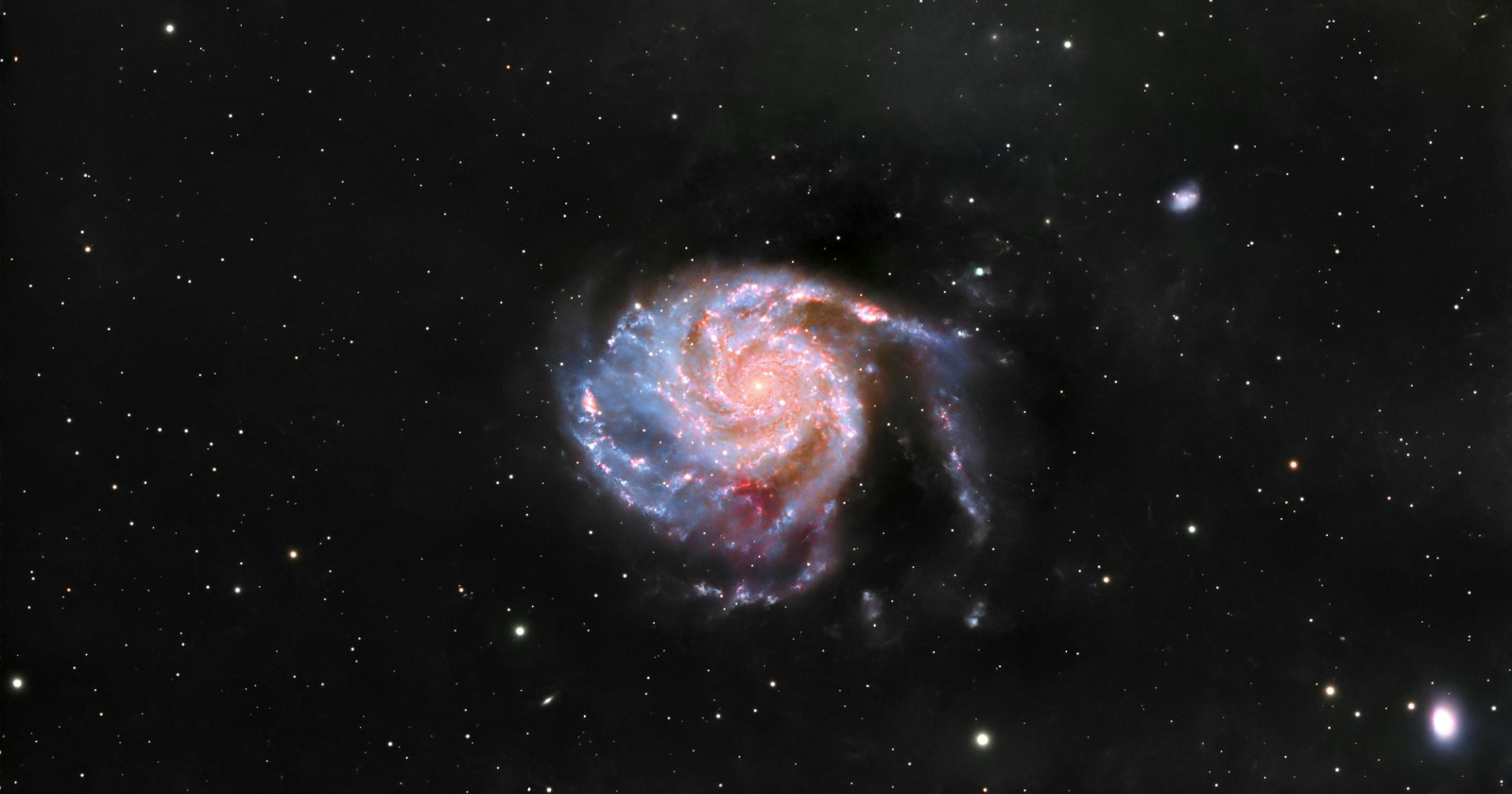
It did. The final image showed spirals, ellipticals, irregular shapes, blue knots, redder smudges, and galaxies only a few pixels across. Some were relatively nearer. Others were so distant that Hubble saw them as they had been billions of years earlier, because their light had taken that long to arrive.
Why the image mattered
A deep field is not just a pretty image with many points of light. It is a way of sampling the universe across time. Looking farther into space also means looking further back, because light travels at a finite speed. The faintest galaxies in the field were not merely dim. Many were old light from young galaxies.
That gave astronomers a dataset for asking how galaxies changed over the history of the universe. Nearby galaxies often have familiar forms: grand spiral arms, smooth elliptical shapes, settled structures. The Deep Field revealed many distant galaxies with less orderly shapes, suggesting that earlier galaxy formation was more active, uneven, and collision-rich than the nearby universe alone might suggest.
The field also changed expectations about what an “empty” sky contains. If such a tiny area held thousands of faint objects, then the visible universe had to be populated on a scale that ordinary experience gives us no instinct for. Hubble did not show that every patch of sky is identical. It did support the broader cosmological assumption that, on large enough scales, no direction is uniquely privileged.
NASA’s 1996 release said the data were being made available immediately to astronomers around the world. That decision mattered. The Hubble Deep Field was not treated as a private treasure for one team. It became a shared reference image, a public dataset, and a target for follow-up observations from other telescopes and wavelengths.
The darkness was never empty
The most durable lesson of the Hubble Deep Field is not that Hubble found galaxies. Astronomers already knew the universe was full of them. The lesson was how much could be hidden in a direction that looked blank, and how misleading the human eye can be when asked to judge astronomical emptiness.
Human vision is built for daylight, surfaces, movement, faces, danger, food, and the scale of Earth. It is not built to register a galaxy whose light has been stretched, dimmed, and thinned by billions of years of travel. A dark patch of sky is not necessarily empty. It may only be asking for an instrument patient enough to wait.
The Deep Field also became a template. Hubble Deep Field South followed in 1998. The Hubble Ultra Deep Field arrived in 2004. Later, the Hubble eXtreme Deep Field pushed the method still further. Webb has since taken up the same basic logic in infrared light, looking for galaxies whose light has been stretched beyond Hubble’s visible reach.
But the 1995 image keeps a special force because of its restraint. It began with a nearly blank square near the Big Dipper and a decision to spend precious observing time on nothing obvious. After ten days, the nothing became a population. The darkness did not disappear. It resolved.