
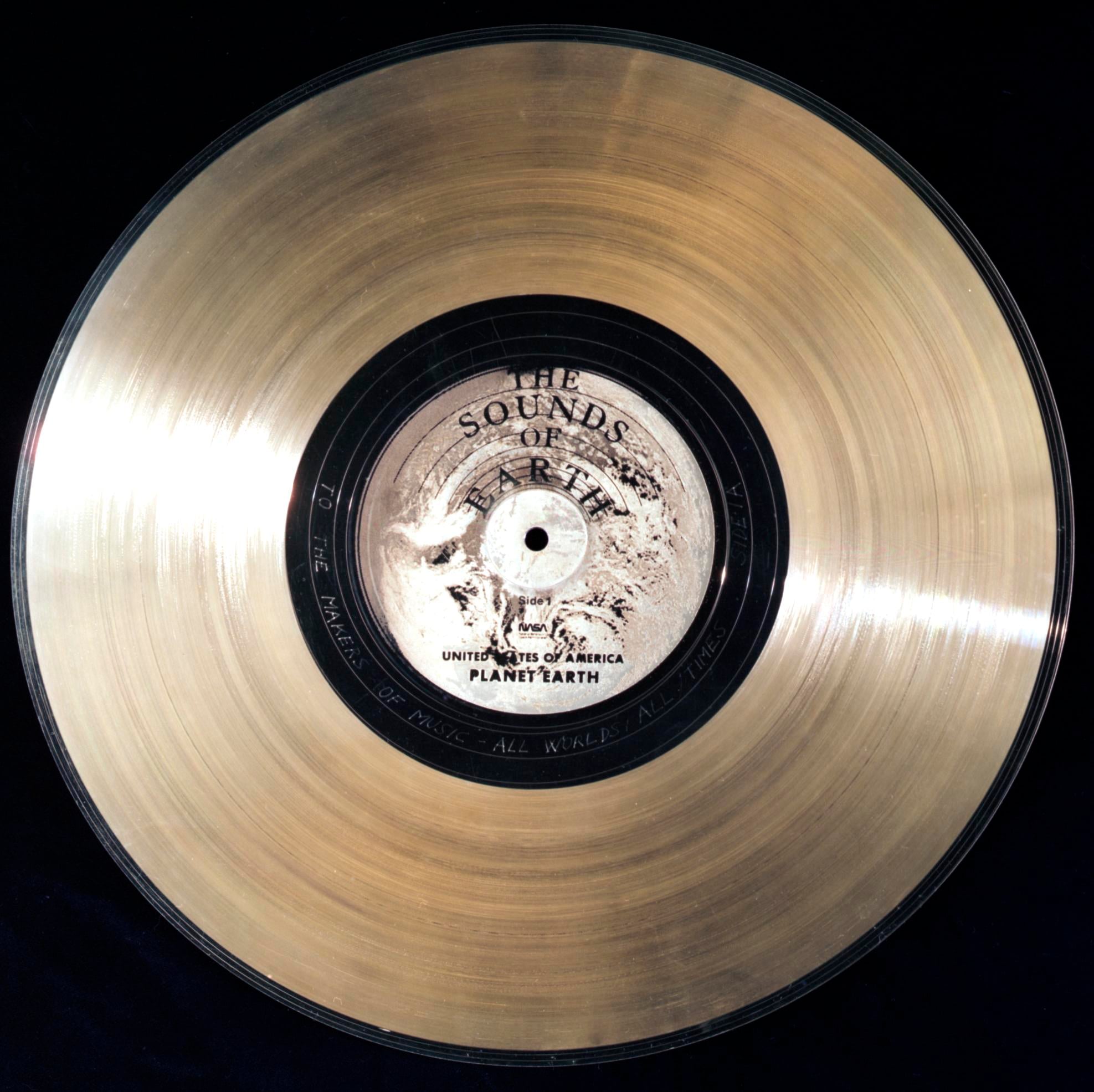
The Voyager Golden Record is usually described as a message from Earth to the unknown. That is true, but it is also incomplete. Tucked inside its catalogue of greetings, music, animal sounds, human voices and scientific diagrams is something far more intimate: a compressed recording of Ann Druyan’s brainwaves and heartbeat, made in 1977, shortly after she and Carl Sagan had decided to marry.
It was not labelled as a love letter by NASA. Officially, it belonged to the Record’s human “life signs”, a small biological trace among the sounds selected to portray life on Earth. But the timing changed its meaning. Druyan later described being newly in love while her nervous and cardiac signals were recorded. A message intended to represent the species had accidentally, or perhaps inevitably, made room for one person’s private interior life.
That minute is now travelling on Voyager 1, more than 25 billion kilometres from Earth, approaching the point later in 2026 when radio signals will take roughly a full day to cross the distance from Earth to the spacecraft. The fact is easy to romanticise. It also rewards careful handling, because the real story is quieter and stranger than the simplified version.
A record for whoever might find it
NASA’s Voyager Golden Record overview describes the object plainly: each Voyager spacecraft, launched in 1977, carries a 12-inch gold-plated copper phonograph record containing sounds and images chosen to portray the diversity of life and culture on Earth. The records were not designed for radio transmission. They are physical objects attached to the spacecraft, time capsules for any distant finder capable of recovering and decoding them.
The idea followed the plaques carried by Pioneer 10 and Pioneer 11, but the Voyager version was more ambitious. Carl Sagan chaired the committee that selected the contents, with contributors including Frank Drake, Linda Salzman Sagan, Ann Druyan, Jon Lomberg and Timothy Ferris. NASA’s own summary says the record includes images, natural sounds, thunder, birds, music from different cultures and eras, and greetings in 55 languages.
It is tempting to describe the Record as a summary of humanity, but no record could do that. It was a selection made under time, technical, political and cultural limits. It tried to show life, intelligence, feeling and craft without assuming too much about the mind of a possible listener. The project was scientific, artistic and diplomatic at the same time, a carefully assembled artifact saying: this is where we are, and this is some of what we are like.
Into that already unusual object went Druyan’s recording.
The minute of life signs
The Smithsonian Magazine account of the Record notes that Druyan had proposed recording a person’s brain waves in the hope that some future intelligence, millions of years later, might be able to decode the thoughts behind them. Druyan became the subject. During an hour-long session at New York University Medical Center, she was connected to an EEG and meditated on prepared themes.
The themes were not trivial. They included the history of Earth, human civilisation, the problems facing humanity and the experience of love. The hour of biological signal was compressed into a minute-long audio segment for the record. That technical compression matters. The Golden Record is not carrying a readable diary, a spoken confession, or a transcript of thought. It is carrying a transformed physiological trace.
Still, the circumstances give the trace its emotional charge. Smithsonian notes that Druyan and Sagan had become engaged just days before, and that “a love story may very well be documented” in her neurological signs. Other retellings, drawing on Druyan’s later description, place the recording two days after the call in which she and Sagan agreed to marry. Either way, the central fact holds: the biological recording was made while she was thinking about the world and about newly recognised love.
That is why the phrase “private love letter” has stuck. It is not a technical description of the audio. It is an interpretation of what was folded into the mission. The message was public, planetary and future-facing. But one part of it carried a private emotional state that no one on the project could fully translate, including Druyan herself.
What can a brainwave say?
It is important not to overstate the science. The recording was not a preserved thought in the ordinary sense. A future listener could not simply play it back and hear, “I love Carl.” Electroencephalography records electrical activity associated with the brain, not sentences. A heartbeat is a rhythm, not a statement. Even if some advanced recipient could infer more from those signals than humans currently can, the Record offers no guarantee that the interior experience would be recoverable.
That uncertainty was part of the gesture. The Golden Record was full of assumptions, some careful, some unavoidable. Would a finder understand diagrams based on hydrogen? Would they infer the playback speed? Would they reconstruct images from analogue signals? Would Bach, whale song, laughter or a human kiss mean anything outside the species that made them?
The life-signs recording belongs in that same category. It is both data and hope. It says that the body is part of the message, and that human feeling is not separate from human knowledge. The record contains mathematics and music, diagrams and greetings, but it also contains pulse and electrical activity from a living person at a particular moment in her life.
That does not make it sentimental in the weak sense. It makes it accurate. Humans do not send messages as disembodied intellects. We send them as animals with histories, bodies, attachments, fears and unfinished questions. The Voyager record is often remembered for its scale, but one of its most durable details is small enough to fit inside a minute.
Distance changes the meaning
Voyager 1 has long since finished the planetary encounters that made it famous. After flybys of Jupiter and Saturn, it continued outward. NASA’s current Voyager status page notes that both Voyager 1 and Voyager 2 have reached interstellar space and continue their journeys. The same page says Voyager 1 is closing in on a one-light-day distance from Earth later in 2026, a distance of about 25.9 billion kilometres.
That distance gives Druyan’s minute a strange afterlife. It is no longer only an archival item from the 1970s. It is a physical trace moving farther from Earth every hour. The record is not broadcasting her heartbeat through space. It is simply being carried, silently, on a spacecraft that may continue for a very long time after its instruments fall quiet.
There is no reason to think anyone will ever find it. NASA has always been clear that the chance of discovery is remote. The Voyagers are not aimed at a nearby civilisation. They are small machines passing through enormous distances. The Record’s practical audience was always, in part, ourselves.
That may be why the story keeps returning. It tells us something about the people who built the mission. They sent engineering beyond the outer planets, but they also allowed a message from Earth to include music, tenderness, humour, bodies and doubt. In an age when space missions can be discussed mostly through budgets, hardware and data rates, the Golden Record is a reminder that exploration has always carried a human grammar inside it.
A human trace on a machine
There is a useful restraint in the story if we let it remain partly unresolved. The Record does not prove that love is readable in brainwaves. It does not turn the Voyagers into monuments to a romance. It does not make space less indifferent. What it does is place a real human trace inside a real machine, and then send both into a journey no living person will see completed.
Druyan and Sagan’s relationship gives the recording its emotional context, but the larger meaning is not only personal. The Golden Record asked what a civilisation should say about itself if it had one chance to leave a durable message. The answer was not just equations, anatomy, maps or classical music. It also included a heartbeat.
That choice still feels precise. A heartbeat is simple, but it is not small. It is the sound of being alive before it is the sound of being eloquent. Paired with brainwaves recorded during thoughts of history, danger, civilisation and love, it becomes one of the most compressed statements humans have ever sent away from home.
Somewhere beyond the planets, that minute remains attached to Voyager. It is not calling back. It is not waiting to be understood. It is simply there, moving outward with the rest of the Record, a private feeling embedded in a public message, carrying one human moment farther from Earth than almost anything we have made.
