
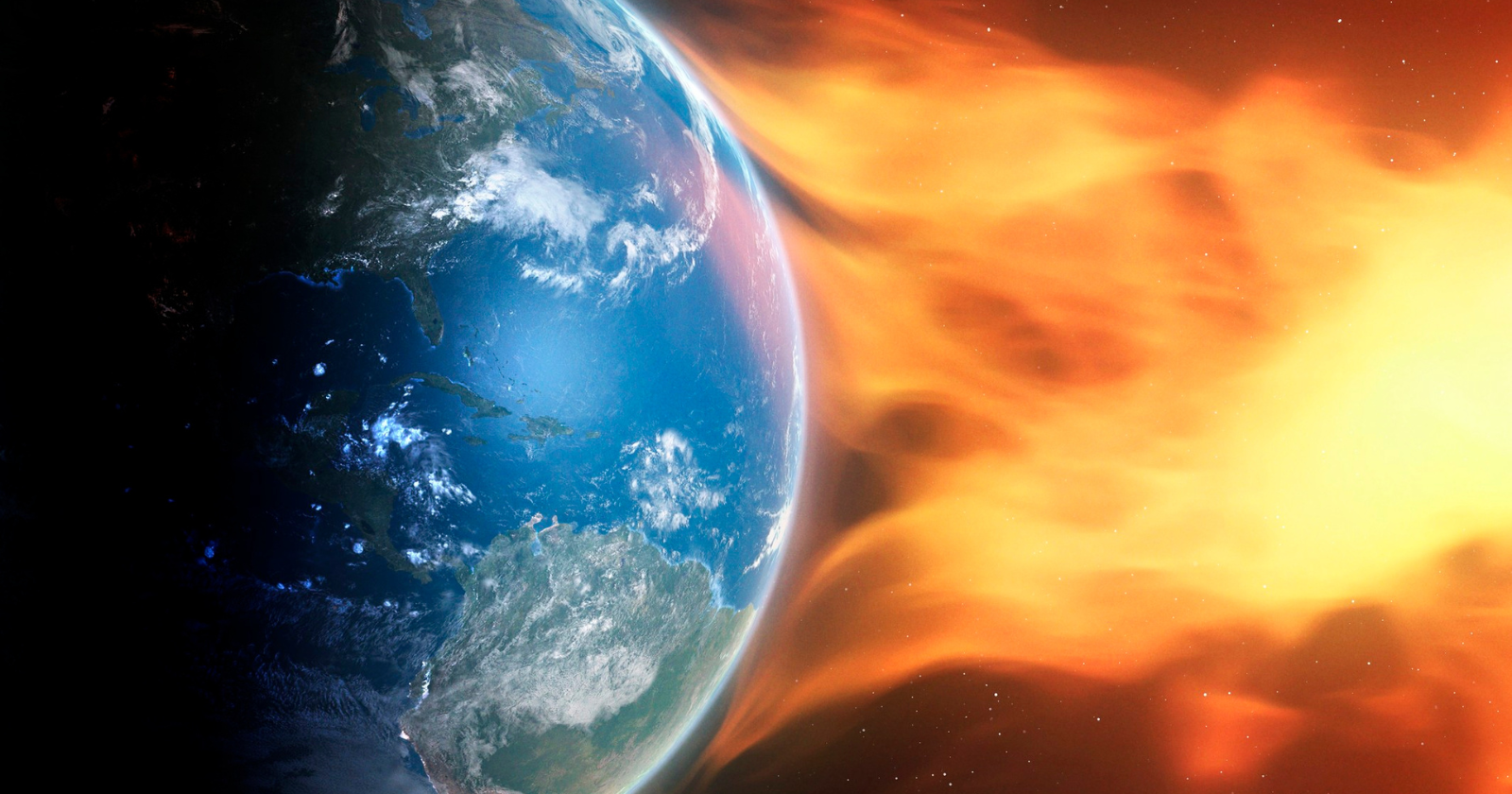
In late August and early September 1859, the Sun threw a burst of charged particles at Earth that lit up the sky with auroras seen as far south as the Caribbean and drove the world’s only electrical network, the telegraph, into chaos. Sparks jumped from the keys. Operators were shocked, in at least one case knocked out of a chair. Paper tape caught fire in the stations. And on some lines, operators disconnected their batteries and found they could keep sending messages, the wires now carrying the storm’s own current.
The episode is called the Carrington Event, and it remains the benchmark for how bad space weather can get. The uncomfortable question is what the same storm would do to a world that now runs on the grid.
What happened in 1859
On 1 September 1859 the English astronomer Richard Carrington was sketching sunspots when he saw a sudden brightening on the Sun, a flare, one of the first ever recorded. Roughly a day later a cloud of solar plasma slammed into Earth’s magnetic field and set off the most intense geomagnetic storm in recorded history, with auroras reported as far south as Cuba and Honolulu.
The telegraph was the only technology exposed. Its long wires, strung for hundreds of kilometres across the landscape, acted as antennas for the electric currents the storm induced in the ground and air. In Boston and Portland, operators reported that they could unhook their batteries entirely and still work the line on the geomagnetic current alone, at least until it surged and the sparks and small fires began. It was a vivid demonstration of a simple fact: a big enough solar storm pushes electric current through any long conductor we leave lying across the planet.
Why a repeat would be different now
In 1859 there was almost nothing to break. Today there is a great deal.
The modern concern is not the shock to an operator but the effect on high-voltage power grids. A severe geomagnetic storm drives what are called geomagnetically induced currents through the long transmission lines that carry electricity between cities. Those slow, direct-current-like flows can push large transformers, the heavy and expensive hearts of the grid, into overheating and, in the worst case, permanent damage. Large transformers are often custom-built to order, with lead times measured in months to years, which is why a storm that destroyed many at once could keep power off for far longer than an ordinary blackout.
There is a real precedent, smaller than Carrington. In March 1989 a geomagnetic storm collapsed the Hydro-Quebec grid in about 90 seconds, leaving around six million people without power for roughly nine hours. That storm was well short of an 1859-class event.
The worst-case number, and where it comes from
The figure most often quoted for a modern Carrington-class storm comes from a 2008 report by the United States National Research Council, part of the National Academies, titled Severe Space Weather Events. Drawing on analysis by John Kappenman of the Metatech Corporation, the report suggested that a long-duration, wide-area blackout from an extreme storm could cost the United States something like one to two trillion dollars in the first year, with full recovery taking four to ten years depending on how many transformers were lost.
That four-to-ten-year figure is the one that tends to make headlines, and the title’s framing of it is accurate. It is worth being clear about what kind of number it is. It is a worst case, built on assumptions about how many transformers would fail and how hard they would be to replace, and it describes the extreme end of the range rather than the likeliest outcome.
Where the experts part ways
This is the part that gets flattened in most retellings. Specialists genuinely disagree about how bad the damage would be.
The pessimistic view holds that a Carrington-class storm could knock out a large number of irreplaceable transformers across a continent, producing exactly the multi-year recovery the 2008 report describes. A more moderate view argues that this overstates the risk: that most transformers would trip offline or suffer recoverable stress rather than be destroyed, that grid operators warned in advance can shed load and reconfigure to protect equipment, and that the trillion-dollar, decade-long scenario has been repeated far more often than the thin evidence behind it justifies. Both camps agree the threat is real and worth preparing for. They disagree on the scale, and that disagreement has not been settled.
Part of the reason it stays unsettled is that we have no modern data point. The closest call came in July 2012, when a Carrington-class eruption crossed Earth’s orbit and missed the planet by about a week. We know the storms still happen. We have simply not had one hit a wired world.
What is actually being done
The response has been less about prediction of the exact damage and more about buying time and hardening the system. Spacecraft parked between Earth and the Sun, such as the instruments at the first Lagrange point, watch the solar wind and can give grid operators a warning of tens of minutes before the worst of a storm arrives. Space-weather forecasting has become a routine government function, run in the United States by the National Oceanic and Atmospheric Administration. Some grid operators have begun studying transformer protection and holding spares.
None of that makes the disagreement over severity go away. It does change the stakes of it. The open question is no longer whether a Carrington-class storm will come again, because on the available evidence one eventually will, but how much of the damage the 1859 sky promised can be engineered away before it does.
