

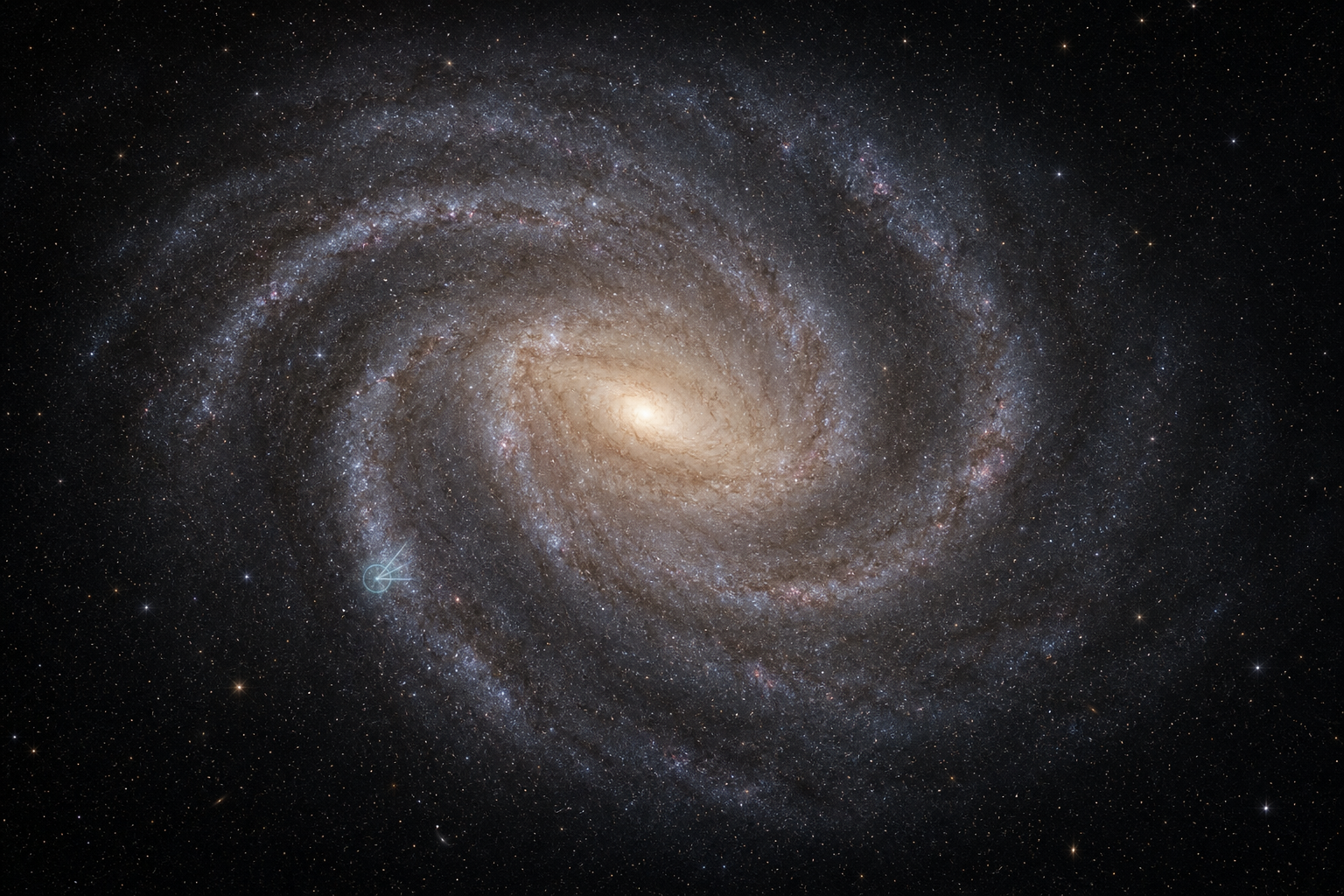
Humanity has been changing the radio sky for a little over a century. Early experimental transmissions, commercial broadcasting, military radar, television, satellite links and communications with spacecraft have all sent some energy beyond Earth. Because radio waves travel at the speed of light, the oldest emissions now occupy a region with a radius of roughly a hundred light-years.
That sounds large until it is placed inside the Milky Way. NASA describes the galaxy’s stellar disk as more than 100,000 light-years across. Even an idealised sphere 100 light-years in radius would span only about one five-hundredth of that diameter. By volume, compared with the galaxy’s broad, flattened disk, it is closer to a local pinprick than a galactic announcement.
There is an even more important correction. The “radio bubble” is a boundary set by travel time, not a sphere inside which everyone can hear us. Most human transmissions are weak, brief, spread across wide bandwidths or aimed in particular directions. At interstellar distances they fade into background noise. An observer may lie inside the causal bubble and still have no instrument capable of detecting Earth.
Outside that boundary, however, the rule is absolute for human radio: our signals have not arrived. A civilisation thousands of light-years away cannot yet receive a broadcast made in 1925, regardless of how advanced its antenna might be. It could discover that Earth supports life by some other method, but it cannot know about that transmission before the wave reaches it.
A light cone, not a loud shell
A radio signal does not slow down or stop at an arbitrary distance. Its wavefront continues moving outward at light speed. What changes is the amount of power available to a receiver. For an approximately omnidirectional transmission, the energy spreads over an ever-growing area, so the received intensity falls with the square of distance.
This is why two questions are often confused. “How far has the signal travelled?” is answered by elapsed time. “How far away could somebody detect it?” depends on transmitter power, antenna direction, bandwidth, interference, observing time and the receiver’s collecting area and signal processing.
Ordinary AM, FM and television transmitters were built to serve people on or near Earth, not to cross interstellar space. Some energy escaped, particularly at frequencies that pass through the atmosphere, but the signal arriving at another star would be exceptionally faint. A SETI Institute technical primer estimates that an alien counterpart of our large radio telescopes could not detect an ordinary television broadcast even from the nearest star system.
Digital communications have not simply made Earth louder. Many modern systems use lower power, wider bandwidth, directional antennas, fibre-optic cables and satellites that direct energy towards intended receivers. A strong narrow carrier can be easier to distinguish from natural noise than a broadband signal containing far more information.
Mobile networks would be difficult to hear next door
A 2023 study in Monthly Notices of the Royal Astronomical Society modelled leakage from millions of mobile phone towers as Earth rotated. The planet’s radio appearance changed with geography and viewing direction because tower coverage is uneven and antennas send most power towards the ground rather than the sky.
The researchers examined hypothetical observers around nearby stars, including Barnard’s Star, about six light-years away. They concluded that a civilisation using a receiver comparable to the Green Bank Telescope would not detect current mobile-tower leakage even from within ten light-years. A much larger array, longer integration or more advanced processing could change that result, but proximity alone was not enough.
This makes the popular image of old programmes washing clearly across nearby planets misleading. The wave exists, but extracting it is another matter. In their 1978 paper in Science, Woodruff Sullivan and colleagues modelled Earth’s radio leakage and showed that a distant observer could potentially infer rotation, transmitter geography and technological activity from strong carrier signals. They did not assume that the television picture and sound would remain conveniently watchable.
Radar is far brighter than broadcasting
Earth’s most detectable radio emissions are not usually entertainment broadcasts. Powerful planetary and military radars concentrate energy into narrow beams. Their effective isotropic radiated power can be many orders of magnitude greater than a broadcast station’s, even though a receiver sees them only if the beam sweeps across the right location.
A 2025 analysis in The Astronomical Journal asked how far an Earth-level civilisation could detect Earth’s present technological signatures using instruments comparable to ours. Its most optimistic radio case involved intermittent, targeted planetary radar. The authors calculated that emissions like the former Arecibo Observatory’s strongest radar transmissions could in principle be detected from as far as about 12,000 light-years.
That number does not mean those signals have already illuminated a 12,000-light-year sphere. A signal transmitted 50 years ago is still no more than 50 light-years away. Nor does it mean every star inside that radius was exposed. Arecibo’s radar beam was narrow and aimed at specific Solar System targets. An extraterrestrial receiver would have to be close to the beam’s line, watching the correct frequency at the correct time.
The famous Arecibo message illustrates the difference. On 16 November 1974, the observatory deliberately sent a narrowband coded transmission towards the globular cluster M13. The original Icarus description records a 2,380-megahertz transmission directed at the cluster. More than half a century later, that message has travelled only a little over 50 light-years towards a target roughly 25,000 light-years away.
The Milky Way scale changes the intuition
The Sun lies in the Milky Way’s disk, well away from the central bar. The galaxy contains hundreds of billions of stars distributed through a structure on the order of 100,000 light-years across. Human radio has reached only the immediate stellar neighbourhood.
Approximating the oldest emissions as a 100-light-year-radius sphere and the stellar disk as a cylinder tens of thousands of light-years in radius gives a radio region amounting to roughly a millionth of the disk’s volume. The calculation is deliberately crude because the Galaxy is not a uniform cylinder and our emissions are not uniform. Its purpose is scale: more than 99.999 percent of the galactic disk lies outside even the oldest radio wavefront.
Our most powerful directed signals cover less territory still. They form thin, expanding patches and cones rather than a complete shell. Earth’s radio history is therefore better pictured as a faint local haze crossed by a few brighter pencil beams.
The same geometry limits conversation. If humanity has been recognisably radio-loud for about a century, an extraterrestrial reply already reaching Earth would generally require a receiver within roughly 50 light-years: about 50 years for our signal to arrive and another 50 for an immediate answer to return. Even that assumes the first signal was detectable, noticed and understood without delay.
Radio is not the only way to notice Earth
The title’s “no possible way” needs a boundary. Most of the Milky Way has no possible way to have received human radio yet. That does not mean distant observers have no possible evidence that Earth exists or supports life.
From a narrow band of viewing positions, astronomers could see Earth transit the Sun and analyse a small fraction of starlight filtered through its atmosphere. Lisa Kaltenegger and Jackie Faherty used Gaia data to identify nearby stars with this geometry in a 2021 Nature study. An advanced observer might look for atmospheric gases associated with biology, seasonal surface changes or, with far more sensitive equipment, industrial compounds.
Earth has already served as a test case for such remote detection. In 1993, Carl Sagan and colleagues used observations from the Galileo spacecraft to conduct a search for life on Earth as if the probe did not know what planet it was observing. It found abundant oxygen, methane out of chemical equilibrium, surface colour patterns and narrowband radio emissions consistent with technology.
A sufficiently capable civilisation could therefore suspect a living planet before any human broadcast arrived. Knowing that technological humans exist is a stronger claim. Outside our radio light cone, no telescope can receive information that has not had time to travel there.
Humanity has not announced itself to the Galaxy in any complete sense. We have altered the electromagnetic environment around one star for a brief interval, and a small number of those alterations are potentially detectable. The Milky Way is so large that most of it is still seeing the Solar System as it was long before radio, before cities and, at sufficient distance, before human beings existed at all.