
Hubble’s first images did not look like the beginning of a new era in astronomy. Stars that should have appeared as sharp points arrived with fuzzy halos. Fine detail was washed out. The telescope was in orbit, its 2.4-metre primary mirror could not be removed, and the problem sat at the centre of an observatory that had cost the United States more than $1.5 billion.
The mirror was not rough, cracked or badly polished in the ordinary sense. It had been made with extraordinary precision to the wrong prescription. Its outer edge was about 2.2 micrometres too flat, a difference NASA describes as roughly one-fiftieth the thickness of a human hair. That tiny, consistent error caused spherical aberration, sending light reflected from different parts of the mirror to different focal points.
The popular description that astronauts gave Hubble glasses is unusually accurate, provided one qualification is kept in view. They did not reshape or replace the primary mirror. Engineers measured its error closely enough to make smaller optics with the opposite error, and astronauts installed those correctors in December 1993.
A telescope built around one mirror
Hubble launched aboard space shuttle Discovery on April 24, 1990, after more than a decade of development. The telescope’s main advantage was simple in principle: above Earth’s atmosphere, it could observe without the blurring and absorption imposed by air. Its primary mirror would collect light and reflect it towards a secondary mirror, which sent the beam into the science instruments.
For that arrangement to work at Hubble’s planned resolution, the primary mirror had to have a precisely controlled hyperbolic shape. Perkin-Elmer, the contractor responsible for the optical telescope assembly, used a device called a reflective null corrector to guide the final figuring of the mirror. The corrector made deviations from the desired shape visible during testing.
The null corrector itself was assembled incorrectly. One lens was displaced by about 1.3 millimetres because a measuring rod used during assembly contacted the wrong surface. The main mirror was then polished until it agreed with the false test. The result was an exceptionally smooth surface whose overall curve was wrong.
NASA’s independent Optical Systems Board of Investigation reconstructed that chain after launch. Its November 1990 failure report, chaired by Lew Allen, concluded that the error should have been detected. Other test results had indicated a problem, but they were discounted in favour of the supposedly authoritative null-corrector result. The board also described failures of communication, quality assurance and independent oversight, compounded by pressure on cost and schedule.
Why a microscopic error mattered
A difference of 2.2 micrometres sounds harmless beside a mirror 2.4 metres wide. The relevant question, however, was not the error as a share of the mirror’s diameter. It was how the shape affected the path of light.
Rays striking near the edge of the flawed mirror came to focus at a different position from rays reflected nearer the centre. Instead of putting most of a star’s light into one compact point, the telescope spread a substantial fraction into a surrounding halo. Bright targets could still be observed, and image-processing methods recovered some information, but the defect damaged the contrast and sensitivity needed for faint objects.
The failure was especially public because Hubble had been presented as a flagship observatory. A 1991 report from the US General Accounting Office noted that the telescope was expected to cost more than $1.5 billion and that the flaw was recognised within two months of launch. The phrase “billion-dollar mistake” describes the scale of the observatory placed at risk, not the cost of grinding alone.
There was one piece of good engineering hidden inside the embarrassment. Hubble had been designed for astronauts to service in orbit. Instruments were modular, handrails and access points were built into the structure, and shuttle missions had always been expected to replace ageing hardware. The planned first servicing visit could be reshaped into a repair mission.
Making the opposite error on purpose
Once the aberration was measured, it was stable and predictable. That made an optical correction possible. A corrective mirror could introduce precisely the opposite distortion before the light reached an instrument, bringing the rays back to a common focus.
There were two main solutions. The Wide Field and Planetary Camera 2 was already under construction as a replacement for Hubble’s first main camera. Its team redesigned the internal optics so the camera corrected the primary mirror’s aberration for itself. NASA’s Jet Propulsion Laboratory later called it the camera that saved Hubble.
The telescope’s other original instruments needed a shared solution. NASA and Ball Aerospace developed COSTAR, the Corrective Optics Space Telescope Axial Replacement. The telephone-booth-sized package held five pairs of small corrective mirrors on deployable arms. Some mirrors were only about the size of a US nickel. COSTAR intercepted light heading to three instruments and folded the corrected beam into their apertures.
This is why “glasses” is more than a metaphor invented after the event. NASA’s own account says the added optical components counteracted the flaw in a way similar to eyeglasses correcting vision. Like prescription lenses, they left the original optical surface untouched while compensating for how it focused light.
Five spacewalks to change the prescription
Space shuttle Endeavour launched on STS-61 on December 2, 1993, carrying seven experienced astronauts. The mission was broader than installing corrective optics. Hubble had failed gyroscopes, troublesome solar arrays and other maintenance needs. Across an 11-day flight, the crew completed five spacewalks totalling 35 hours and 28 minutes, according to NASA’s mission history.
Story Musgrave and Jeffrey Hoffman removed the original Wide Field and Planetary Camera and guided WFPC2 into its place. On the next spacewalk, Kathryn Thornton and Thomas Akers removed the High-Speed Photometer to make room for COSTAR. The correction therefore carried a cost beyond money and effort: one scientific instrument had to be sacrificed so the package could serve three others.
Installation was only part of the challenge. Equipment designed on Earth had to deploy and align in orbit, with small mirrors moving into beams inside a telescope that could not be disassembled. The astronauts also replaced solar arrays, gyroscope units, electronics and other hardware, turning the flight into one of the most complicated servicing missions attempted at that point.
The “astronauts fixed it” version is true, but it compresses years of work on the ground. Optical engineers first had to infer the exact prescription from Hubble’s distorted images and from the investigation of the mirror. Instrument teams then had to build the inverse error, verify it, package it for launch and write procedures that spacewalkers could perform in bulky gloves.
The moment the blur disappeared
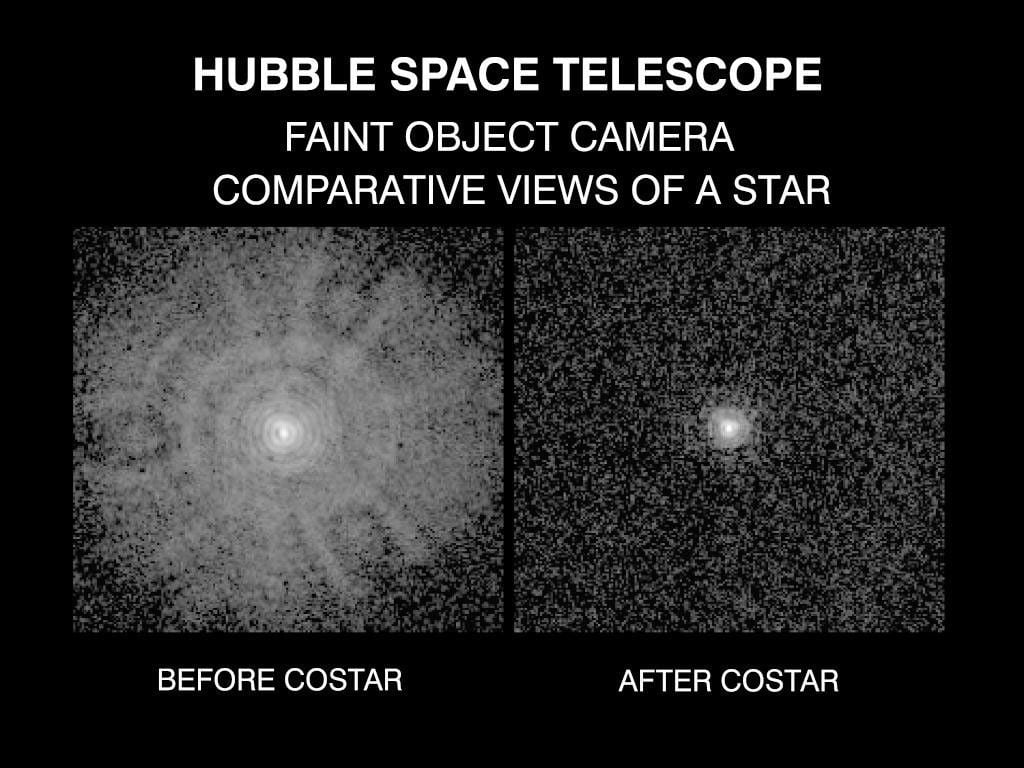
After Endeavour released Hubble, ground teams activated, aligned and tested the new systems. On January 13, 1994, NASA showed the result. A pair of images from the Faint Object Camera displayed the same star before and after COSTAR. In the first, much of the light formed a broad halo about one arcsecond wide. In the second, most was concentrated into a point about one-tenth of an arcsecond across. NASA said the telescope had been restored to its planned optical performance.
The correction did not make the flawed primary mirror physically perfect. It made the complete optical system work. That distinction became the long-term design strategy. Every new science instrument installed after Hubble’s deployment included its own corrective optics.
COSTAR gradually became unnecessary as the original instruments it served were replaced. Astronauts removed it during Servicing Mission 4 in 2009 and installed the Cosmic Origins Spectrograph in its place. NASA’s history of that final servicing flight records COSTAR’s removal and return to Earth. It is now held by the Smithsonian National Air and Space Museum.
The repair did not erase the failure
Hubble’s recovery is often told as a reassuring story about ingenuity, and it is one. A microscopic manufacturing error in an inaccessible primary component was measured from orbit and cancelled with new optics installed by hand hundreds of kilometres above Earth.
Yet the successful repair should not soften the investigation’s central finding. The mirror flaw was preventable. Conflicting evidence existed before launch. The testing programme placed too much confidence in one instrument, and organisational boundaries made it easier to dismiss results that did not fit expectations.
The repair succeeded because the aberration was regular, the telescope was serviceable, the shuttle could reach it, and engineers could reproduce the inverse error with extreme accuracy. A different defect, or an observatory beyond astronaut reach, might not have allowed the same recovery.
That combination makes Hubble’s first servicing mission more than a rescue anecdote. The primary mirror remained wrong for the rest of the telescope’s life. Everything Hubble later saw clearly depended on accepting that fact and placing a second, deliberately imperfect optical system in front of it. The billion-dollar observatory did not regain its vision because the original mistake vanished. It worked because engineers learned its shape well enough to build the right pair of glasses.
