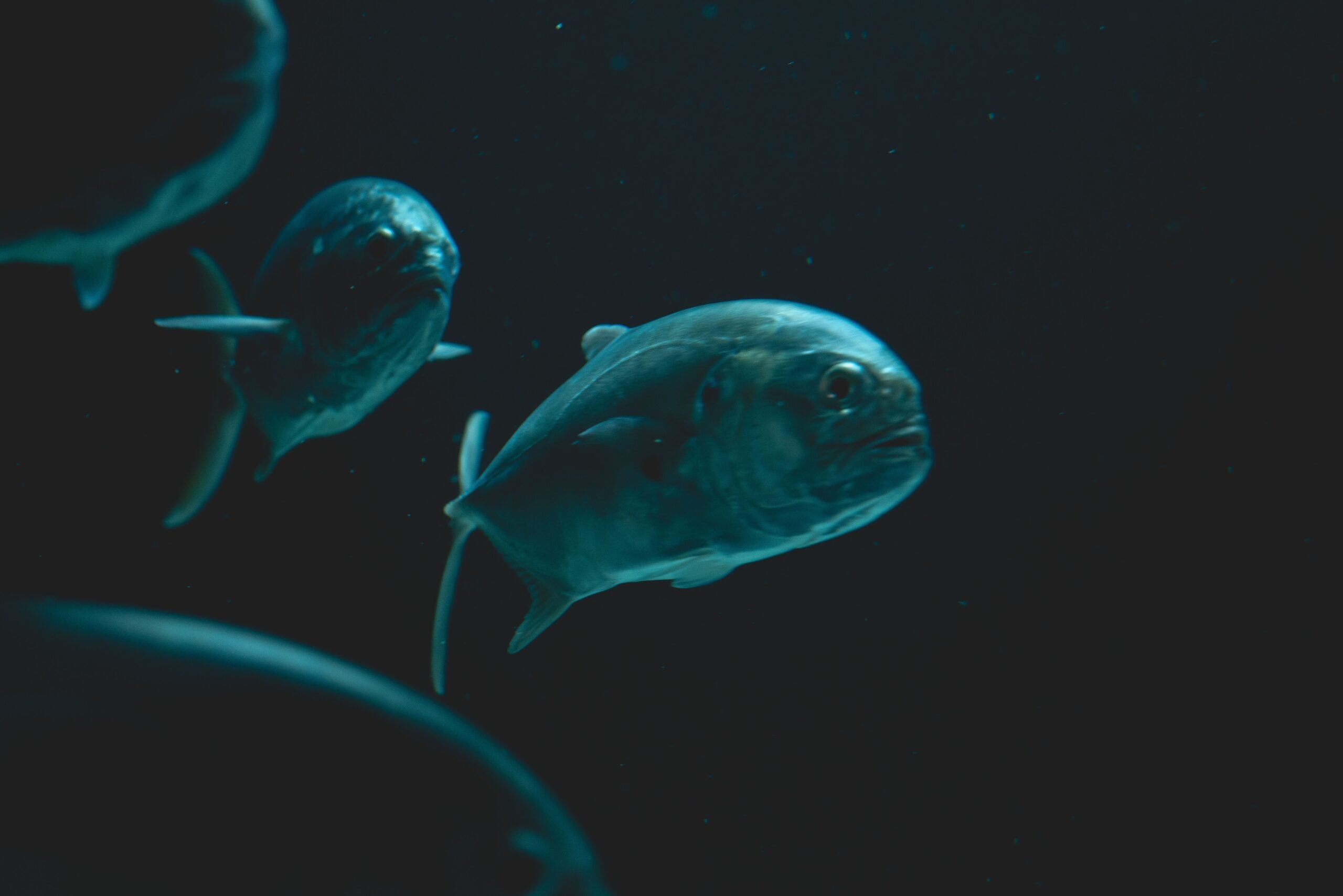
In August 2022, a baited camera descended into the Izu-Ogasawara Trench south of Japan and recorded a small juvenile snailfish at 8,336 metres. The observation, later described in Deep-Sea Research Part I, remains the deepest confirmed video of a fish. A few days later, two Pseudoliparis belyaevi were caught at 8,022 metres in the neighbouring Japan Trench, the first fish physically recovered from beyond eight kilometres.
At the record depth, the surrounding water exerts about 84 megapascals of pressure. That is roughly 840 bar, or more than 800 times the atmosphere pressing on us at sea level.
The thousand-cars comparison in the title gives the right sense of scale, but it should not be read literally. Pressure is force divided by area, so the number of cars changes with the area over which their weight is imagined to act. A thousand 1.5-tonne cars concentrated on an area of about 0.18 square metres would produce something close to the pressure around this fish. But no such stack is balanced on its spine. The sea presses from every direction at once.
The snailfish is not holding up the ocean with its back. Its water-rich tissues sit at almost the same pressure as the water outside, and it has no large gas-filled swim bladder waiting to implode. The difficult part begins much farther down in scale. Pressure alters the behaviour of water, proteins, membranes, enzymes and the molecular machines that keep a cell alive.
That is what makes this fish so interesting to me. It has not defeated pressure in the way a submarine hull resists the sea. It has made nearly every part of its biology work while fully immersed in it.
The pressure does not crush it in the way we imagine
Hadal snailfish do not resemble the armoured monsters often imagined in deep water. They are small, pale and almost translucent. Their bodies contain thin muscle, gelatinous tissue and lightly mineralised skeletons. In the Mariana snailfish, Pseudoliparis swirei, even the skull is incompletely ossified.
That softness is often presented as the answer: no hard bones, therefore nothing for the pressure to crush. The fuller explanation is subtler. Water and water-filled tissue are already difficult to compress. Because pressure inside the fish closely matches pressure outside, its body does not experience the enormous inward pressure difference that would destroy an air-filled container lowered from the surface.
A rigid submarine must keep its interior near one atmosphere for the people inside. Its hull therefore holds back a pressure difference of roughly 84 megapascals at 8,336 metres. The snailfish does not preserve a pocket of surface conditions. Its internal fluids share the pressure of the trench.
The absence of a swim bladder is crucial. Many shallow fish use this gas-filled organ to adjust buoyancy. At eight kilometres, maintaining a useful bubble against more than 800 atmospheres would demand a specialised gas-secretion system and would leave the animal sensitive to changes in depth. Hadal snailfish instead rely on watery muscle and gelatinous, low-density tissue to reduce their sinking rate without carrying a compressible gas space.
A 2019 review titled “On the Success of the Hadal Snailfishes” describes these adaptations across multiple trenches. It also makes clear that there is no single pressure-proof feature. Survival is distributed across the body, the cells and the chemistry inside them.
The skeleton remains part of that system. A partly cartilaginous, less mineralised body is lighter and cheaper to carry where food is limited. Distributing small rigid elements through soft tissue may also reduce local shear stresses. But the snailfish is not a bag that remains safe simply because it has fewer bones. Its enzymes still have to catalyse reactions. Its nerves must carry signals. Its gills must move ions. Its DNA must be copied and repaired.
Why pressure can make a protein come apart
A protein begins as a chain of amino acids. It usually becomes useful only after that chain folds into a precise three-dimensional structure, creating the surfaces and pockets that let it bind other molecules or speed up a chemical reaction.
The folded structure is not a solid billiard ball. It contains microscopic cavities, imperfectly packed regions and water-excluding pockets. Increasing hydrostatic pressure changes the thermodynamic balance among possible shapes. Water can penetrate spaces within the protein, and pressure can favour states with a smaller total volume, including hydrated, partly unfolded forms that no longer work properly.
This can sound backwards. An unfolded chain looks more spread out, so why would pressure favour it? The relevant volume is not the outline one could draw around the molecule. It includes internal voids, hydration and the way the protein changes the surrounding water. An open, water-infiltrated state can have a lower thermodynamic volume than a compact-looking folded protein with empty cavities.
Pressure does not affect every protein identically. Depending on its structure and reaction, pressure can stabilise one state, destabilise another or change the rate at which an enzyme moves between them. A thermodynamic analysis published in Nature Communications showed why the sign and size of these volume changes depend on several molecular contributions rather than one universal rule.
For a living fish, partial tolerance is not enough. Thousands of proteins must work together. A membrane pump that slows may disturb ion balance. A molecular chaperone that fails may leave newly made proteins misfolded. An enzyme that binds its substrate differently can interrupt an entire metabolic pathway.
The cold compounds the problem. Hadal water is generally only a few degrees above freezing. Low temperature slows chemical reactions and makes lipid membranes more ordered. High pressure also packs lipid molecules together. The fish must therefore maintain proteins that are flexible enough to work in cold water without becoming too unstable under pressure, along with membranes that remain fluid without leaking.
TMAO helps hold the molecular machinery together
The best-known chemical part of the solution is trimethylamine N-oxide, or TMAO. It is a small organic molecule found in many marine animals. In bony fish, tissue concentrations of TMAO rise with the depth at which a species lives.
TMAO is an osmolyte, meaning it contributes to the concentration of dissolved substances in cellular fluid. When it protects against pressure it is also called a piezolyte. The practical result is that it shifts the balance back towards compact, functional proteins.
There is still active debate about the exact molecular description. Work on protein backbones suggests that TMAO is preferentially excluded from much of the surface exposed during unfolding, making the unfolded state energetically less favourable. Other experiments show that TMAO changes water’s hydrogen-bonding behaviour and can make the surrounding network more resistant to pressure-induced disturbance.
These are not necessarily rival stories. A protein does not fold in isolation. Stability emerges from a three-way system involving the protein, the dissolved TMAO and water. A PNAS study examining TMAO at microscopic scale concluded that both energetic and crowding effects contribute to destabilising the unfolded ensemble.
The depth pattern is unusually clear. A 2014 study led by Paul Yancey measured TMAO in fish from different habitats and found concentrations rising with depth. Five Kermadec snailfish caught at 7,000 metres contained an average of 386 millimoles of TMAO per kilogram of muscle. Their tissue-fluid osmolality averaged 991 milliosmoles per kilogram, already close to seawater at roughly 1,100.
The fish also appear to modify the proteins that operate in this chemical environment. Comparative studies have found pressure-tolerant forms of enzymes in hadal species. In the 2019 genome study of Mariana snailfish, researchers identified repeated amino-acid changes in Hsp90, a molecular chaperone that helps other proteins fold and activate. The substitution sat near Hsp90’s ATP-binding pocket, making it a plausible adaptation, though the authors were careful to say that direct structural and functional testing was still needed.
The same genome study examined FMO3, the enzyme involved in producing TMAO. Most of the fish genomes compared carried several copies, so copy number alone was not the Mariana snailfish’s special trick. Instead, the hadal species showed protein-coding and regulatory differences that may increase TMAO production. Again, the genome supplies a strong lead rather than a complete biochemical demonstration.
The molecule that saves the fish may also stop it going deeper
TMAO introduces a problem of its own. A typical marine bony fish has body fluids far less concentrated than seawater. Water therefore tends to leave its body. To compensate, it drinks seawater and expels excess salts through specialised cells in the gills and through the kidneys.
Adding more TMAO raises the concentration of the fish’s internal fluid. The deeper a fish lives, the more TMAO it appears to need, and the closer its tissues move towards the osmolality of the sea.
In their 2014 paper in the Proceedings of the National Academy of Sciences, Yancey and colleagues extrapolated measurements across multiple species. Their line reached an isosmotic state, where fish tissue and seawater have approximately the same concentration, at around 8,200 metres.
Below that depth, a fish following the same TMAO trend would need internal fluids more concentrated than the surrounding water. Water would then tend to enter rather than leave its body. Its whole osmoregulatory arrangement would have to reverse. No fully marine teleost, the enormous group containing most bony fish, is known to handle such a reversed gradient.
This produces an elegant but severe possibility. TMAO is the molecule that lets fish proteins function under deep pressure, yet accumulating enough of it may eventually make water balance impossible. The protection carries its own ceiling.
The 8,336-metre video record sits 136 metres below the paper’s central estimate. That does not falsify the hypothesis. The predicted limit was an extrapolation, not a physical wall placed at one exact depth. Salinity, temperature, species differences and uncertainty in the measurements all shift the boundary. The record holder was also one solitary juvenile at the far edge of the observed distribution, while the deepest captured fish came from 8,022 metres.
The broader geography is more persuasive than any precise number. The deepest 25 per cent of the ocean extends from about 8,400 metres to nearly 11,000 metres. Invertebrates such as amphipods live all the way down. Fish have repeatedly been found approaching the upper edge of that interval, but not throughout it.
TMAO may explain why. Fish do not gradually thin out all the way to Challenger Deep. Their physiology appears to encounter a chemical boundary about two and a half kilometres above the deepest seafloor.
A living fish needs more than pressure-resistant proteins
The cell membrane presents a second molecular challenge. Both cold and pressure reduce membrane fluidity, potentially interfering with receptors, transport proteins and electrical signalling. Deep-sea animals commonly adjust the fatty acids in their membrane lipids, increasing unsaturation so the membrane does not pack too tightly.
The Mariana snailfish genome contained expansions in gene families associated with fatty-acid metabolism. It had 15 copies of acaa1, involved in the final stage of producing the highly unsaturated fatty acid DHA, compared with five in the other fully sequenced teleosts examined. Another fatty-acid synthesis gene, fasn, also showed increased copy number. The pattern is consistent with membranes tuned for cold, high-pressure water, though gene counts do not directly measure the lipids in a living fish.
Darkness has reshaped the animal too. The Mariana species has lost the familiar pigmentation gene mc1r and several genes important for photoreception. Its skin is transparent enough for internal organs and muscle to show through. Retaining expensive colour and sophisticated vision offers little advantage where sunlight has never reached.
Food might seem like the next impossible problem. Yet trenches are not simply empty holes. Their steep slopes can funnel organic material towards the axis, and small crustaceans called amphipods gather in large numbers on the seabed. Analyses of stomach contents found amphipods made up 97.3 per cent of counted prey items and 87.7 per cent of prey mass in Mariana snailfish.
These fish are therefore predators, not merely scavengers waiting beside carrion. Their large gape and strong pharyngeal jaws help them take small crustaceans by suction. A 2026 analysis of Mariana snailfish swimming in place described slow cruising, few sharp accelerations and a repeated head-down posture close to the bottom, consistent with searching by smell and touch while conserving energy.
The record-setting fish was a juvenile. Hadal snailfish are unusual because younger individuals can occupy the deepest end of the species’ range. Its position at 8,336 metres was not necessarily the final drift of an exhausted adult. It may have been where that stage of life was adapted to feed.
The deepest fish lives on a biochemical boundary
I have written before about Antarctica’s Don Juan Pond, where dissolved salts alter water’s freezing behaviour so dramatically that liquid can persist in extreme cold. The snailfish uses a different molecule for a different problem, but the underlying lesson is similar. Life often survives an apparent physical impossibility by changing the chemistry of the water within or around it.
This matters when thinking about the growing list of moons thought to hide internal oceans. Europa in particular may hold more water than Earth beneath an ice shell that one recent analysis put at roughly 29 kilometres thick. Its deeper water and seafloor may experience pressures well beyond the range of any fish.
The snailfish is not evidence that an animal could live there. It inherited Earth’s long evolutionary history, uses oxygen, eats crustaceans whose energy ultimately belongs to an established ocean food web, and descended from ancestors that did not begin at eight kilometres. Europa offers none of those assumptions for free.
What this animal demonstrates is narrower and, to me, more useful. Pressure does not rule out complex life by squeezing its external shape. It changes the chemistry from which life is built. Any organism in a high-pressure ocean would need some way to stabilise macromolecules, preserve membranes, move ions and balance its internal fluid against the surrounding water.
The fish that appeared before the camera is soft, translucent and small. Inside it is an intricate compromise: no gas bladder, little heavy bone, membranes adjusted towards fluidity, enzymes tuned for pressure, and tissue loaded with enough TMAO to keep proteins working without yet overturning the animal’s water balance.
At 8,336 metres, that compromise is almost out of room. The deepest fish is remarkable not because it ignores a physical limit, but because every molecule in its body appears to be living directly against one.