

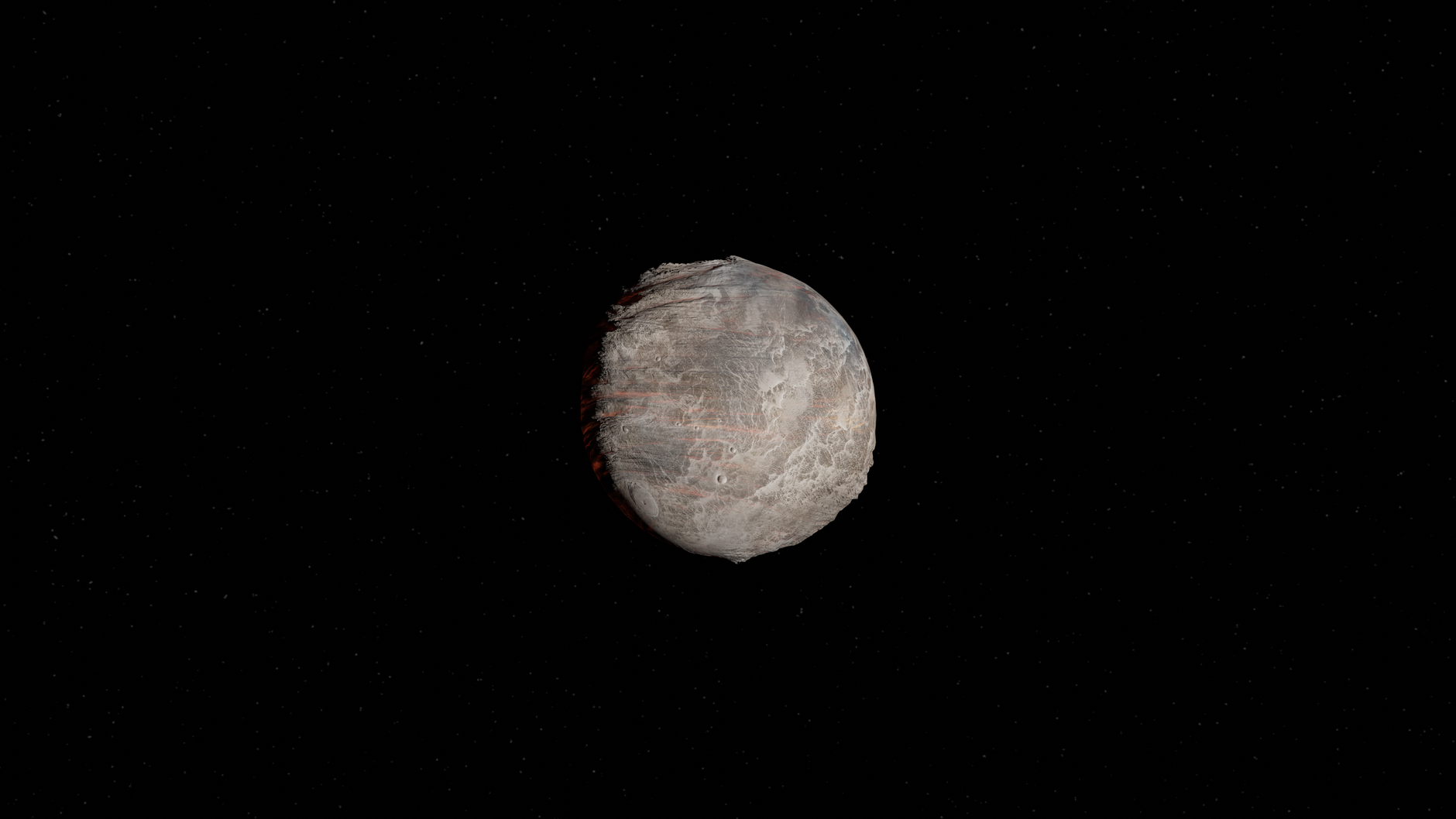
A nearby planet has changed category without moving an inch. GJ 3378 b, a world orbiting a red dwarf about 25 light-years away in the direction of Camelopardalis, was initially assigned a minimum mass of 5.26 Earth masses. A reanalysis published in The Astrophysical Journal on 30 June 2026 cuts that figure to 2.3 Earth masses, or about 44 percent of the earlier value.
The same work revises the planet’s year from 24.73 Earth days to 21.45 days. Yet the most arresting part of the result is what did not change: GJ 3378 b still receives about 91 percent of the starlight Earth receives from the Sun. The combination makes it a much more persuasive candidate for a rocky planet in its star’s habitable zone. It does not establish that the planet is rocky, inhabited or even capable of keeping an atmosphere.
Why the planet’s measured weight changed
Astronomers do not see GJ 3378 b as a resolved dot. They detect it through radial velocity, tracking minute wavelength shifts as the planet’s gravity pulls its star alternately toward and away from Earth. The original 2024 analysis identified a 24.73-day signal and reported a minimum mass of 5.26 Earth masses, with uncertainties close to one Earth mass.
The new team added observations from the Habitable-zone Planet Finder on the Hobby-Eberly Telescope and NEID on the WIYN 3.5-metre Telescope, then analysed them alongside published CARMENES and SPIRou measurements. With a broader data set and a different accounting of periodic signals in the star, the preferred planetary orbit shifted to 21.45 days. The smaller stellar wobble associated with that solution yields a minimum mass of 2.3 plus or minus 0.4 Earth masses.
This is a revision of a statistical model, not a planet physically shedding half its mass. The world was always whatever it is today. Astronomers have improved the interpretation of a subtle signal hidden in the spectrum of its star.
The crucial words are “minimum mass”
Radial velocity directly constrains a quantity called m sin i. The unknown i is the inclination of the orbit to our line of sight. An almost edge-on orbit makes the measured minimum close to the true mass; a more face-on orbit means the planet is actually heavier. The value of 2.3 Earth masses is therefore a floor, not a complete weighing.
GJ 3378 b is not known to cross, or transit, the face of its star. Without a transit, researchers do not have a measured radius. Without both radius and true mass, they cannot calculate the planet’s bulk density, one of the clearest ways to distinguish a mostly rocky body from a lower-density world wrapped in a substantial layer of gas.
That is why the revision changes probabilities rather than revealing geology. A minimum mass above five Earth masses allowed more room for a gas-rich sub-Neptune. A value near 2.3 Earth masses places GJ 3378 b much more comfortably among possible rocky super-Earths. As Space Daily reported when the revision appeared, the lower figure strengthens the terrestrial interpretation. It does not prove it.
What 90 percent of Earth’s starlight means
The NASA Exoplanet Archive lists an incident flux of 0.91 plus or minus 0.09 times Earth’s, a 21.45-day orbital period and an orbital distance of about 0.0967 astronomical units. That close orbit is possible because GJ 3378 is a cool M4 red dwarf, far dimmer than the Sun. The planet must stay near its star to receive roughly Earth-like total energy.
On paper, that puts the orbit inside the conservative liquid-water habitable zone. NASA’s habitable-zone explanation describes this as the range of distances where liquid water could persist on a planet’s surface under suitable conditions. The phrase is a filter for selecting interesting targets, not a declaration that a world is habitable.
The archive also gives an equilibrium temperature near 272 kelvin, but this should not be read as a surface weather report. Equilibrium temperature is a simplified energy-balance estimate. A real surface temperature would depend on reflectivity, heat circulation, greenhouse gases, clouds and whether there is an atmosphere at all. None of those properties has been measured for GJ 3378 b.
A world near the cosmic shoreline
The June paper highlights a second reason the revised mass matters. GJ 3378 b lies near the so-called cosmic shoreline, an empirical relationship introduced to describe how planetary irradiation and escape velocity appear to separate many airless bodies from worlds that retain atmospheres. The original cosmic-shoreline study treated it as a broad pattern across Solar System bodies and exoplanets, not a sharp physical wall.
Lowering a planet’s estimated mass reduces the gravity available to hold gases, while the incoming radiation remains almost the same. GJ 3378 b may therefore occupy a particularly informative borderland: massive enough that it might preserve an atmosphere, yet irradiated enough that atmospheric loss could be important over billions of years.
Red dwarfs complicate that balance. Their high-energy ultraviolet and X-ray histories can differ markedly from the Sun’s, especially when the stars are young. Total starlight alone cannot say how severely a planet’s upper atmosphere has been heated and eroded. The new paper makes atmospheric survival a sharper scientific question; it does not supply the answer.
Nearby does not mean easy to examine
A distance of roughly 25 light-years is close on the scale of the Milky Way, making GJ 3378 an attractive laboratory for precision measurements. Continued radial-velocity observations can tighten the planet’s period and minimum mass, test whether stellar activity is biasing the solution and search for additional companions whose gravity might reveal more about the system.
Its non-transiting geometry is a major obstacle. Astronomers cannot simply wait for starlight to pass through the planet’s atmosphere and look for molecular absorption. Directly separating a small, temperate planet from its star is also beyond what present observatories routinely accomplish. Future high-contrast imaging and astrometry may constrain the inclination, true mass or atmospheric properties, but no such measurement is guaranteed.
The system’s proximity makes those attempts more plausible than they would be for a similar world hundreds of light-years away. It also turns GJ 3378 b into a useful test of planet demographics: if revised data move objects from the sub-Neptune regime into the rocky super-Earth regime, estimates of how common nearby terrestrial habitable-zone planets may shift as well.
A stronger candidate, with the mystery intact
The June result changes three numbers that frame GJ 3378 b: a 21.45-day year, a minimum mass of 2.3 Earth masses and an incident flux about 0.91 times Earth’s. Together they describe a nearby planet that is more plausibly rocky and still orbits where liquid water could be physically possible under the right atmospheric conditions.
The limits are equally important. No radius or density has been measured. No atmosphere, surface liquid, climate or biosignature has been detected. The planet’s true mass may exceed the radial-velocity minimum, and its red dwarf may have subjected it to a difficult history of high-energy radiation.
GJ 3378 b has not become a second Earth. It has become a better question. By moving the planet from a possible gaseous world toward the terrestrial side of the ledger, the revised analysis gives astronomers a nearby target where composition, atmospheric survival and the real meaning of a habitable-zone orbit can eventually be tested.