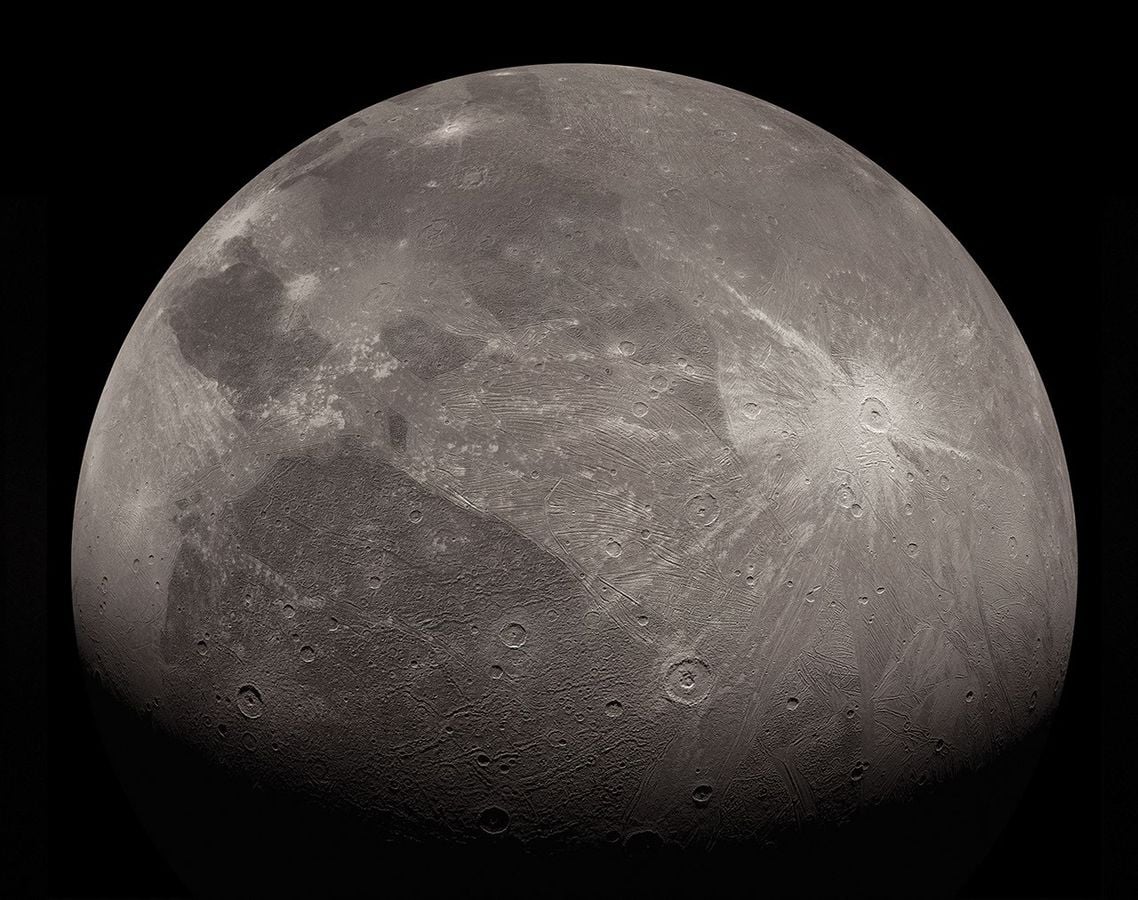
Calling Ganymede a moon is correct, but it does very little to prepare us for what the object actually is.
It is the largest moon in the Solar System, with a diameter of about 5,262 kilometres. It has an iron-rich core, a rocky mantle, an immense layer of water and ice, an old and geologically complicated surface, a thin atmosphere, auroras and a magnetic field generated inside the moon itself. If it travelled around the Sun rather than Jupiter, nobody encountering it for the first time would mistake it for a minor piece of debris.
That does not mean Ganymede has been misclassified. A moon is defined by what it orbits, not by how geologically accomplished it appears. But Ganymede is a useful reminder that the word describes an orbital relationship, not a level of complexity. This is a full-sized world living as one component of the Jupiter system.
Larger than Mercury does not mean heavier
The cleanest comparison begins with size. JPL lists Ganymede’s mean radius as 2,631.2 kilometres. Mercury’s mean radius is 2,439.4 kilometres. Ganymede is therefore almost 8 per cent wider than the smallest planet.
It is not, however, more massive. Ganymede has only about 45 per cent of Mercury’s mass. The difference is composition. Mercury is an unusually dense, metal-rich planet, while Ganymede is a much lighter mixture of rock and water ice. Mercury’s average density is about 5.43 grams per cubic centimetre; Ganymede’s is about 1.94.
This distinction matters because the familiar sentence, “Ganymede is bigger than Mercury,” can accidentally create the wrong mental image. The moon has a larger volume, but much less material packed inside it. Its surface gravity is only around 15 per cent of Earth’s, lower even than the Moon’s.
The comparison also exposes why size alone cannot decide whether something is a planet. Mercury independently circles the Sun. Ganymede completes an orbit around Jupiter every 7.15 days. Its status follows that architecture, even though its body is more planet-like than the word moon tends to imply.
Under the crust is a differentiated world
Small Solar System bodies are often imagined as frozen mixtures that never became warm enough to organise themselves internally. Ganymede did. NASA’s current overview describes a deep metallic core, a surrounding rock shell and an outer system of water and ice. In other words, the moon differentiated into layers, as the rocky planets did.
The surface keeps part of that history. Dark, heavily cratered terrain records very old ground. Brighter regions are crossed by long grooves and ridges, evidence that the crust was stretched, fractured and resurfaced. Ganymede is no longer as visibly active as neighbouring Io, but it is not a featureless ball that simply froze in place.
The contrast with its parent planet is almost comic. As I explored in an earlier article about why there is no solid surface on Jupiter to land on, the giant planet becomes progressively denser with depth until hydrogen behaves like an electrically conducting metal. Ganymede, despite orbiting that enormous fluid world, offers recognisable ground, internal layers and geological provinces. The moon is the place with the planetary surface; the planet is not.
The water claim is large, but easy to misunderstand
The statement that Ganymede may contain more water than Earth does not describe an open sea. No camera has looked through the crust, and no probe has sampled the liquid. The evidence comes from several indirect measurements, including how Ganymede responds to Jupiter’s changing magnetic environment.
One especially elegant test used the moon’s auroras. Jupiter’s magnetic field should make those glowing bands rock back and forth by about six degrees. In Hubble observations, they moved by only about two degrees. A conductive, salty ocean beneath the crust provided the best explanation, because electrical currents in the water generate a secondary magnetic response that damps the motion.
The 2015 model associated with those observations placed an ocean roughly 100 kilometres thick beneath about 150 kilometres of mostly ice. Those figures are estimates, not a sonar reading. Other models allow a layered arrangement in which liquid water is separated by different phases of high-pressure ice, closer to a club sandwich than one unbroken sea.
Even with that uncertainty, Ganymede’s total water inventory may exceed all the water on Earth’s surface. The careful wording matters. Earth also stores water inside its mantle, and Ganymede’s water is not necessarily all liquid at once. The comparison concerns the moon’s enormous combined water layer and the oceans, ice and surface water visible on Earth.
This is part of the larger change I wrote about in the expansion of the habitable-zone idea beyond sunlight. It also explains why the list of credible hidden-ocean moons keeps growing. Yet water volume alone does not make Ganymede habitable. If high-pressure ice separates the ocean from rock below, the chemical exchange available at a rocky seafloor may be limited. The depth that protects the water also makes it extraordinarily difficult to investigate.
The moon carries a magnetosphere inside a magnetosphere
Ganymede’s most unusual property is not its size or even its water. It is the only moon known to generate its own intrinsic magnetic field. NASA’s Galileo spacecraft detected the field during close encounters beginning in 1996. The leading explanation is a dynamo operating in a liquid, electrically conducting part of the metallic core, broadly the same physical mechanism that sustains Earth’s global field.
The distinction between intrinsic and induced fields is important. The buried saltwater ocean appears to develop an induced response as Jupiter’s external field changes around it. The stronger, permanent field comes from much deeper inside Ganymede. Measurements and modelling describe a small Ganymede magnetosphere nested within Jupiter’s much larger one.
That arrangement produces auroras near the moon’s poles, but it should not be confused with an Earth-like protective cocoon. Ganymede has only a very tenuous atmosphere, and it remains immersed in Jupiter’s radiation and plasma environment. A magnetic field can organise the charged particles around the moon without turning its surface into a safe refuge.
There is still an active question about how such a small world has retained the fluid motions needed for a dynamo. Space Daily recently examined the proposal that Ganymede’s core may still be evolving. The details are not settled, but the field is direct evidence that the moon is not internally inert.
Ganymede is a world, but not an isolated one
It is tempting to describe Ganymede as a planet that happens to have been captured by Jupiter. That would go too far. Ganymede’s history and present behaviour are inseparable from the system it inhabits.
Its orbit participates in the Laplace resonance with Europa and Io. For every orbit Ganymede completes, Europa completes about two and Io about four. Their recurring gravitational tugs prevent the orbits from becoming perfectly circular and help redistribute energy through the moons. I described the same mechanism in an article about Europa’s place in Jupiter’s three-moon gravitational machine.
Past tidal heating may have helped Ganymede separate into its present layers, and Jupiter controls the magnetic environment in which its ocean signal is measured. The moon is also tidally locked, keeping the same face towards Jupiter as it travels around the planet. Its planet-like qualities therefore do not make it independent. They show how elaborate a satellite can become while remaining physically bound to a larger system.
This is the more interesting lesson than a debate over labels. A moon can have the diameter of a planet, the interior architecture of a planet and a dynamo usually associated with planets, while its geology and energy budget remain shaped by a relationship no solitary planet has.
JUICE is going there because Ganymede requires an orbiter
Most of what we know about Ganymede comes from fly-bys, remote observations and measurements made during brief passages. ESA’s Jupiter Icy Moons Explorer, or JUICE, is designed to change the scale of the investigation.
JUICE launched in April 2023 and is scheduled to reach Jupiter in July 2031. After a tour of the Jovian system, the mission plan calls for insertion into orbit around Ganymede in December 2034. If successful, it will become the first spacecraft to orbit a moon beyond Earth’s own.
Its instruments are meant to treat Ganymede as a system rather than a single target. Radar will probe the icy shell. Magnetic measurements will separate signals from the core, ocean and Jupiter. Laser altimetry, radio science and cameras will examine the moon’s shape, gravity, surface and response to tides. Together, those observations should constrain how thick the ice is, how the water is arranged and how the deep interior keeps its field alive.
Ganymede does not need to be promoted from moon to planet for any of this to count. “Moon” tells us that it goes around Jupiter. “World” tells us that it has a history, structure and physical identity worth studying on its own terms. Ganymede is both, and the tension between those descriptions is exactly what makes it so revealing.