

A white dwarf looks like the simplest kind of clock. It has finished the nuclear fusion that once supported a living star, expelled its outer layers and collapsed to a remnant roughly the size of Earth. With no furnace left to replace escaping heat, it should do one thing for the rest of time: cool and fade.
Gaia exposed a small population that refuses to follow that schedule. These white dwarfs crowd into a narrow band of colour and brightness even though their motions through the Milky Way imply that many are ancient. The combined evidence indicates that some have spent at least eight billion years at nearly the same luminosity.
The leading explanation is not renewed fusion. It is a slow rearrangement of matter inside the star. Crystals form, float upward and melt, while liquid enriched in a heavier isotope sinks. That descent releases gravitational energy as heat, replacing much of the energy radiated from the surface.
Gaia found a traffic jam in the cooling sequence
Astronomers did not watch one white dwarf remain unchanged for eight billion years. Gaia has operated for only a small fraction of a human lifetime. The long delay is inferred by comparing a large population of stars with models and with the way those stars move through the Galaxy.
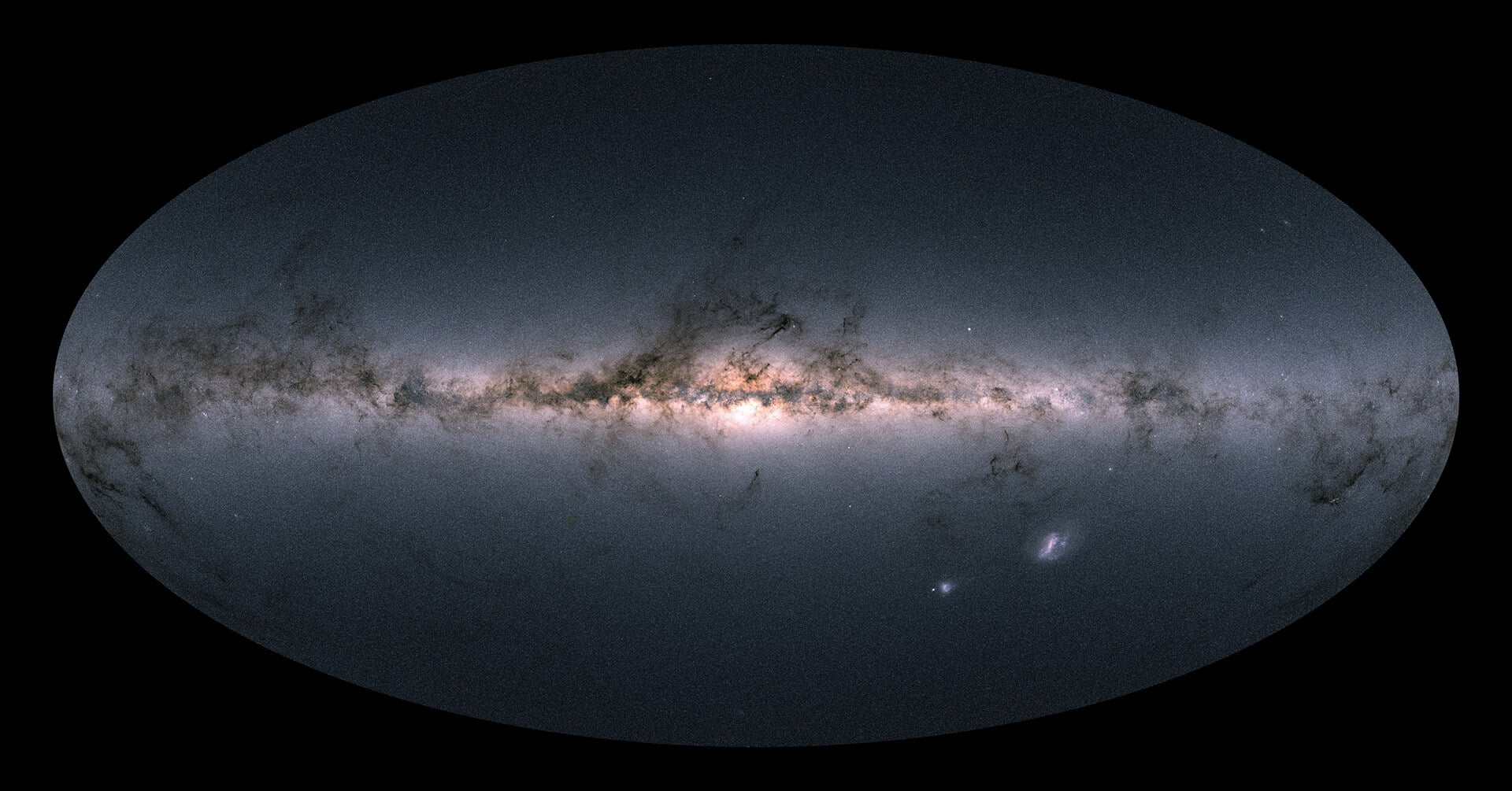
Gaia measures parallax, the small apparent shift caused by Earth’s orbit. Parallax supplies distance; distance turns apparent brightness into intrinsic luminosity. Combine that with a star’s colour and astronomers can place it on a Hertzsprung-Russell diagram, a map of luminosity against temperature or colour.
In 2019, researchers using Gaia data reported a pile-up of nearby white dwarfs where cooling models predicted stars should continue moving through the diagram. SpaceDaily covered that first direct evidence that thousands of white dwarfs were crystallising. The feature became known as the Q branch.
Ordinary crystallisation explains much of the broader pile-up. A 2019 Nature analysis found that latent heat, together with gravitational energy released as carbon and oxygen separate, can slow cooling by roughly one billion years. That was already enough to alter stellar age estimates.
A subset was harder. Many high-mass Q-branch stars have large sideways velocities through the Galaxy, a statistical sign that they belong to an old population. Their brightness made them appear young while their motion said otherwise. The inference was that about 5 to 9 per cent of high-mass white dwarfs stop cooling for at least eight billion years.
Normal freezing did not provide enough energy
White-dwarf matter does not resemble an ice cube in a freezer. A typical remnant compresses a substantial fraction of the Sun’s mass into a sphere comparable with Earth. Its core density can approach ten million grams per cubic centimetre, and crystallisation begins while its interior is still near ten million degrees.
At those densities, carbon and oxygen nuclei sit in a sea of free electrons. The electrons supply degeneracy pressure, a quantum-mechanical resistance to compression that holds the star against gravity. As thermal motion declines, the positively charged nuclei settle into an ordered lattice. The material becomes solid even though its temperature would vaporise ordinary matter.
Freezing releases latent heat. Carbon and oxygen also prefer the solid and liquid phases in different proportions, producing separation that releases some gravitational energy. These effects make every crystallising white dwarf cool more slowly for a time.
They could not explain the exceptional branch. The observed excess was too sharp, the stars stayed within too narrow a temperature interval, and the inferred delay was many times longer than the standard energy sources allowed. Across the Q branch’s width, the relevant stars change surface temperature by only about 10 to 15 per cent.
Neon-22 turns crystallisation into distillation
The missing ingredient appears to be neon-22. This isotope contains two more neutrons than the common neon-20 nucleus, making it unusually heavy for its electric charge. It is produced during the earlier nuclear evolution of stars and can remain as a minority impurity in a carbon-oxygen white dwarf.
In 2021, calculations showed that neon-22 phase separation could power the high-mass cooling anomaly. The decisive condition is the composition of the solid. If a newly formed carbon-oxygen crystal contains less neon-22 than the liquid around it, the crystal is slightly less dense.
It therefore rises. At a shallower, warmer layer it melts, while its motion displaces neon-rich liquid downward. Fresh crystals continue forming below. Instead of a single solid core growing steadily outwards, a broad region contains rising solid and sinking liquid in convection-like flows.
The analogy used by the researchers is ice floating in water. It captures the direction of buoyancy, but not the physical setting. There are no visible cubes bobbing in an empty chamber, and this is not frozen water. It is a phase separation among nuclei in an ultra-dense plasma, buried beneath an opaque stellar atmosphere.
Gravity supplies the usable energy. When neutron-rich liquid migrates closer to the centre, the star moves towards a more tightly bound state. The lost gravitational potential energy becomes heat. Distillation does not create energy from nothing; it converts the energy available from rearranging heavy matter in a strong gravitational field.
The new model reproduced the entire Q-branch peak
A 2024 Nature study by Antoine Bédard, Simon Blouin and Sihao Cheng placed that process inside full white-dwarf evolution models. The team calculated carbon-oxygen remnants between 1.00 and 1.25 solar masses, initially giving neon-22 about 3 per cent of the core by mass.
The otherwise steady fall in surface luminosity was almost completely halted for about 7 to 13 billion years, depending on the star’s mass. During roughly ten billion years in a representative 1.15-solar-mass model, the neon-22 concentration at the centre rose from 3 per cent to about 30 per cent.
That redistribution increased the central density by around 8 per cent and reduced the stellar radius by roughly 1 per cent. Small structural changes are consequential when an object is this dense. The associated gravitational energy was sufficient to keep the model radiating at the brightness of the observed delayed stars.
The population test was equally important. When 5 to 9 per cent of simulated high-mass white dwarfs were assigned carbon-oxygen cores that underwent distillation, the calculation reproduced the Q branch’s location, width and height within the observational uncertainty. A baseline population without distillation missed the sharp peak by more than four standard deviations.
That is why distillation is now the leading explanation rather than merely an attractive analogy. It accounts at once for the crowded branch, the narrow range of luminosities and the multi-billion-year delay. SpaceDaily’s earlier report described how the floating-crystal mechanism lets some white dwarfs “cheat death”; the underlying result is more precise than the phrase suggests. The stars are not revived. Their cooling is temporarily balanced by another finite energy reservoir.
Only unusual white dwarfs seem to receive the long pause
All white dwarfs are expected to crystallise eventually, but the extreme delay belongs to a minority of massive ones. Most high-mass white dwarfs are thought to contain oxygen-neon cores and follow the conventional solidification route. Distillation requires a carbon-oxygen core with enough neutron-rich impurity and a suitable phase diagram.
The researchers argue that stellar mergers can produce that unusual composition. Two stars, or a white dwarf and another evolved star, may combine into a massive carbon-oxygen remnant while leaving thin outer layers of hydrogen and helium. The merger history would explain why only a small fraction occupies the delayed branch.
This connection is plausible but not stamped onto every object. Astronomers cannot normally see through a white dwarf’s atmosphere to read its core directly. A 2025 ultraviolet study of WD 0525+526 found atmospheric carbon and very thin hydrogen and helium layers, identifying that ultra-massive star as a merger remnant. Its cooling is probably being delayed by neon distillation, but one object does not establish the history of the whole branch.
The Sun will become a white dwarf and eventually crystallise, but it is not expected to leave such a massive merger remnant under ordinary evolution. The striking 7 to 13-billion-year pause should not be assigned to every future crystal white dwarf.
A stellar clock can hide billions of years
White dwarfs are used as clocks because, once their cooling physics is known, temperature and luminosity can be translated into age. The coolest members of a cluster help date the cluster; populations across the Milky Way help reconstruct when different parts of the Galaxy formed.
A distilling star breaks the simplest reading. Two white dwarfs with similar present temperatures may differ in age by billions of years if one spent much of its history on the Q branch. That does not make white-dwarf dating useless. It means mass, composition and merger history must be included before luminosity becomes a trustworthy clock.
The European Space Agency’s account of Gaia’s original crystallisation result described an experiment on ultra-dense matter that cannot be performed in a terrestrial laboratory. The later work sharpened that experiment: a crowded line on a stellar census became evidence for chemical circulation deep inside objects that appear as points of light.
These white dwarfs will not glow forever. The available neon will eventually be concentrated, the distillation will end and cooling will resume. Yet a finite reservoir can still be immense. By allowing heavy liquid to sink and light crystals to rise, a dead star can hold almost the same brightness for a span longer than Earth has existed.