
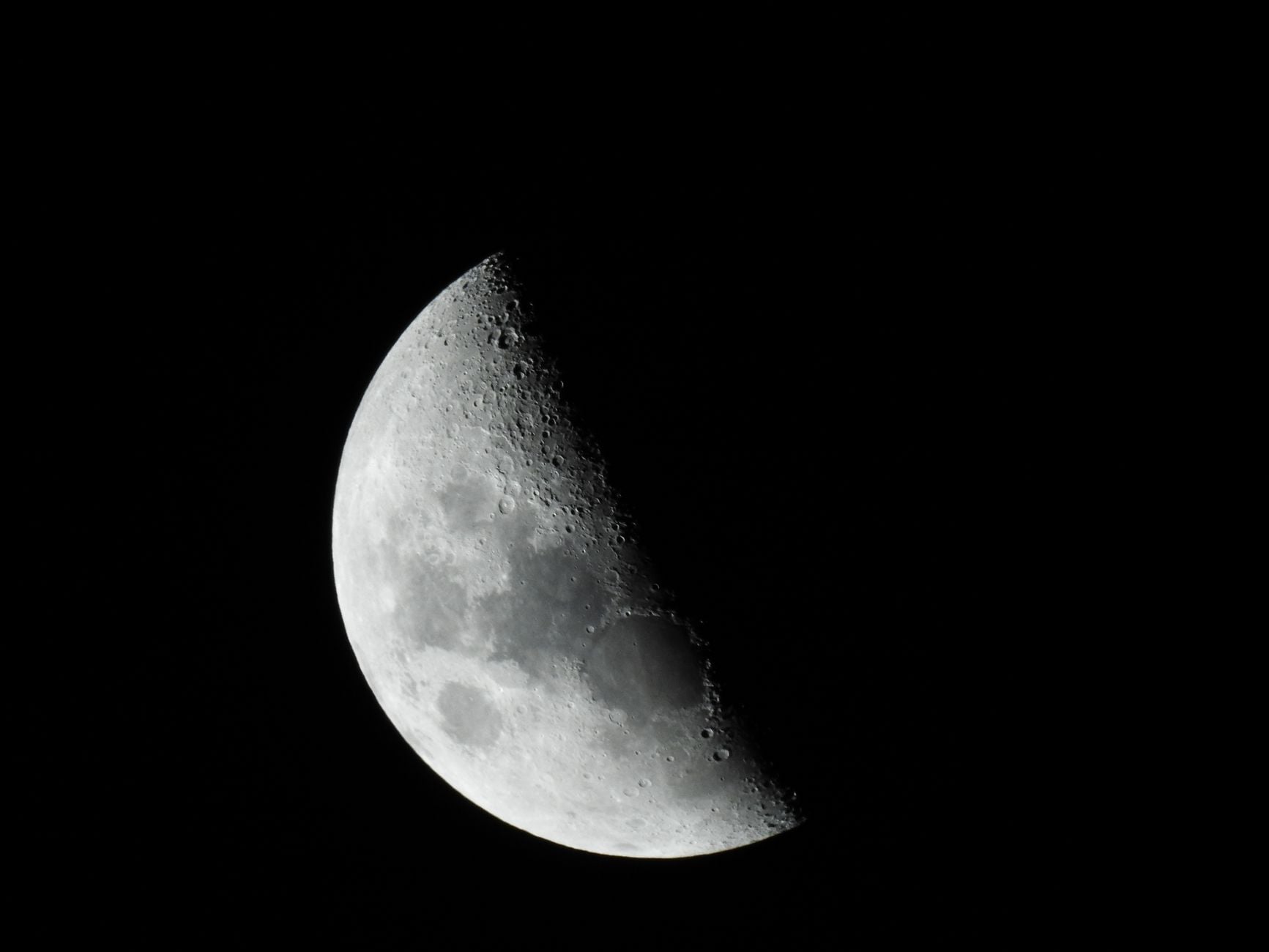
The Moon has no helium-3 mine, and no power grid on Earth is waiting for lunar fuel to arrive. The attraction begins with a simpler physical fact: most of the lunar surface sits exposed to the solar wind in a way Earth does not.
That exposure has been going on for a very long time. NASA describes the Moon as having a very thin exosphere, no global magnetic field, and a surface that is mostly directly exposed to solar wind. Over time, particles from that solar wind can be implanted into the outer grains of lunar soil. Among the trapped material is helium-3, a light isotope that exists on Earth only in trace amounts.
The source is exposure, not geology alone
The Moon’s surface is often described as almost airless, which is accurate enough for this question. NASA’s Moon fact sheet says the Moon has a very thin exosphere and that this atmosphere does not protect the surface from the Sun’s radiation or meteoroid impacts.
Earth is different in two useful ways. Its atmosphere and global magnetic field keep most solar-wind particles from reaching the ground. The Moon lacks that protection. According to NASA’s solar-wind overview, with no magnetosphere and almost no atmosphere, most of the surface is exposed to charged particles from the Sun.
That exposure does not make helium-3 appear in thick seams. It leaves very small amounts in the upper regolith, especially in tiny soil grains and minerals that can hold implanted particles. The useful phrase here is not abundance. It is accumulation.
Helium-3 is attractive because it is a possible fuel for deuterium-helium-3 fusion reactions, which produce fewer energetic neutrons than the deuterium-tritium reaction that dominates near-term fusion planning. But the Moon’s role in that idea is as a reservoir, not as a ready-made energy system.
What the lunar samples show
The strongest numbers come from returned lunar soil and later reserve estimates built from those measurements. In a 2007 Lunar and Planetary Science Conference paper, E. N. Slyuta, A. M. Abdrakhimov and E. M. Galimov reviewed Apollo and Luna sample data and estimated probable helium-3 reserves in lunar regolith.
The paper reported representative helium-3 abundances from sample sites ranging from 1.4 parts per billion at Apollo 16 to 15.1 parts per billion at Apollo 11. Luna 24 soil was listed at 3.4 parts per billion. Apollo 17 was listed at 8.0 parts per billion. These are not ore-grade numbers in the ordinary mining sense.
They are also not nothing.
Slyuta and colleagues argued that helium-3 retention depends strongly on grain size, mineral composition and regolith maturity. They wrote that most trapped helium is held in fine particles, with a large share in grains smaller than 50 microns. Their table summed probable reserves at 2,469,158 tons, while also describing the estimate as rough because the available data are limited.
This is one resource estimate, not settled consensus. It is still useful because it puts the scale of the claim in the right frame: the Moon may hold a very large total inventory, but the material is scattered through immense amounts of soil.
A large inventory can still be hard to mine
Parts per billion changes the engineering discussion. At one part per billion by mass, a tonne of regolith contains about one milligram of helium-3. At 10 parts per billion, it contains about 10 milligrams. A single gram would therefore require processing roughly 100 tonnes of soil at that concentration, before losses and inefficiencies are counted.
That arithmetic is why helium-3 is better understood as a possible by-product of a broader lunar industrial system than as a simple target for a small mining mission. Any real extraction architecture would need to excavate, heat or otherwise process large volumes of abrasive regolith, collect released gases, separate helium-3 from other volatiles, store it, and then send it somewhere useful.
The regions of interest would not be chosen only by helium-3 concentration. They would also have to make sense for power, thermal management, landing access, dust handling, communications, equipment maintenance, and perhaps the presence of other useful resources. Some mare regions with higher titanium content appear more favourable in the 2007 estimate, but high total inventory and practical recovery are not the same claim.
Why fusion keeps pulling the idea back
The reason helium-3 keeps its hold on the space economy imagination is that it sits at the meeting point of two hard problems: fusion fuel supply and lunar resource use. Deuterium is common in seawater. Tritium, the other half of the main deuterium-tritium fusion pathway, is rare in nature and decays relatively quickly. The U.S. Department of Energy notes in its explainer on deuterium-tritium fusion fuel that future commercially feasible fusion plants would need robust fuel supply chains.
The same DOE explainer also names deuterium-helium-3 as one of the aneutronic reactions of interest, while adding the key caveat: these reactions occur at higher ion temperatures than deuterium-tritium fusion and would face supply-chain challenges of their own.
That caveat should be near the centre of any article about lunar helium-3. It is not enough to say the Moon has the fuel. The fuel would still have to be extracted at scale. A reactor would still have to burn it economically. The surrounding power system would still have to turn that reaction into reliable electricity. None of those steps is a footnote.
DOE’s 2022 announcement on fusion ignition at the National Ignition Facility is a useful reminder of the distance between laboratory milestones and commercial power. In that experiment, DOE said the target produced more fusion energy than the laser energy used to drive it, but also said many science and technology developments were still needed for affordable inertial fusion energy.
Why the Moon keeps returning to the discussion
If helium-3 were common on Earth, the Moon would be a far less interesting source. If the giant planets were easy to mine, lunar regolith might look like an inconvenient intermediate case. The Moon attracts attention because it is nearby, solid, already sampled, and covered with material that has recorded long exposure to the Sun.
That does not make the business case obvious. It makes the scientific and strategic case easier to understand. Lunar helium-3 depends on many other things becoming real first: cheaper transport to the Moon, durable surface machinery, large-scale regolith handling, volatile extraction, off-world logistics, and fusion systems that can use helium-3 in a way that justifies the effort.
For now, the measured fact is modest and interesting: Apollo and Luna samples show helium-3 in the lunar soil at parts-per-billion levels, and the Moon’s exposed surface gives a clear mechanism for why it is there. The open question is whether a thinly spread isotope can ever become an industrial fuel, or whether it will remain a technically plausible prize waiting for the rest of the lunar economy to catch up.
Sources
- NASA Science, “The Solar Wind at the Moon”
- NASA Science, Moon facts
- Slyuta, Abdrakhimov and Galimov, “The estimation of helium-3 probable reserves in lunar regolith,” Lunar and Planetary Science Conference, 2007
- U.S. Department of Energy, “DOE Explains… Deuterium-Tritium Fusion Fuel”
- U.S. Department of Energy, National Ignition Facility fusion ignition announcement
