
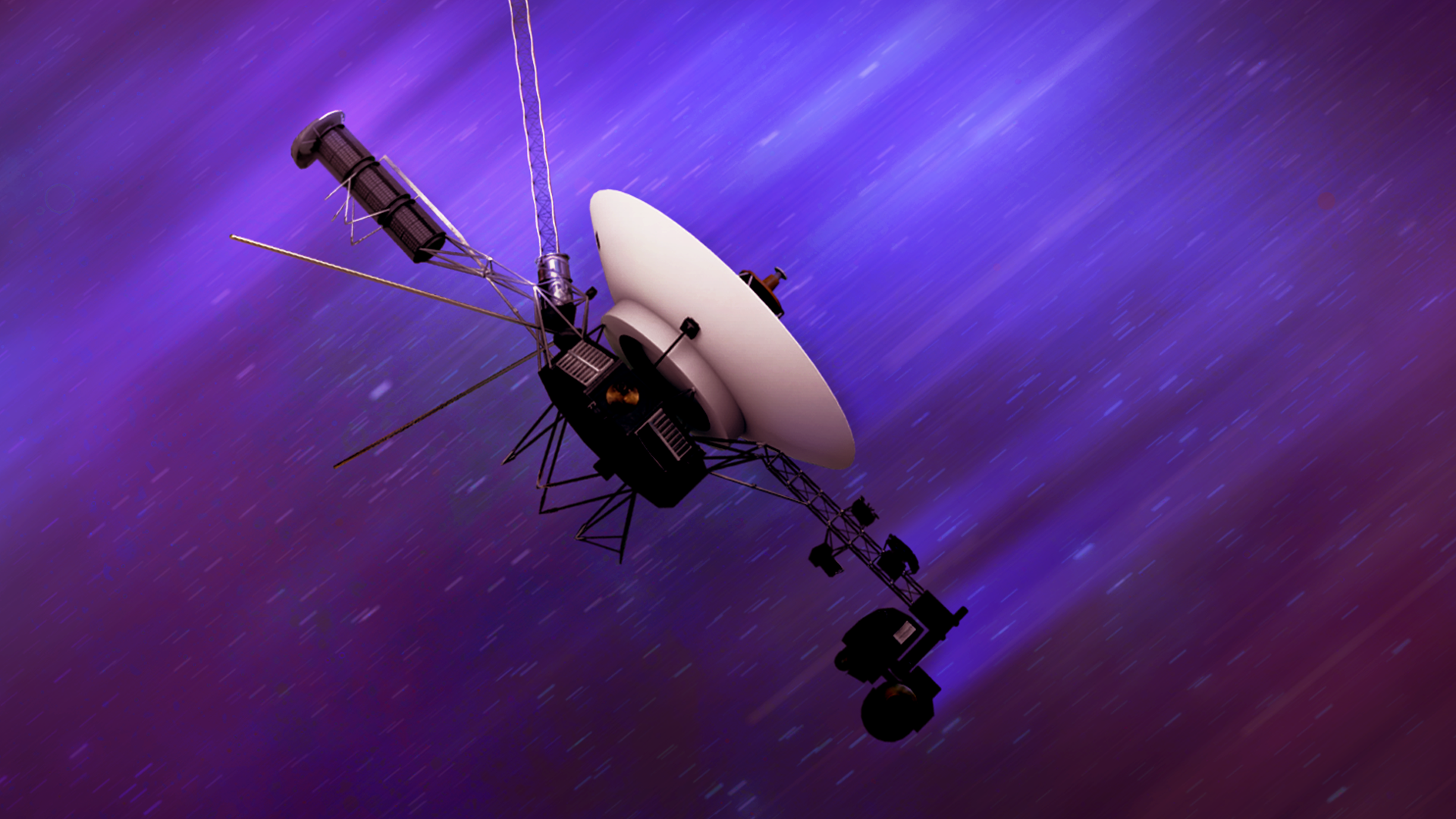
For most spacecraft, a failed thruster is an engineering problem. For Voyager 1, it is a problem stretched across interstellar space, handled by commands that take more than 23 hours to arrive and another 23 hours to report back.
That is why NASA’s 2025 recovery of Voyager 1’s long-dormant roll thrusters was more than a clever repair. It was a race against distance, age and an approaching communications blackout. The thrusters had been considered unusable since 2004. The spacecraft was more than 15 billion miles from Earth. And the team knew that if the thrusters fired before their heaters came back to life, the result could be a small explosion aboard the most distant operating spacecraft humanity has ever built.
The alternative was not much better. Voyager 1 uses tiny thruster pulses to keep its high-gain antenna aimed at Earth. If the spacecraft ever loses that aim and cannot correct it, the mission could go quiet not because its instruments failed, but because Earth slipped out of its beam.
In May 2025, NASA announced that engineers at the Jet Propulsion Laboratory had successfully revived the old roll thrusters, giving Voyager 1 another possible way to hold its orientation as its newer working set continues to suffer from residue buildup in fuel tubes. It was the kind of repair that only Voyager seems to demand: part archaeology, part remote surgery, and part bet on a spacecraft launched in 1977 still responding to commands sent from home.
Why roll matters
Voyager 1 is often described as flying through interstellar space, but its survival depends on something much more precise than forward motion. It must keep pointing.
Both Voyager spacecraft use thrusters to make small attitude-control adjustments. Some pivot the spacecraft up and down or left and right. The roll thrusters handle a different motion: they rotate the spacecraft around the axis of its antenna, like turning a record on a turntable. That roll control keeps the spacecraft aligned with a guide star used by its star tracker, which in turn helps the probe keep its antenna pointed back toward Earth.
Without roll control, the spacecraft could lose its reference. If that drift became large enough, Voyager 1 might no longer be able to maintain the alignment needed for communication. At 15 billion miles, there is no rescue mission, no manual override, and no second chance measured in minutes. Every command sequence is written for a machine so distant that the engineers are always seeing yesterday’s spacecraft.
The spacecraft has several sets of thrusters, but they are not interchangeable in every role. NASA previously revived trajectory correction maneuver thrusters on the Voyagers after decades of dormancy, but those thrusters cannot induce roll motion. For roll, Voyager 1 had been relying on its backup roll thrusters since 2004, when the primary roll thrusters lost power in two small internal heaters and were written off as likely unfixable.
The clogging problem
The Voyagers use hydrazine thrusters, and after nearly half a century in space, the plumbing is showing its age. Residue from propellant can build up inside the fuel tubes, narrowing the flow path. NASA has managed the problem by switching between available thruster sets and by changing how the spacecraft fires them, but there are fewer options left with every passing year.
By 2025, the roll thrusters actively being used on Voyager 1 were at risk of becoming too clogged to function, potentially as early as the fall. That made the old, supposedly dead primary roll thrusters suddenly valuable again. If they could be revived, they would not make Voyager young. But they could restore redundancy in one of the few places where the mission still had a chance to buy time.
The failure history mattered. In 2004, engineers concluded that the primary roll thrusters had stopped working because their small catalyst-bed heaters had lost power. Those heaters matter because the thrusters need to be warmed before firing. A cold firing could be dangerous. NASA’s 2025 account says that if the dormant roll thrusters automatically fired while their heaters were still off, it could trigger a small explosion.
For years, that risk was academic because the team had a good backup. Two decades later, the backup was wearing out. So engineers reopened the old case.
A switch that might not have been broken
The Voyager team began to suspect that the 2004 failure might not have been a permanent hardware death after all. The heater circuits may have experienced an unexpected change that effectively left a switch in the wrong position. If that was true, a command might be able to restore power to the heaters and bring the thrusters back into the usable category.
The difficulty was sequencing. To test the dormant roll thrusters, the team had to turn them on and then try to fix and restart the heaters. But Voyager 1’s own software could automatically fire the roll thrusters if the star tracker drifted too far from the guide star. If that happened before the heaters warmed, the repair attempt could become destructive.
So the engineers first had to get Voyager’s pointing as precise as possible, reducing the chance that the spacecraft would try to correct itself too soon. Then they had to send the commands and wait. There is no live control loop at that distance. By the time a signal from Voyager 1 reaches Earth, whatever happened aboard the spacecraft happened almost a day earlier.
On March 20, 2025, according to NASA, the team watched the returned data as Voyager executed the command sequence. Within about 20 minutes of the relevant telemetry, the temperature of the thruster heaters rose sharply. The old heaters were alive. The thrusters once considered dead had been pulled back into service.
The antenna deadline
The timing was forced by Earth as much as by Voyager. On May 4, 2025, Deep Space Station 43 in Canberra, Australia, was scheduled to go offline for upgrades lasting into February 2026, with only brief operating windows in August and December.
DSS-43 is not just another dish. It is a 70-meter antenna and, according to NASA, the only Deep Space Network antenna with enough signal power to send commands to the Voyager spacecraft. The DSN has complexes in California, Spain and Australia, which allows continuous coverage as Earth rotates, but for commanding the Voyagers at their current distances, Canberra’s giant dish carries a special burden.
That created a hard deadline. The team wanted the revived roll thrusters available before the long command pause, in case the active roll thrusters became too clogged while DSS-43 was unavailable. If Voyager 1 needed help during the pause and could not be commanded, the mission would have far less room to recover.
The successful March test therefore changed the risk picture before the antenna went offline. Voyager 1 still remained fragile. Its power supply continues to decline. Its instruments and heaters have been shut down one by one to stretch the mission. But the spacecraft had regained a crucial attitude-control option before a months-long communications constraint began.
A spacecraft that outlived its assumptions
Part of what makes the Voyager story so strange is that many of its present-day crises arise because the spacecraft exceeded the imagination of its original timelines. Voyager 1 launched in 1977, flew by Jupiter and Saturn, and later became the first human-made object to enter interstellar space. It was never expected to require delicate thruster troubleshooting in the 2020s from more than 15 billion miles away.
NASA’s own 2025 account includes the telling point that in 2004, the team could accept the loss of the primary roll thrusters because the backup worked and because few people expected the mission to keep going another 20 years. Voyager did keep going. That success turned an old acceptable failure into a new mission risk.
The repair did not make Voyager 1 immortal. The spacecraft is powered by radioisotope thermoelectric generators that produce less electricity every year. NASA has already had to turn off instruments and nonessential systems to keep the mission alive. Eventually, power will fall too low for science operations and then for communication.
But the revived roll thrusters are a reminder that old spacecraft do not always fail in clean, predictable ways. Sometimes a system that looked dead was misdiagnosed because the backup made deeper investigation unnecessary. Sometimes the solution sits hidden in a circuit assumption for 21 years. Sometimes a machine built before the personal-computer era can still accept a command, warm an old heater and answer from interstellar space.
Voyager 1 is now far beyond the planets, sampling a region no other operating spacecraft has crossed. Its survival depends on watts, propellant residue, aging electronics, a guide star and a radio beam narrow enough that pointing is life. In 2025, NASA reached across more than 15 billion miles and gave the spacecraft one more way to keep that beam on Earth.
At Voyager’s distance, that counts as a repair. It also counts as a message from the edge: the spacecraft is old, but it is still listening.
Sources
NASA: NASA’s Voyager 1 Revives Backup Thrusters Before Command Pause, May 14, 2025
NASA Voyager mission page
NASA: Voyager team software patch and thruster clogging background
Canberra Deep Space Communication Complex: Deep Space Station 43
Live Science report on the 2025 Voyager 1 thruster recovery
