
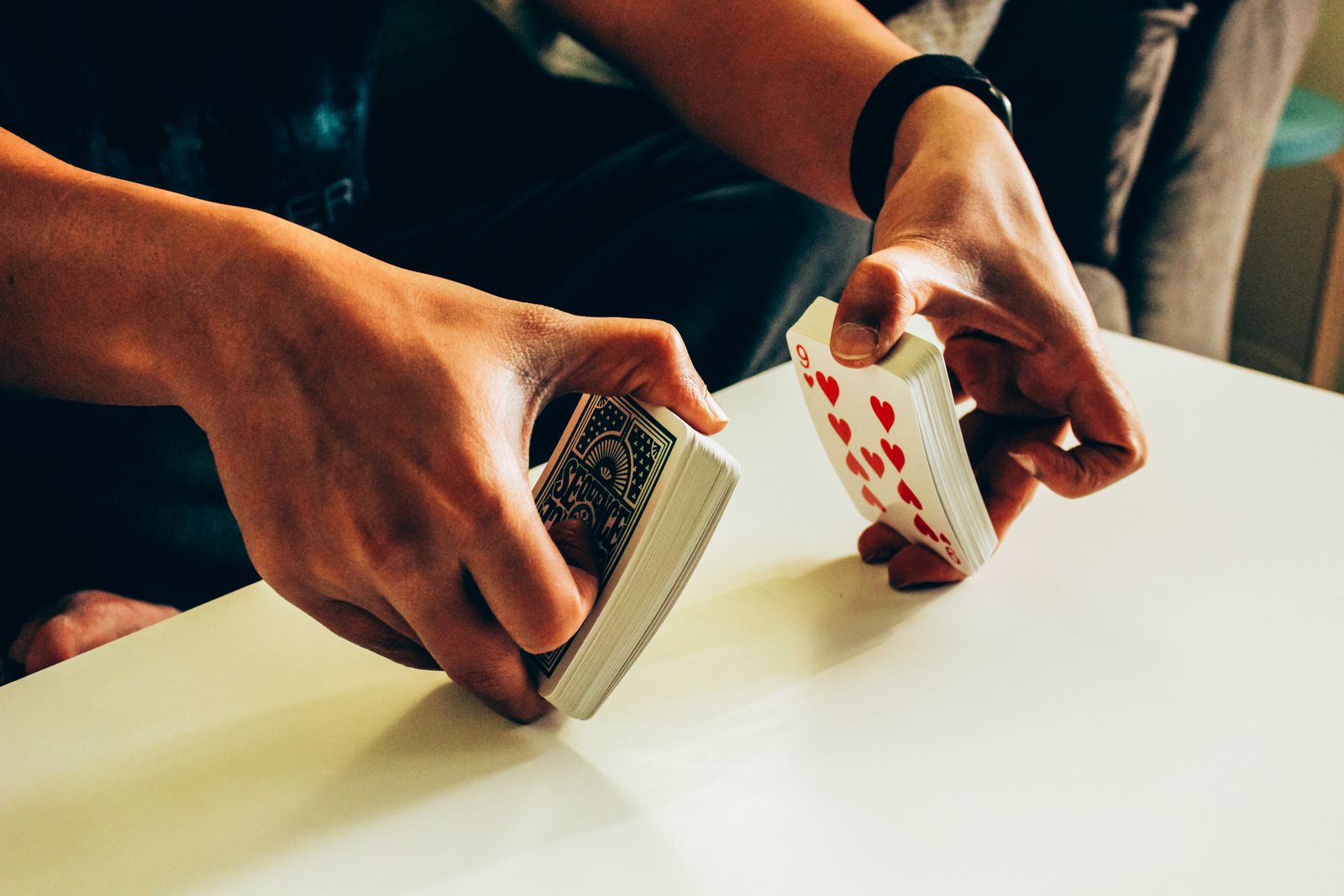
Pick up a deck of cards, give it a proper shuffle, and you have almost certainly just produced an arrangement of those 52 cards that has never existed before, anywhere, in the entire history of the universe. It sounds like an exaggeration. The numbers say it is close to a certainty.
The reason is that the possible orderings of a deck are not just large. They are large on a scale that dwarfs the age of the cosmos itself.
The numbers
The number of ways to arrange 52 cards is 52 factorial, written 52!, which means 52 multiplied by 51, by 50, and so on down to 1. That works out to roughly 8 followed by 67 zeros, about 80,000,000,000,000,000,000,000,000,000,000,000,000,000,000,000,000,000,000,000,000,000,000,000,000,000.
Now compare that to time. The universe has existed for about 13.8 billion years since the Big Bang. Converted to seconds, that is roughly 4 followed by 17 zeros, a vast number in everyday terms, but next to 52! it is nothing. The arrangements of a single deck outnumber the seconds since the beginning of time by a factor of around ten to the fiftieth power.
The number is hard to grasp because factorials explode so fast: each extra card multiplies the total again, and by 52 the result has outrun almost anything you can name. It comfortably exceeds the estimated number of stars in the observable universe, and the grains of sand on every beach on Earth, by enormous margins.
Put another way, you could have every person who has ever lived shuffle a fresh deck once every second, for the whole 13.8 billion years, and the orders they produced would still be an essentially invisible fraction of the total. There is simply not enough time, or matter, in the universe to have worked through them.
Why “almost certainly”
The careful word is “almost.” Nothing forbids two shuffles, somewhere, sometime, from landing on the same order. It is just staggeringly unlikely. Against a pool of 8 with 67 zeros after it, the few billions of shuffles that humans have ever performed are so close to zero that a freshly shuffled deck being new is about as safe a bet as exists. Each honest shuffle is, in all probability, a first.
Why “proper” matters
There is one real condition, and it is the word “proper.”
The claim only holds for a thoroughly randomised deck. A new pack comes in a fixed factory order, identical to every other new pack, so an unshuffled deck is the opposite of unique. And a lazy shuffle barely moves things around, leaving long runs of cards in their old sequence. Mathematicians Persi Diaconis and Dave Bayer worked out that it takes about seven good riffle shuffles to properly randomise a 52-card deck. Do fewer than that and the order is not really random, and could well echo one that has come up before.
Give it those seven shuffles, though, and the result is almost guaranteed to be new.
A very large number in your hands
What makes this strange is how ordinary the object is. A deck of cards is a cheap, familiar thing, and yet it holds more possible configurations than there have been seconds since the universe began, more than enough that no two thorough shuffles in human history have ever needed to repeat.
The next time you shuffle, the arrangement you spread on the table has, in all likelihood, never been seen by anyone, and never will be again. You made it, and the universe had not got around to it in 13.8 billion years of trying. For a few moments on the table, you are holding something entirely original, then it is gone.
