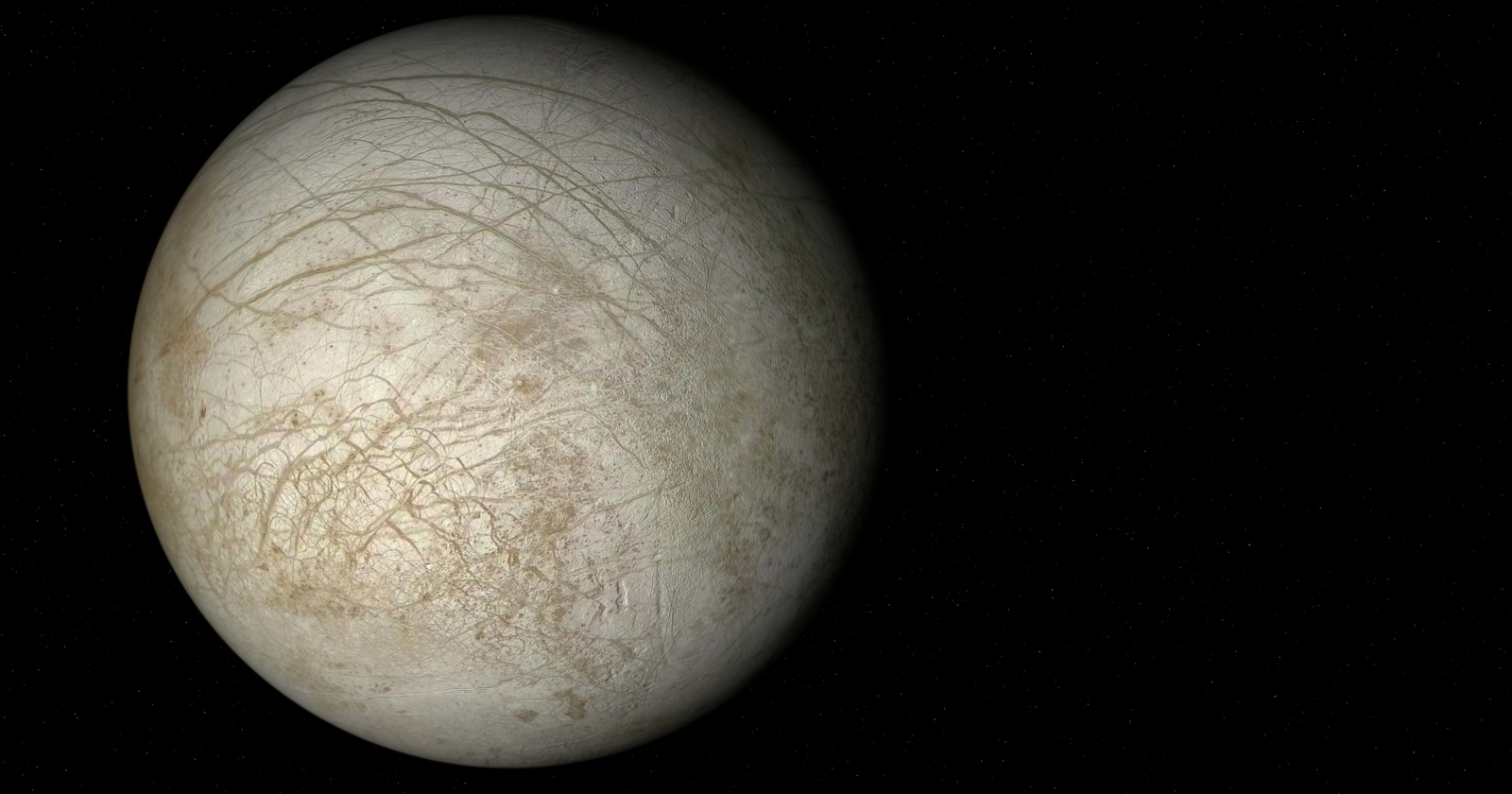
Europa is smaller than Earth’s Moon, but there may be more liquid water inside it than in every terrestrial ocean put together.
That sentence sounds geometrically impossible until you remember how shallow our oceans are. Earth is a large world with a thin, interrupted film of water across part of its surface. Europa is a much smaller world wrapped in what may be a continuous ocean tens of kilometres deep, buried beneath a global roof of ice.
The second surprise is how that ocean remains liquid. At Europa, sunlight is about 25 times weaker than it is at Earth. The surface is cold enough to make Antarctica seem mild. Yet far below that frozen exterior, water may have remained liquid for much of the Solar System’s history.
It is tempting to say Jupiter simply squeezes Europa like a slow, endless fist. That is a useful first image, but the real mechanism is stranger and more elegant. Jupiter supplies the enormous gravitational pull, while two other moons keep Europa from settling into the kind of neat, circular orbit that would eventually turn much of its tidal heater down.
Europa’s ocean may survive because three moons are caught in a rhythm they cannot escape.
A smaller world can still contain a larger ocean
Europa is about 3,100 kilometres across, roughly 90 per cent the diameter of our Moon and only about a quarter the diameter of Earth. But size alone does not determine how much water a world can hold. Depth and coverage matter enormously.
NASA’s comparison of the two ocean worlds gives Earth’s oceans an average depth of about four kilometres and a volume of roughly 1.4 billion cubic kilometres. Europa’s suspected ocean may average about 100 kilometres deep and contain around three billion cubic kilometres of water.
Earth’s continents also interrupt its ocean. Europa’s water layer is thought to encircle the entire moon, sitting between an ice shell above and rock below. A relatively small sphere can therefore carry a very thick global layer, just as a small onion can devote a larger share of its radius to one layer than a much bigger onion does.
Those numbers are estimates, not the result of lowering a measuring line through a hole. No spacecraft has seen Europa’s ocean directly. Models allow a broad range, with NASA commonly describing an ocean 60 to 150 kilometres deep. Even the ice above it remains uncertain. In a previous article on Juno’s estimate of a 29-kilometre ice shell, I looked at why a single, regional measurement should not be mistaken for a finished global map.
Still, the broad conclusion is robust enough to be astonishing. Europa can be smaller than our Moon and yet plausibly possess more than twice Earth’s liquid water because almost its entire hidden geography is ocean.
Jupiter alone would eventually switch much of the heater off
Gravity does not pull equally on every part of a moon. Europa’s Jupiter-facing side is closer to the giant planet than its far side, so it feels a slightly stronger attraction. That difference raises a tide through the entire body, not just through the ocean. Ice bends. Rock deforms. The shape of the moon becomes subtly elongated.
But a permanent bulge is not enough to generate large amounts of heat. Heat comes from change.
Europa is already tidally locked, meaning the same hemisphere always faces Jupiter. If its orbit were also perfectly circular, its distance from Jupiter would stay almost constant. The tidal distortion would be comparatively steady. A world held in one strained shape is not the same as a world being bent, released and bent again.
Natural satellite systems tend to move towards that quieter condition. Tidal friction dissipates orbital energy and generally helps circularise an orbit. Left alone for long enough, Europa should become less eccentric, the amplitude of its changing tides should fall, and a major source of internal heat should weaken.
That is why “Jupiter keeps the ocean liquid” leaves out the most important part of the machinery. Jupiter provides the muscle, but the neighbouring moons prevent Europa from finding rest.
The 4:2:1 resonance is the machine’s timing belt
Io, Europa and Ganymede orbit Jupiter in a relationship known as the Laplace resonance. For every orbit completed by Ganymede, Europa completes two and Io completes four. Their alignments therefore recur with extraordinary regularity.
Each alignment brings small gravitational tugs between the moons. Individually, those tugs are modest beside Jupiter’s pull. Repeated at the same points in their orbits, however, they keep the orbits from becoming perfectly circular. NASA describes the result as a forced eccentricity: the moons continually restore some of the orbital irregularity that tidal dissipation is trying to erase.
Europa circles Jupiter every three and a half days. During each circuit, its slightly elliptical path carries it closer to the planet and then farther away. Jupiter’s tidal pull strengthens and weakens accordingly. Europa’s body stretches more, relaxes, and stretches again.
The fist analogy is therefore incomplete. Jupiter is not steadily compressing Europa from all directions. It is producing a changing difference in gravity across the moon. The near side and far side are pulled unequally, and the strength of that inequality varies as Europa moves through its orbit. The better image is a piece of material being rhythmically kneaded.
The resonance also explains why the Jovian moons are such a natural laboratory. Io receives so much tidal energy that it is the most volcanically active body known. Europa, farther out and rich in water, occupies a less extreme position. Ganymede participates in the rhythm but experiences a different balance again. One clockwork system produces dramatically different worlds.
How repeated bending becomes heat
If you bend a metal paper clip back and forth, it warms near the bend. The comparison is imperfect, but it captures the essential conversion. Real materials are not perfectly elastic. When they deform, some organised mechanical energy is lost through internal friction and emerges as disorganised molecular motion: heat.
On Europa, dissipation may occur in the rocky interior, in the ice shell and possibly within the ocean. How much occurs in each layer depends on quantities scientists do not yet know precisely, including the thickness and viscosity of the ice, the structure of the rock, the depth and salinity of the ocean, and the exact response of each layer to the tidal cycle.
This is not a small cosmetic effect. If an ocean lies beneath the ice, models suggest Europa’s surface could rise and fall by tens of metres during the tidal cycle. A completely frozen body would deform far less. The ocean mechanically decouples the ice shell from the rock below, allowing the exterior to respond more strongly to Jupiter.
Tidal heating is also not the only heat in the system. Radioactive elements in Europa’s rocky interior release energy as they decay, just as they do inside Earth. Salts can lower water’s freezing point. The ice shell itself acts as insulation, slowing the escape of heat to space. Convection may carry warmer ice upward while colder ice descends.
So the accurate version of the claim is not that Jupiter alone prevents every drop from freezing. It is that the resonance-maintained flexing caused by Jupiter is probably a crucial part of Europa’s long-term heat budget, assisted by radiogenic heat, chemistry and the insulating behaviour of the shell.
That distinction matters beyond Europa. As I argued when writing about icy moons and the limits of the traditional habitable zone, a world can be far beyond the reach of sunlight capable of warming a surface sea and still maintain liquid water internally. Habitability can depend on orbital architecture, not just distance from a star.
The ocean was discovered without ever being seen
The strongest evidence for Europa’s ocean came from a magnetic field.
NASA’s Galileo spacecraft made 12 close flybys of Europa while orbiting Jupiter from 1995 to 2003. Its magnetometer found that Jupiter’s changing magnetic field was being disrupted around the moon in a way consistent with an induced field inside Europa. The most plausible conductor is a global layer of salty liquid water.
The surface tells a separate but compatible story. Europa has surprisingly few large impact craters, which suggests that the exterior is geologically young. Long bands cross the ice for thousands of kilometres. Some regions contain fractured blocks that appear to have shifted and rotated before freezing into new positions. Pits, domes and areas of so-called chaos terrain all hint at a shell that has been active over warm material below.
None of those clues alone is a photograph of an ocean. Together, they form a strong inference. That is a pattern across the outer Solar System. In another recent article, I explored the growing list of moons suspected to hide internal oceans. The evidence differs from world to world: magnetic induction at one, plumes at another, rotation or gravity at a third. Ocean worlds are often detected by the secondary effects of water we cannot reach.
Europa may offer one of the clearest examples. We infer the sea from the magnetic response, from the fractured and renewed ice above it, and from the way a layered moon should flex under a changing tide.
The heater may also operate a chemical engine
Liquid water is necessary for life as we know it, but it is not sufficient. An ocean can be vast, ancient and sterile. The more interesting question is whether Europa’s internal machinery can maintain useful chemical gradients.
If tidal and radiogenic heat drive geological activity in the rocky seafloor, water may react with fresh minerals and acquire chemical energy. Hydrothermal systems are possible, but they have not been observed at Europa and should not be treated as established fact. The nature of the seabed, and whether water circulates through it, remain open questions.
At the opposite boundary, Jupiter’s radiation strikes surface ice and breaks molecules apart, producing chemically reactive compounds. In principle, some of that material could be transported downwards through cracks, overturning ice or local melt zones. Mixing surface oxidants with compounds from the rocky interior could create the kind of chemical imbalance that organisms exploit on Earth.
The ice is therefore both protector and obstacle. It shields the ocean from lethal radiation and the vacuum of space. It may also separate the surface chemistry from the water below by tens of kilometres. Whether material moves efficiently through that barrier may be as important to habitability as the total amount of water.
More water does not automatically mean more life. A deep ocean with weak circulation or little contact with rock could be less biologically promising than a smaller, chemically active sea. Europa’s appeal lies in the possible combination of water, energy, time and exchange, not in the water volume alone.
Europa Clipper will measure a moon that breathes
NASA’s Europa Clipper is already on its way. After launching in October 2024 and passing Mars in March 2025, it is due to swing about 3,200 kilometres from Earth in December 2026 for another gravity assist. It should enter orbit around Jupiter in April 2030, with its first Europa flyby expected in 2031.
The spacecraft will not orbit Europa directly. Jupiter’s radiation environment is too punishing for that to be the safest design. Instead, Clipper will loop around Jupiter and make 49 close flybys, repeatedly diving past Europa and then retreating to transmit data and reduce its accumulated radiation exposure.
Its most revealing measurements may come from combining instruments. Radar will probe the structure of the ice. A magnetometer and plasma instrument will separate the ocean’s induced magnetic response from the electrically charged environment around the moon. Spectrometers will map surface chemistry. A thermal camera will search for unusually warm regions.
Gravity science will turn the entire spacecraft into a probe of Europa’s breathing motion. As Clipper flies through the moon’s gravity field at different points in its orbit, researchers will track tiny changes in the radio signal between the spacecraft and Earth. Those Doppler shifts reveal how Europa’s gravity field changes as the moon stretches and relaxes. NASA’s instrument overview explains how these measurements will be layered together to constrain the ocean’s depth and salinity, the thickness of the shell and the locations of possible water pockets within the ice.
According to the current mission timeline, some flybys will pass as low as 25 kilometres above the surface. Clipper is not equipped to detect life. Its task is more fundamental: determine whether Europa contains environments that could support it.
The ocean belongs to an orbit as much as to a moon
The most important thing about Europa’s hidden sea may be that it is not solely a property of Europa.
Its existence depends on the moon’s water inventory and internal structure, but its persistence may also depend on where Europa sits in a system of moving bodies. Jupiter raises the tides. Io and Ganymede help preserve the orbital eccentricity that makes those tides change. Rock, ocean and ice decide where the resulting mechanical energy is dissipated. Salts and an insulating shell help determine how quickly the heat escapes.
Remove one part of that arrangement and Europa’s history could be very different.
This is what makes the moon so much more than a frozen ball with an ocean inside it. Europa is an energy-conversion machine. It takes the precisely repeated geometry of three orbits and turns it into deformation. It turns deformation into heat. That heat helps preserve liquid water in darkness, nearly 800 million kilometres from the Sun.
The phrase “Jupiter squeezes Europa like a fist” captures the violence of the forces involved, but not their delicacy. A fist closes once. Europa’s tide is a rhythm, maintained by neighbouring moons and repeated every orbit across geological time.
Beneath the ice, the result may be the largest accessible reservoir of liquid water in our part of the Solar System. Above it, a spacecraft now crossing interplanetary space is preparing to read an invisible ocean from magnetism, radar echoes and the almost imperceptible rise and fall of an entire world.