
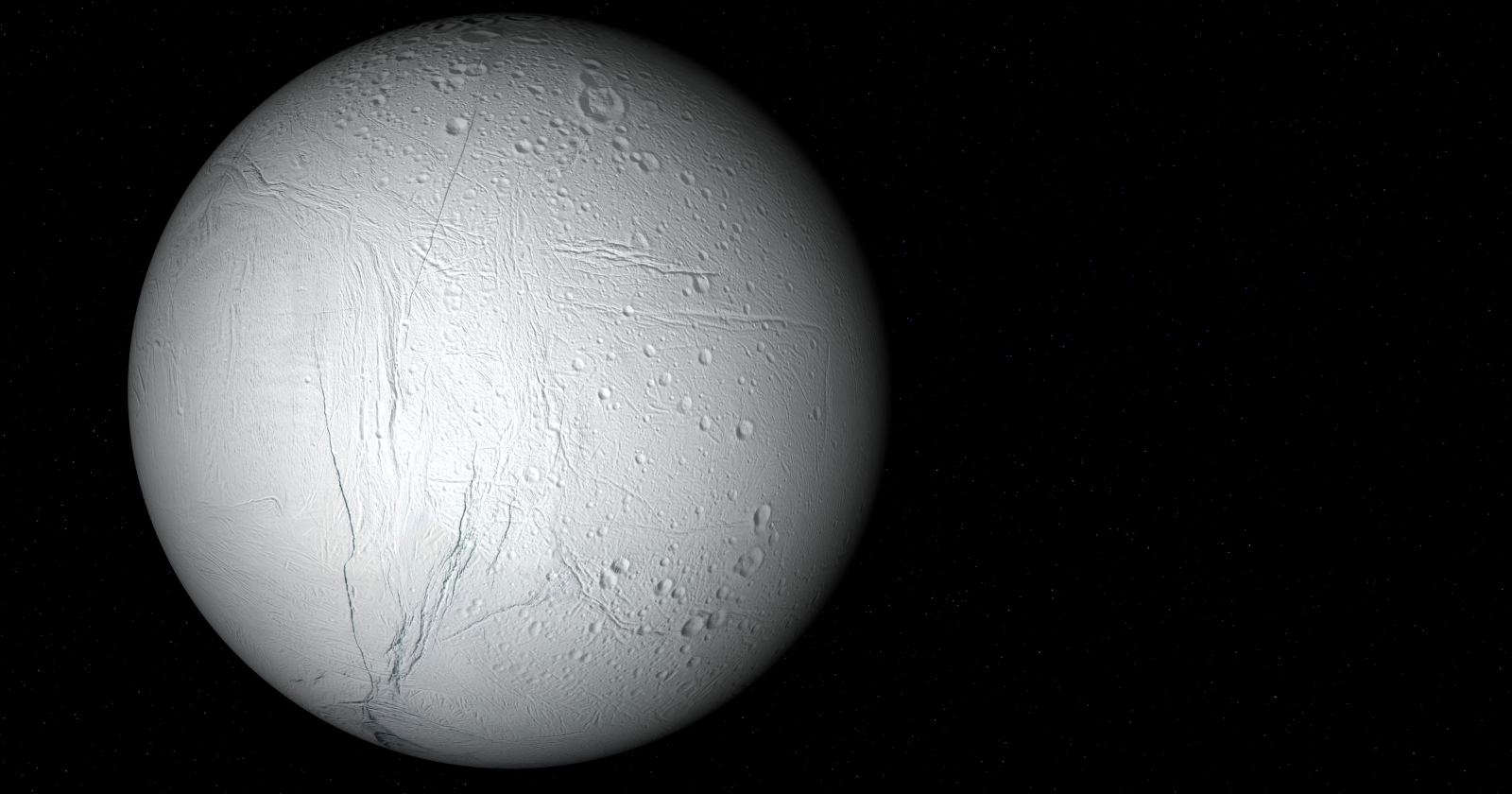
This is accurate, and a spacecraft has already done it. Enceladus, a moon of Saturn only about 500 kilometres across, has a global ocean of liquid water under a shell of ice. Through fractures near its south pole, that ocean vents continuously into space as a plume of water vapour and fine ice grains. Between 2004 and 2017, NASA’s Cassini spacecraft flew through that plume repeatedly and analysed what was in it. It sampled the contents of an ocean it never touched.
What that sampling has and has not shown is worth setting out carefully, because this is a subject where the gap between the finding and the popular reading is wide.
How a moon turns its ocean inside out
Enceladus is small, bright, and covered in ice. Near its south pole, the surface is cut by four long fractures that Cassini scientists nicknamed the tiger stripes. From these fractures, jets of water vapour and ice particles erupt into space, combining into a plume that extends far beyond the moon itself.
The plume does not simply disperse. It feeds one of Saturn’s rings, the faint outer band known as the E ring, which is built largely from Enceladus’s ejected ice. This is the mechanism that makes the moon so unusual as a target. On most worlds, reaching subsurface material means landing, then drilling or digging. Enceladus delivers its subsurface to orbit on its own.
The ice grains and vapour are derived from the ocean, though they are not a literal scoop of seawater. Material is altered as it freezes and travels up through the fractures. The plume is a processed sample, very informative but not untouched, and analyses of it are read with that in mind.
What sampling without landing actually got
The point usually left out of the clean version of this story is that Cassini was not built to do this.
The spacecraft launched in 1997. The Enceladus plume was not discovered until 2005, after Cassini arrived at Saturn and its instruments detected the venting. The two instruments that did the sampling, the Cosmic Dust Analyser and the Ion and Neutral Mass Spectrometer, were general-purpose tools for studying dust and gas around Saturn, not a purpose-built ocean-chemistry laboratory. The most astrobiologically interesting work of the mission came from instruments turned to a job they were not designed for, on a target no one knew was there when the spacecraft was assembled.
What they found, across many plume and E-ring passes, was a subsurface ocean of salty water containing a range of organic compounds. Later analysis of the archived data, reported by NASA in 2023, identified phosphorus in the ice grains, an element essential to life as it is known on Earth and one that had not previously been confirmed there. The ocean appears to be salty, moderately alkaline, and chemically active.
The newest result, and what it does not show
In 2025, a study in Nature Astronomy, by Khawaja and colleagues, added a further piece. The team analysed grains collected during one of Cassini’s fastest flybys, an encounter at nearly 18 kilometres per second in 2008, and identified a wider set of organic compounds than had been seen before.
The high speed mattered. At that velocity, an ice grain striking the detector is vaporised, which is what allows its chemistry to be read, and it also fragments molecules in ways that reveal more of their structure. Just as importantly, the grains were caught fresh, close to the moon, before long exposure to space could alter them. As a NASA summary of the study notes, this gave researchers confidence that the organic compounds came from inside Enceladus rather than from weathering of older particles in the E ring.
Here is where care is needed. Organic compounds are carbon-based molecules. They are common in the solar system, they form readily without biology, and their presence is not a sign of life. What the Enceladus findings establish is a case for habitability: liquid water, an energy source, salts, phosphorus, and a varied organic chemistry are conditions under which life as we understand it could exist. That is a statement about the ocean being a plausible place to look. It is not a detection of anything living. No Cassini instrument was capable of identifying life, and none did. The honest framing is that Enceladus has moved up the list of places worth examining, not that the question has been answered.
What it would take to go further
Cassini is no longer available to do this work. The mission ended in September 2017, when the spacecraft was deliberately flown into Saturn’s atmosphere, partly to ensure it could not one day contaminate Enceladus. Every result now being published comes from re-analysis of data already collected. There is no instrument at Saturn today.
Several mission concepts have been proposed to return to Enceladus, some designed specifically to fly through the plume with instruments built to search for biosignatures rather than to study dust. These are concepts and proposals. None has been funded and scheduled as a confirmed mission, and the distance between a proposed planetary mission and a launched one is measured in decades.
The open question is not whether material from Enceladus’s ocean can be sampled from space. Cassini settled that. It is whether a future spacecraft will carry instruments designed from the start to ask, of that sampled material, the harder question Cassini was never equipped to answer.
