
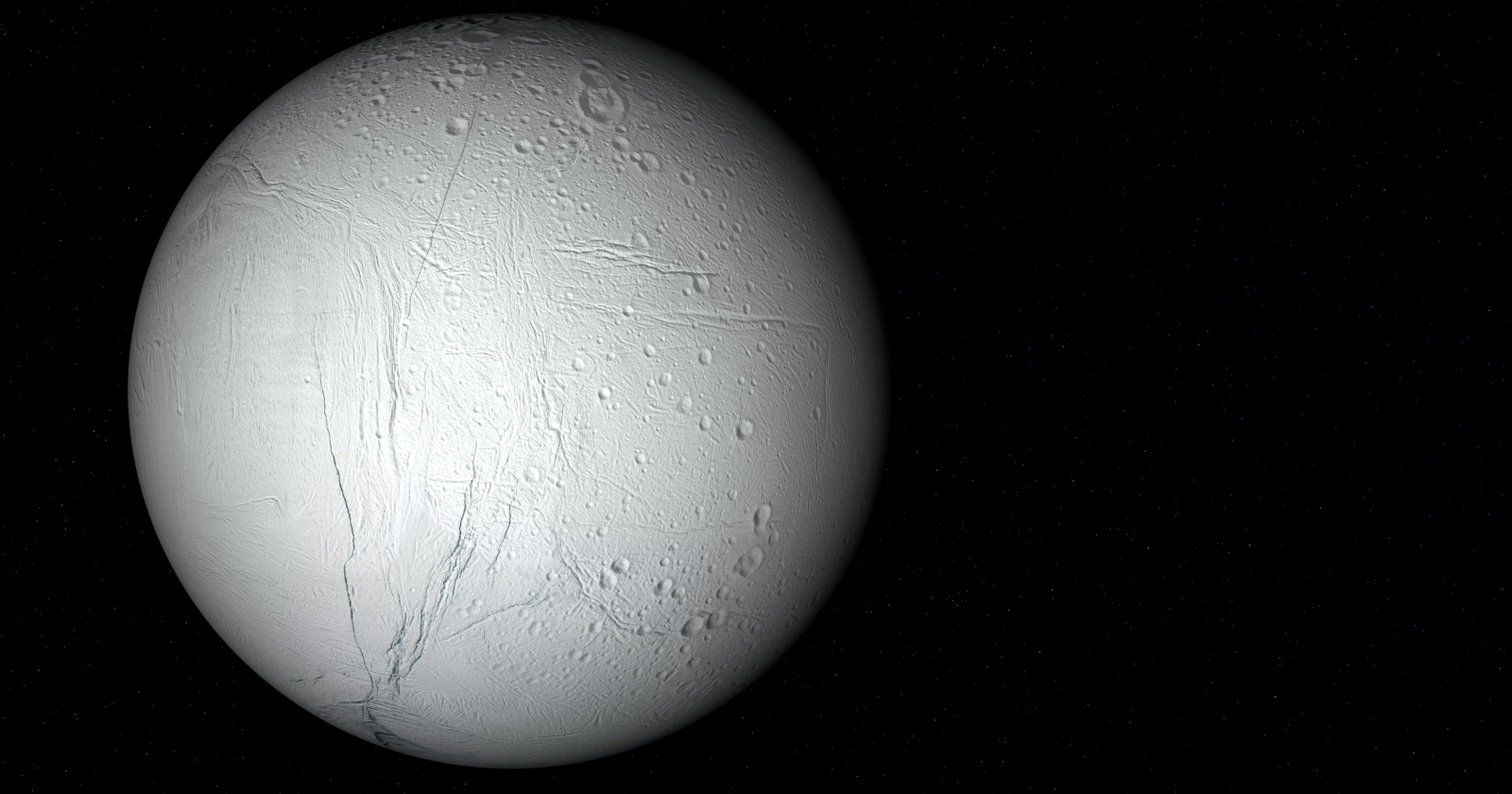
Enceladus is small, only about 500 kilometres across, a moon you could lose among Saturn’s dozens. It is also one of the most interesting places in the solar system to ask whether life could exist beyond Earth. From cracks near its south pole it is constantly spraying water vapour and ice grains into space, drawn from a salty ocean hidden beneath its frozen shell, and the chemistry of that spray has made a real case for the moon being habitable.
Habitable, it is worth saying at the outset, is not the same as inhabited. Nothing living has been found there. What Enceladus has is the conditions.
A moon that leaks
NASA’s Cassini spacecraft discovered the plumes in 2005, jets of vapour and frozen droplets erupting from four warm fractures, nicknamed the tiger stripes, across the moon’s southern terrain. The material feeds one of Saturn’s faint rings and, more usefully, betrays what lies underneath: a global ocean of liquid salt water wrapped around the moon’s rocky core, kept from freezing beneath kilometres of ice.
That arrangement handed scientists an unusual gift. An ocean world that vents its own ocean into space is a world you can sample without landing, and Cassini did exactly that, flying repeatedly through the plume to taste what came out.
The ocean has the ingredients
What the spacecraft found, over a series of passes, reads like a checklist for habitability.
There was salt, and silica, and a range of organic molecules. In 2017, the Cassini team reported molecular hydrogen in the plume, which on Earth is produced where hot rock meets water. Its presence is strong evidence of hydrothermal vents on the ocean floor, the same kind of warm, mineral-rich setting that supports thriving communities of life around Earth’s deep-sea vents, and a potential source of chemical energy.
Then, in 2023, came the ingredient that had been missing. Analysis of Enceladus ice grains revealed phosphates, the first time phosphorus had been detected in an ocean beyond Earth. Phosphorus is one of the elements life as we know it cannot do without, and on Enceladus it appears to be present at concentrations at least a hundred times higher than in Earth’s seawater. Water, energy, and the chemistry of life were now all accounted for.
Warm, and possibly old
The remaining question is time. A pond with the right ingredients is not enough if it freezes solid every few thousand years. For life to have a chance, the ocean would need to have stayed liquid, warm, and chemically active for a very long stretch.
Modelling suggests it could have. Enceladus is squeezed and flexed by Saturn’s gravity as it orbits, and that tidal kneading generates heat, plausibly enough to keep the ocean liquid and the vents running over geological timescales. If those models are right, the ocean has had the kind of long, stable history in which, on Earth, life took hold.
This is the part to hold loosely. How much heat the tides actually supply, and how old and stable the ocean really is, are still debated, and the estimates carry real uncertainty. That the ocean could have lasted long enough for life to emerge is a reasonable inference from the models, not a settled fact, and it is a statement about opportunity rather than about anything actually being there.
Habitable is not inhabited
That distinction is the one worth keeping in view. Everything Cassini found describes a place where life could plausibly survive, not evidence that it does. A warm, salty, chemically rich ocean is a promising address. It is not a tenant.
Confirming whether anything lives in that ocean would take a mission built for the job, flying through the plume with instruments designed to look for the signatures of biology, or landing to sample the fresh snow of ocean spray that falls back onto the surface. Concepts for exactly that kind of mission have been proposed, and Enceladus sits high on the list of places worth the trip. For now, the honest summary is the most interesting one. A tiny moon is handing us samples of a hidden sea that has much of what life needs, and we do not yet know what, if anything, is in it.