

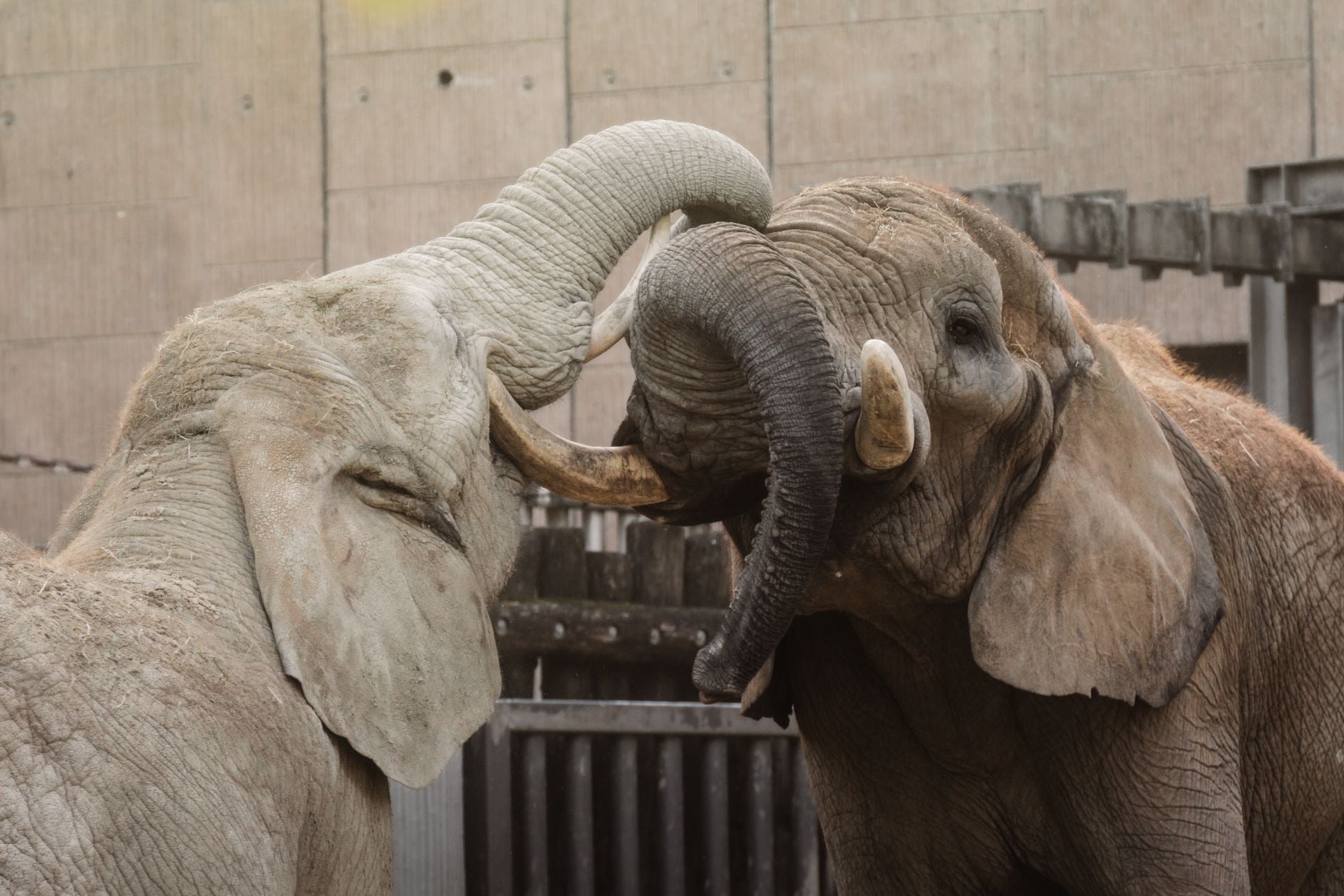
Elephants at play do more than chase, spar and wrestle with their trunks. In a study of African savannah elephants, a player that saw a companion perform a distinctive trunk or head movement became more likely to reproduce that exact movement within the next second.
The researchers call this rapid motor mimicry. Its closest familiar comparison is the way a smile can pull another face into a smile, or one person’s laughter can make others join in before anyone has consciously decided to copy it.
This is one study, not settled consensus. It observed a single captive group in Spain, and its results do not show that elephants laugh, smile or necessarily share a human-like emotional experience. What it documents is narrower: tightly timed matching of bodily play signals.
Five movements and a one-second window
The study, led by Giada Cordoni of the University of Turin and published in Scientific Reports in May 2025, followed 15 African savannah elephants at Parque de la Naturaleza de Cabárceno in Cantabria. The group lived in a 25-hectare outdoor area and included six immature animals, two late adolescents and seven adults.
From 91 hours of footage collected between April and July 2022, the team extracted 30 hours of two-elephant social play covering 188 sessions. Trained coders examined the video frame by frame or in slow motion, achieving what the authors classified as good inter-observer agreement.
They focused on five conspicuous play movements. One was a forward trunk swing towards a partner. Another held the trunk upright in a curved “periscope”. The list also included resting an S-shaped trunk against the forehead in a “circus pose”, flopping the trunk onto the head, and waggling the head from side to side.
When one elephant performed a target movement, it was labelled the trigger. The playmate counted as a responder if it began the same movement within one second. The researchers compared that response with a matched moment in the same session, at least 10 seconds away, when the trigger had not just performed one of the movements.
Copying the same move, not merely moving
The matched comparison is essential. Two excited elephants may move vigorously at the same time because both are already playing. Shared activity alone does not establish mimicry.
Responders were significantly more likely to reproduce the same target movement after seeing it than during the control moment. They were not significantly more likely to perform a different target movement. This specificity supports the interpretation that they were matching the displayed action rather than merely becoming more active.
Only eight elephants had been exposed to at least one target movement in the circumstances required for that core test. The result therefore comes from a small number of individuals, even though the observational dataset covered the full 15-member group. The statistical comparison was exact and within-session, but it does not turn eight animals into a species-wide finding.
Play becomes contagious at two different speeds
The same group had previously been observed for a 2024 study of play contagion. In that analysis, an uninvolved elephant was more likely to begin playing within three minutes after seeing others play than during a matched control period. Contagion occurred mostly within 30 metres and was strongest between animals that affiliated more often.
Rapid motor mimicry operates on a different scale. It happens inside an existing play bout, between current partners, in less than a second. Behavioural contagion describes an observer joining the general activity without necessarily copying its exact movement. One is a near-instant echo inside the game; the other is the game spreading through the group.
The elephants most central in the rapid-mimicry network also tended to be the ones most likely to catch the broader urge to play. The reported correlation was strong, but it cannot reveal what the animals felt. It shows that two forms of behavioural matching were related in this particular group.
The rougher the play, the more useful a signal may become
The copied movements appeared around more offensive forms of play than target movements that went unanswered. The researchers recorded 48 transitions around mimicry events and 108 around movements that were not copied. Mimicry was often preceded and followed by sparring, and was also preceded by chasing.
That pattern suggests a possible function. Fast matching may help partners coordinate vigorous play and signal that a push, chase or trunk slap still belongs to the game. In rough-and-tumble play, the difference between competition and conflict depends partly on both animals continuing to read the exchange in the same way.
This interpretation remains a hypothesis. Mimicry was not associated with longer play sessions, unlike findings reported in some primates and dogs. It may help regulate a difficult moment without extending the whole interaction. The study did not test whether preventing mimicry caused play to break down or aggression to increase.
The comparison with contagious smiles and laughter
In humans, rapid facial matching can begin within fractions of a second. Smiles recruit facial responses, while hearing or seeing laughter can elicit laughter and smiling in an observer. An independent experimental study of human participants found that audio-visual laughter was the most reliable trigger, with sound particularly important for laughter contagion.
Comparable rapid matching of play faces has been described in great apes, monkeys, dogs, meerkats and sun bears. Across those species, researchers usually study an open-mouth play face. Elephants present a different anatomical problem.
The elephant trunk combines the nose and upper lip, and its motor control is connected with other parts of the face. An open mouth is not a clean play-only signal because elephants also use it during vocalisation and conflict. Cordoni’s team therefore examined trunk and head movements that function as recognisable markers of elephant play.
The resemblance to contagious laughter lies in the rapid matching and possible coordinating role, not in the outward expression. A raised trunk is not an elephant smile. Nor does a shared timing threshold prove that the underlying neural process or felt emotion is identical across species.
No detectable age, sex or friendship effect
The researchers tested whether the ages and sexes of the two players, their level of affiliation or the duration of the session predicted mimicry. None of those factors produced a detectable effect in the model.
That absence should not be overread. The animals had lived together for nearly a decade, so high familiarity may have concealed social differences. The number of relevant events and individuals was also limited. A larger population might reveal effects that this dataset could not resolve.
The lack of an age effect is nevertheless worth noticing because elephant play does not stop with juveniles. Adults in this group also played, giving rapid bodily matching a possible role across a much wider part of life than the word “play” sometimes implies.
Sequence is not the same as inner experience
Frame-by-frame observation can establish sequence, but it cannot directly establish intention or feeling. The elephants may have copied automatically, anticipated a familiar partner, reacted to a shared cue or used a learned convention. The matched-control method makes simple coincidence less likely, but a one-second threshold remains an operational definition rather than a window into an elephant’s subjective experience.
The study also involved one captive group of one elephant species. Wild populations face different space, social choices and risks. Replication in other captive groups, wild African elephants and Asian elephants would show whether the pattern is widespread.
The most defensible conclusion is still a meaningful one. During play, elephants can become bodily responsive to one another on a sub-second timescale. A gesture made by one animal does not merely carry information across the gap. It can reappear almost immediately in the moving body of its partner, helping two very large animals keep the same game going.