

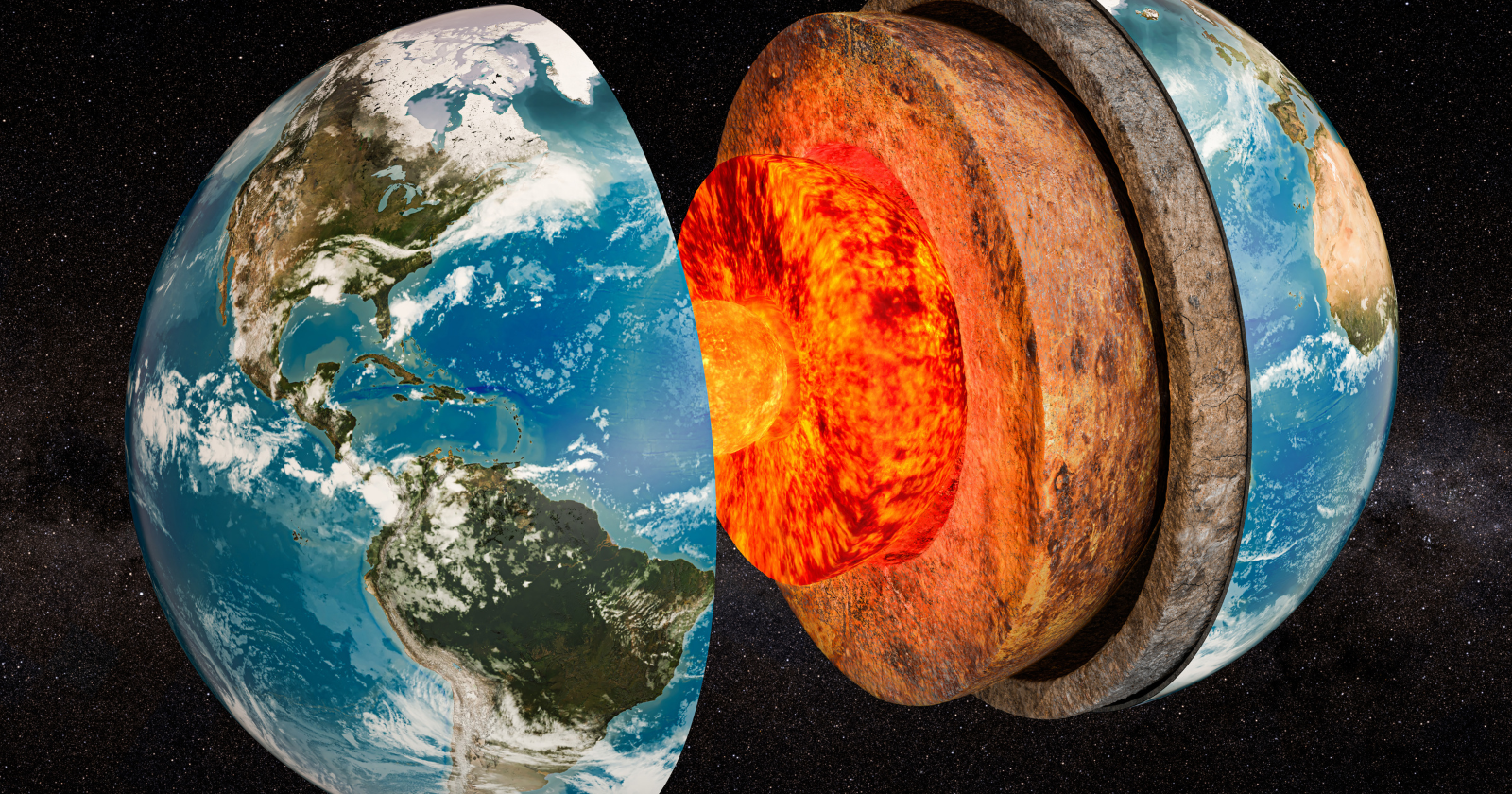
Earth’s centre sounds like a contradiction. The inner core is hot enough to sit in the same temperature range as the visible surface of the Sun, yet it is not a liquid ocean. It is a solid, iron-rich sphere buried under the weight of the rest of the planet.
That statement is not based on a sample. No drill has come close to the core, and no piece of it has ever been brought to the surface. The evidence comes from seismology, mineral physics, and high-pressure experiments that try to recreate a tiny fraction of core conditions in the laboratory.
The standard starting point is the Preliminary Reference Earth Model published by Adam Dziewonski and Don Anderson in 1981. PREM places the boundary between the liquid outer core and the solid inner core about 5,150 kilometres below the surface, with the inner core extending another roughly 1,220 kilometres to the centre of Earth.
Above it is the outer core, a shell of liquid iron-rich metal. Below it is the inner core, made mostly of solid iron alloy. The boundary between the two is one of the most extreme phase changes in the planet: metal on one side flows, while metal on the other side holds together as a solid.
A temperature that sounds impossible
The Sun comparison is useful because it gives a human scale to an otherwise abstract number. NASA’s solar fact sheet lists the Sun’s effective temperature at about 5,772 kelvin. Estimates for the temperature near Earth’s inner-core boundary sit in broadly the same range, though the exact number is still debated.
One influential calculation by Dario Alfe, Michael Gillan, and Geoffrey Price used ab initio simulations and seismic constraints to estimate the core’s composition and temperature. Their 2002 Earth and Planetary Science Letters paper placed the temperature at the inner-core boundary in the range of roughly 5,400 to 5,700 kelvin.
Later laboratory work pushed the possible melting point higher. A 2013 Science paper led by Simone Anzellini used fast X-ray diffraction at extreme pressure and reported an iron melting temperature of about 6,230 kelvin, with a large uncertainty, at conditions close to the inner-core boundary.
Those figures do not mean geophysicists know the inner core’s temperature to the last degree. They mean the correct scale is thousands of kelvin, not hundreds. The deep core is a place where everyday intuition about hot and solid stops working.
Why hot iron can still be solid
At the surface, pure iron melts at about 1,811 kelvin, or 1,538 degrees Celsius. If the inner core’s iron-rich material were sitting at ordinary pressure, temperatures of five or six thousand kelvin would not leave it as a neat solid ball.
The difference is pressure. Near the inner-core boundary, pressure is roughly 330 gigapascals, or more than three million times atmospheric pressure. Under that load, iron atoms are forced so close together that the melting curve shifts upward. In plain language, pressure raises the temperature at which iron-rich metal can remain solid.
This is the heart of the paradox. The inner core is not solid because it is cool. It is solid because the melting temperature of iron alloy under core pressure is even higher than the local temperature. Move the same material to the surface without changing its heat, and it would not behave like a cold metal sphere at all.
The outer core is liquid for the same reason in reverse. Its pressure is lower, its composition differs, and its temperature sits on the liquid side of the relevant melting boundary. Earth therefore contains a liquid metal shell wrapped around a solid metal centre, not because one is simply hot and one is simply cold, but because pressure, temperature, and composition all meet differently with depth.
Not pure iron, and not rock
The phrase iron-rich matters. The core is not thought to be pure iron. It likely includes nickel and lighter elements such as oxygen, silicon, sulfur, carbon, or hydrogen in some combination. A 2014 PNAS study by James Badro, Alexander Cote, and John Brodholt modelled core compositions that match seismic constraints by treating Earth’s core as iron alloyed with nickel and lighter elements.
That uncertainty is not a small footnote. Light elements change density, sound speed, freezing behaviour, and how the liquid outer core convects. A core made of absolutely pure iron would not match the density inferred from seismic observations, so the inner core is better described as iron-rich metal than as a perfect iron sphere.
It is also not rock. The mantle above the core is mostly silicate rock, but the core is metallic. That separation is a record of early Earth, when dense metal sank inward and lighter rocky material remained above. The planet’s centre is more like an immense high-pressure alloy than a hidden version of the crust.
How scientists know it is solid
Earthquakes are the closest thing we have to a planetary scan. Different seismic waves move through solids and liquids in different ways. Some wave types cannot cross a liquid, while others bend, reflect, or speed up as they pass through boundaries between materials.
The layered structure of Earth came from that global pattern of arrivals. Seismologists learned that the outer core must be liquid because it blocks shear waves, while other wave paths reveal a distinct central region. The inner core’s existence was first inferred by Inge Lehmann in 1936, and later models refined its size, density, and seismic behaviour.
The evidence has become more detailed, but not simpler. The inner core appears to have anisotropy, meaning seismic waves can travel differently depending on direction. Studies have also explored hemispherical differences, possible texture in the solid metal, and changes near the boundary with the liquid outer core. The textbook diagram is a useful simplification, not the whole object.
A pressure experiment the size of a planet
Laboratories can squeeze microscopic samples of iron between diamonds or shock-compress them with lasers, but Earth performs the real experiment continuously. Gravity piles thousands of kilometres of rock and metal above the centre. That pressure changes what counts as solid, liquid, and meltable.
This is why the inner core can be described as both Sun-hot and solid without contradiction. Temperature alone does not decide the state of matter. Pressure can move the boundary, and at Earth’s centre the boundary has been moved to an extraordinary place.
The result is one of the strangest ordinary facts about the planet. Beneath our feet is an iron-rich ball under such crushing pressure that heat comparable to the Sun’s surface is not enough to melt it. The inner core is not defying physics. It is showing what physics looks like when the entire Earth is pressing down.