
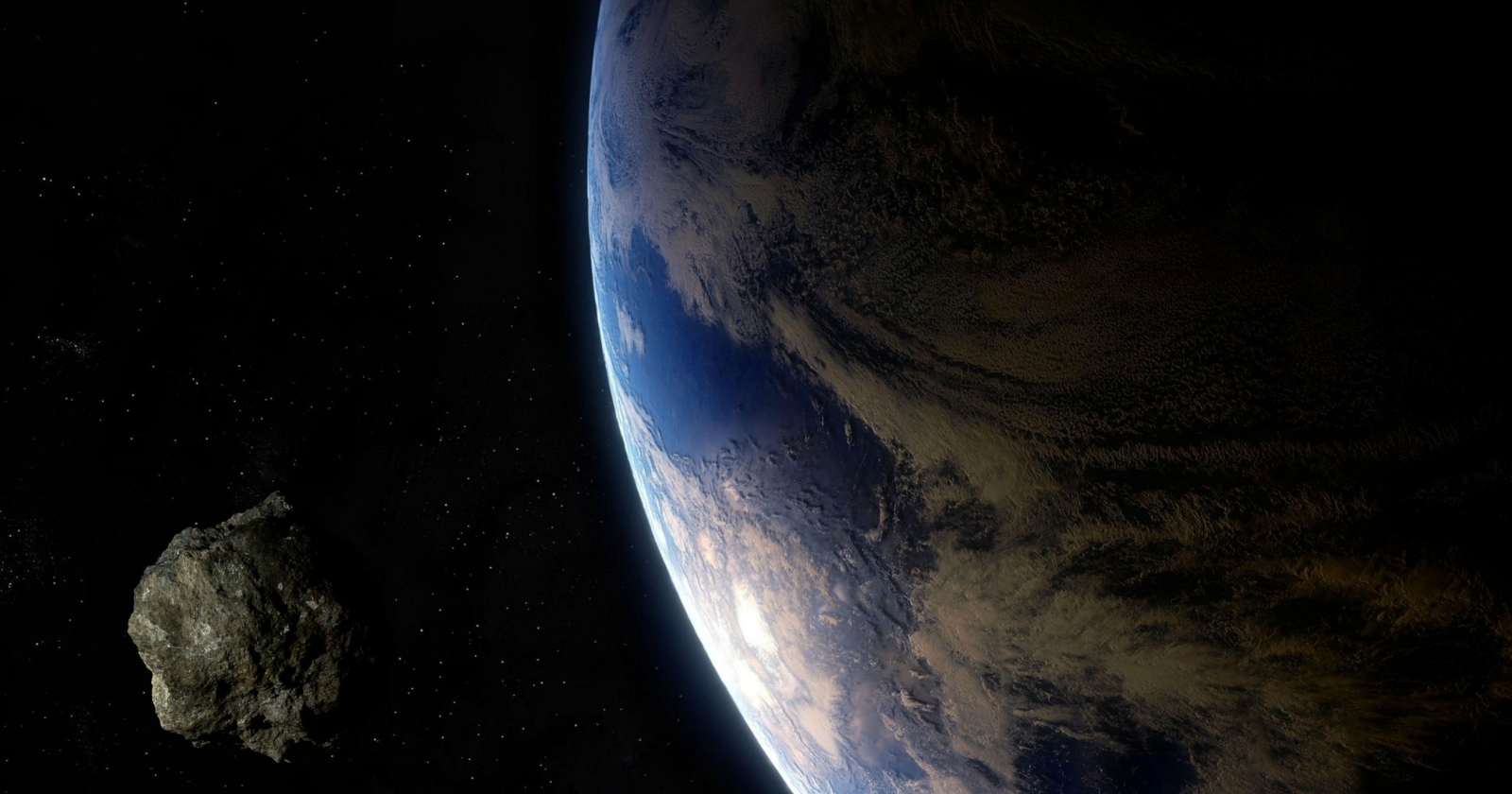
Every so often, Earth picks up a second moon. Not the kind anyone notices, and never for long. A small asteroid drifting through the inner solar system passes close enough and slowly enough to be briefly caught by Earth’s gravity, sometimes looping around the planet and sometimes only lingering nearby, before slipping free again to resume its orbit around the Sun. Astronomers call these objects minimoons, and on the available evidence the planet has hosted a great many of them.
The catch, in every sense, is their size. These are rocks measured in metres, not the 3,475-kilometre Moon, and most are far too faint to see without a serious telescope.
The ones we have actually caught
Researchers divide minimoons into two kinds. A temporarily captured orbiter completes at least one full loop around Earth and can stay bound for months or years. A temporarily captured flyby never finishes a single revolution, lingering for days, weeks or a couple of months before leaving.
Only two long captures have ever been confirmed. The asteroid 2006 RH120, a few metres across, was gravitationally bound to Earth for about a year from mid-2006, completing roughly four loops, and 2020 CD3, somewhere between the size of a cow and a small car, was bound for at least two and a half years before escaping in 2020. Both were found by the Catalina Sky Survey, and 2020 CD3 was only recognised as a captured object by the Minor Planet Centre after the fact.
The briefer flybys are a little more common in the records. The asteroid 1991 VG swung past in 1992, 2022 NX1 was bound in both 1981 and 2022, and in late 2024 a rock called 2024 PT5, somewhere between about 5 and 10 metres across, lingered near the planet from late September to late November without completing an orbit before drifting off. As the mini-moon specialist Carlos de la Fuente Marcos has explained, for capture to happen an object generally has to approach within about 4.5 million kilometres and travel slowly, around 3,500 kilometres per hour, so that its energy relative to Earth tips briefly negative.
How common they really are
Here the honest answer is that the confirmed handful badly understates the true number. Modelling of the near-Earth object population suggests minimoons should be arriving and leaving more or less continuously.
The astronomer Robert Jedicke has put it as roughly one dishwasher-sized minimoon orbiting the Earth-Moon system at any given time, with larger ones much rarer and smaller ones more numerous still. The reason the count of confirmed objects is so small is not that captures are rare but that the objects are tiny, dim and fast-moving against the sky, so almost all of them come and go undetected. The population is, for now, more inferred than observed.
What counts, and what does not
It is worth being precise about the word, because several different things get filed under “second moon” in popular coverage.
Some temporarily captured objects are not natural at all. Spent rocket stages from past missions wander the same near-Earth space, and at least one apparent minimoon, catalogued in 2002, turned out to be a discarded Apollo-era booster. Separately, objects such as 469219 Kamoʻoalewa are sometimes called second moons, but they are quasi-satellites, co-orbiting the Sun in step with Earth rather than being gravitationally bound to it, which is a different arrangement. And intriguingly, both Kamoʻoalewa and 2024 PT5 may be fragments thrown off the Moon by ancient impacts, which would make some of these visitors pieces of our existing moon rather than strangers.
What to watch
The gap between the modelled population and the observed one is about to narrow. New wide-field surveys, the Vera C. Rubin Observatory chief among them, are expected to be sensitive enough to catch these faint, fast objects routinely, which would turn minimoons from a rarely glimpsed curiosity into a steadily growing catalogue.
That matters beyond bookkeeping. A small rock already moving slowly in Earth’s neighbourhood is among the easiest targets in the solar system to reach, which makes minimoons plausible candidates for cheap robotic visits or sample return. The thing to watch is whether the next few years of survey data confirm the prediction that there is almost always a small second moon overhead, waiting to be noticed.
