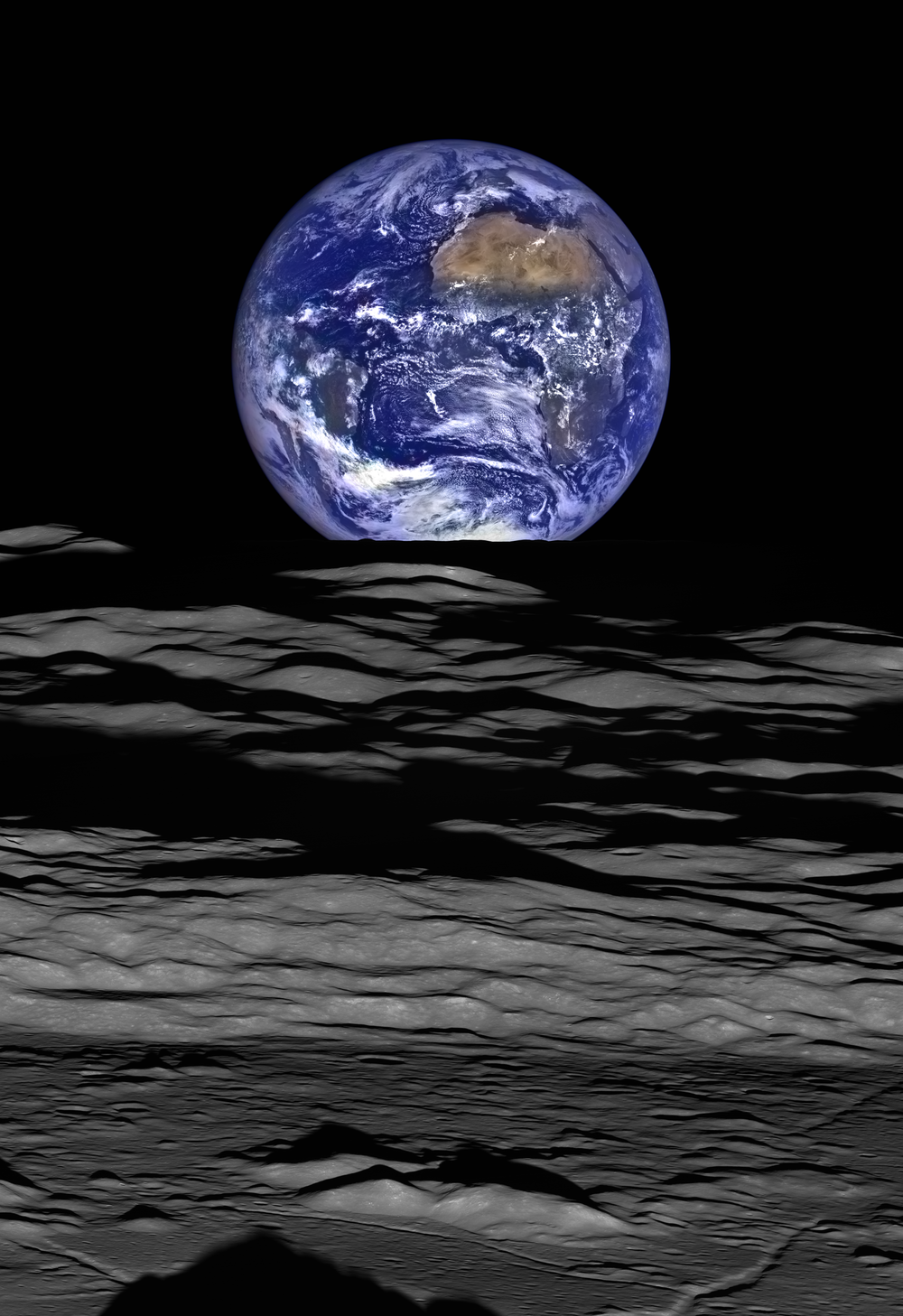
We built clocks around the day and then quietly began treating the day as though it were a clock.
It is not. Earth’s rotation has changed throughout its history, and two studies published in 2023 argued that the change may once have paused for roughly a billion years. During part of the Proterozoic eon, they found, a solar day appears to have remained close to 19 or 19.5 hours.
The proposed mechanism is a balance between two tides. The Moon raised tides in the oceans that slowed Earth’s spin. Solar heating raised a tide in the atmosphere that, under the right resonant conditions, could speed the spin up. For an immense interval, the two torques may have nearly cancelled.
It is a beautiful idea. It is also a reconstruction assembled from sparse rocks and climate models, not a billion-year clock record. That qualification does not make the idea less interesting. It tells us where the wonder actually is: deep time has left just enough evidence for Earth to remember the length of its own day, but not enough to remove every doubt.
The Moon has been lengthening the day
The Moon does not merely lift the ocean and let it fall. Because Earth rotates faster than the Moon travels around it, the oceanic tidal bulges are carried slightly ahead of the Moon. The Moon’s gravity pulls backwards on those displaced bulges, applying a braking torque to Earth.
Angular momentum is transferred to the Moon’s orbit, pushing the satellite outwards. NASA puts the present recession at about 3.78 centimetres per year. Lunar laser ranging measures that modern rate directly.
I recently wrote about Titan moving away from Saturn far faster than older models predicted. The systems differ, but the shared principle is useful: a moon’s orbit and its planet’s rotation exchange angular momentum through tides.
The modern lunar recession rate cannot simply be projected backwards unchanged. Ocean depths, continental positions and seafloor shape alter how efficiently tides dissipate energy. Deep-time rotation is a history, not one rate multiplied by four billion years.
The Sun can create a tide without lifting the ocean
NASA’s explanation of ordinary tides notes that the Sun also exerts a gravitational tide. The proposed 19-hour mechanism involves something different: a thermal atmospheric tide.
Sunlight heats the atmosphere unevenly as Earth rotates. That daily heating launches global pressure waves, including a strong component that cycles twice per day. The atmosphere has natural oscillation periods, much as a bell has tones at which it responds most strongly.
If half of Earth’s day approached one of those natural atmospheric periods, the solar heating could drive a resonance. The pressure bulges would grow larger and, because of their phase relative to the Sun, the Sun’s gravity could apply a torque that accelerated Earth’s rotation.
So the phrase “solar heating pulled one way” is useful shorthand, but heat itself was not grabbing the planet. Heating organised atmospheric mass into a travelling tide; the Sun’s gravity acting on that tide supplied the opposing torque.
Two studies found versions of the same pause
Ross Mitchell and Uwe Kirscher compiled geological estimates of ancient day length and applied statistical change-point analysis. Their 2023 study in Nature Geoscience found an apparent plateau near 19 hours between about two billion and one billion years ago.
A separate team led by Hanbo Wu used global circulation models, geological constraints and a dynamical model of the Earth-Moon system. Their Science Advances study favoured a roughly 19.5-hour day between about 2.2 billion and 600 million years ago.
Those are not identical time windows. One is roughly a billion years; the other is closer to 1.6 billion. Their agreement is the broad proposal that day length stalled near 19 hours during the Proterozoic. Their differences are a warning against turning that proposal into an exact timetable.
I wrote about a very different planetary clock in my article on JPL teams living by the 24-hour, 39-minute Martian sol. Mars time feels strange because our bodies and institutions are built around 24 hours. The Proterozoic result is stranger: even Earth’s familiar period may be a late chapter rather than a default.
Rocks can preserve a clock, but not a perfect one
No one measures a Precambrian day directly. Researchers infer it from geological rhythms. Tidal rhythmites can preserve repeated layers deposited by changing currents. Growth bands in stromatolites may record daily and seasonal cycles. Cyclostratigraphy identifies sedimentary patterns linked to changes in Earth’s orbit and precession.
A 2024 cyclostratigraphic study of Mesoproterozoic sediments illustrates both the power and difficulty of the method. Orbital cycles written into layers can constrain Earth-Moon dynamics, but interpreting them depends on dating, sedimentation rates and recognising which periodic signal a rock actually contains.
Some apparent daily layers may be missing, merged or misidentified. The record is sparse, and a few points carry disproportionate weight. A 2024 review of the locking hypothesis argued that important length-of-day estimates rely on uncertain stromatolite data and that newer atmospheric models may not produce a thermal tide strong enough to cancel lunar braking.
This is not a minor footnote. The 19-hour plateau is a serious published interpretation, but it is contested. “May have stalled” is currently more defensible than “stalled”.
The pause overlaps a quiet chapter in life’s history
The proposed plateau overlaps much of the interval informally called the Boring Billion, when oxygen levels, climate and biological evolution are often described as relatively stable. Mitchell and Kirscher noted the coincidence, and earlier work proposed a possible connection between day length and oxygenation.
Longer days can change the duration of light and darkness available to photosynthetic microbial mats. A 2021 Nature Geoscience study explored how longer daylight could allow more oxygen to escape from such mats into the water.
But overlap is not causation. In my earlier article on cyanobacteria and the Great Oxidation Event, the important lesson was how many chemical, biological and geological feedbacks sit behind a simple atmospheric number. A 19-hour day may have influenced those systems without being the switch that controlled them.
Why the balance ended is part of the uncertainty
A resonance is not permanent. The atmosphere’s natural period depends on temperature, composition and structure. Solar luminosity changed. Earth’s climate and atmospheric pressure changed. Continents rearranged the oceans and altered lunar tidal dissipation.
Any of those changes could move the atmospheric tide away from resonance or weaken its torque. Once the near-balance failed, lunar braking could dominate again and the day could resume lengthening towards 24 hours.
Calling this a tug-of-war makes the mechanism vivid, but there was no rope, no conscious contest and perhaps no clean moment when one side “won”. There were two transfers of angular momentum whose strengths depended on a planet that was itself continually changing.
That is the version I find most persuasive to hold lightly. Earth’s day may have remained near 19 hours for an interval longer than complex animals have existed, because sunlight organised the air in just the right rhythm to counter the Moon’s pull on the sea. The evidence is suggestive, the mechanism is physically plausible, and neither is final.
Twenty-four hours feels inevitable only because every human life has happened inside it. The rocks suggest it may instead be what remained after an ancient balance broke.