
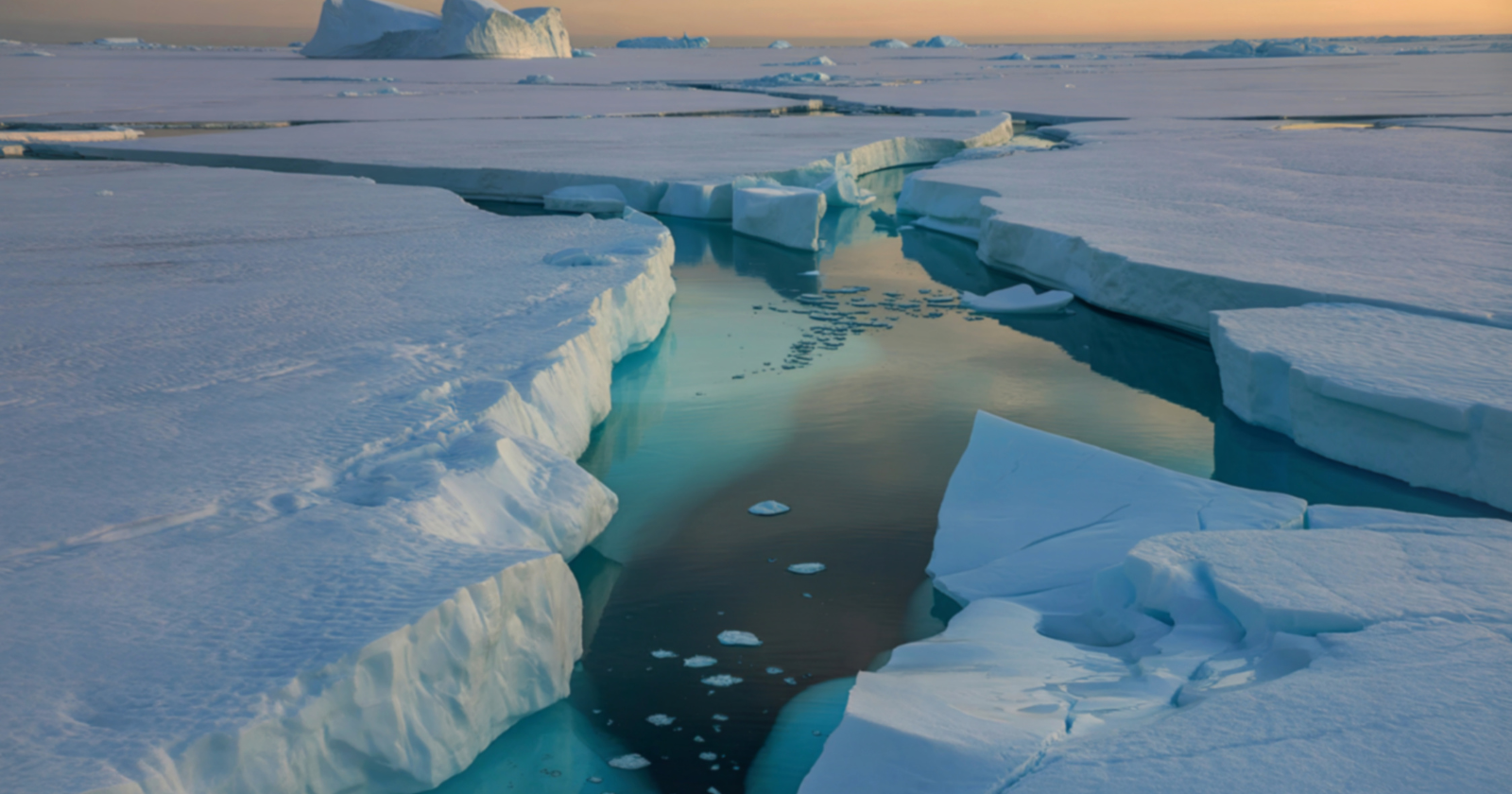
When snow falls on the interior of Antarctica, it does not melt. It piles up, year on year, and the weight of each new layer presses the layers below into ice. As that happens, something useful is trapped. Air fills the spaces between snowflakes, and as the snow compacts into solid ice, that air is sealed off into tiny bubbles.
Each bubble is a small, dated sample of ancient atmosphere, sealed into the ice after the snow had been buried deeply enough for the open spaces to close. Drill a long cylinder of ice from the right place in Antarctica, and you recover a stacked sequence of those samples, oldest at the bottom, most recent near the top. The bubbles can be crushed open in a laboratory and the gas inside measured directly.
This is the basis of ice core science. The air in the bubbles is not a proxy or a reconstruction. It is the actual ancient atmosphere, kept intact, carrying its original carbon dioxide and methane. It is a sample of a world no living person has breathed.
How far back the record goes
It is worth being precise about the timescales, because two different numbers get used and they are not the same.
The benchmark for a long, continuous record, layers in unbroken order, came from a core drilled at Dome C in East Antarctica, completed in 2004. It reached back about 800,000 years. For two decades that 800,000-year mark was the standard.
That record is now being extended. The Beyond EPICA project, a European effort drilling at a site called Little Dome C, has recovered a core that its team reports carries a continuous climate and atmosphere record back at least 1.2 million years. The deepest ice from that project is still being analysed.
Separately, and this is where care is needed, much older ice has been found. In the Allan Hills region of Antarctica, researchers have recovered ice dated to several million years old, with samples reported in 2025 at around 6 million years. But that ice is not a continuous record. It is old ice brought near the surface by the way the ice sheet flows, with layers disturbed and gaps in time. It gives isolated snapshots of very ancient air, not an unbroken sequence. The 1.2-million-year figure and the 6-million-year figure answer different questions: one is the longest continuous record, the other is the oldest ice located at all.
Why the ice and the air are different ages
There is a subtlety in the bubbles themselves that matters for reading the record honestly.
The air sealed in a layer of ice is always somewhat younger than the ice around it. The reason is the way snow turns to ice. For a long time, decades to centuries, the upper layer of compacted snow stays porous, and air moves through it and mixes. The bubbles do not fully close off until the snow has been buried deep enough to seal. So the ice records the date the snow fell, and the trapped air records a somewhat later date, when the bubbles finally closed.
This gap is well understood and scientists correct for it, but it is a real feature of the record, not a flaw in it. It is part of why ice core work is careful, technical, and slow.
What the bubbles have shown
The central result from ice cores is a direct measurement of how the atmosphere has changed.
Across the 800,000-year record, the cores show carbon dioxide and methane rising and falling in step with the planet’s cycles of glacial and warm periods. Greenhouse gas levels and temperature move together, repeatedly, over hundreds of thousands of years. This is measured from the trapped gas itself, not inferred indirectly, which is part of why the ice core record carries the weight it does in climate science.
The cores also provide a baseline. They show the range that atmospheric carbon dioxide moved within across hundreds of thousands of years of natural cycles. Present-day carbon dioxide levels sit well outside that range. The ice does not argue a case. It simply records what the numbers were, and lets the comparison be made.
The push to drill older ice is aimed at a specific open question. Roughly a million years ago, the planet’s glacial cycles changed rhythm, shifting from a roughly 41,000-year beat to a roughly 100,000-year one. Why that happened is not settled. A continuous record of greenhouse gases through that transition, which is what the Beyond EPICA core is meant to provide, is one of the few ways to test the competing explanations.
A physical archive
What makes ice cores unusual, in the end, is how direct they are. Most of what is known about ancient climate is reconstructed indirectly, from chemical traces in rock or sediment or shells, signals that have to be interpreted. An ice core bubble is not a signal to interpret. It is a held sample of old air.
The oldest continuous records reach back more than a million years, and the oldest ice located so far reaches back several million. In both cases the same plain fact applies. Sealed in the ice is air that last touched the open sky before there were modern humans to breathe it, and it can be opened, now, in a laboratory, and measured.
