

“Dark star” is one of astronomy’s more misleading names. The hypothetical object would not be dark. A supermassive example could shine as brightly as billions of Suns and remain visible to the James Webb Space Telescope across more than 13 billion years.
Nor would it be made mostly of dark matter. The star would consist almost entirely of the same primordial hydrogen and helium available to the universe’s first stars. A minute quantity of annihilating dark matter would provide the heat that holds it up.
That change of power source produces the strange possibility in the title. Instead of becoming compact, fiercely hot and self-limiting, a dark star could remain enormously swollen. Its surface would be cool enough to avoid flooding its surroundings with the most destructive ionising radiation. Gas could keep falling in, taking the star from an ordinary stellar mass towards 100,000 or even more than one million Suns.
If such an object finally collapsed, the black hole left behind would not need to begin life with ten or 100 solar masses. It could be born as an enormous “seed”, already much closer to the supermassive black holes Webb is finding unexpectedly early in cosmic history.
The first fusion stars lived fast
The standard comparison is Population III, the name astronomers give the first generation of stars. They formed before earlier stars had enriched the gas with carbon, oxygen, iron and other elements. Their raw material was overwhelmingly hydrogen and helium, with a trace of lithium from the Big Bang.
No Population III star has been confirmed. Models nevertheless agree on the central difficulty faced by a very massive one. Greater mass squeezes and heats the core, accelerating fusion. NASA’s guide to the first stars notes that a 100-solar-mass example could have a surface temperature near 100,000 kelvins, radiate with the power of a million Suns and die within a few million years.
These stars did more than consume their fuel quickly. Their ultraviolet radiation ionised the surrounding hydrogen, heated it and drove feedback into the gas cloud. Accretion onto a growing star depends on cold material continuing to fall inward. A hot expanding bubble works against that inflow.
This is why “the first stars were massive” does not automatically mean they could reach a million solar masses. Fusion-powered Population III stars were brilliant engines whose own radiation changed the reservoir feeding them. SpaceDaily’s earlier account of the hunt for first-born stars described the hot, blue-white spectra astronomers expect and the extreme gravitational magnification that may be needed to see an individual example.
A dark star would be ordinary matter with an unusual heater
The dark-star idea grew from work by Douglas Spolyar, Katherine Freese and Paolo Gondolo, who asked what dark matter would do inside the first collapsing star-forming haloes. Their 2008 Physical Review Letters paper identified conditions under which annihilation heating could overtake the gas’s normal cooling processes.
The mechanism requires a particular kind of dark matter. In the classic model, weakly interacting massive particles, or WIMPs, are their own antiparticles. Two that meet can annihilate, converting their mass into other particles and energy. Neutrinos mostly escape, but other annihilation products can become trapped as the gas grows dense and deposit their energy inside it.
The efficiency is the important part. Hydrogen fusion converts less than one per cent of the fused mass into usable energy. Particle annihilation can convert much more of the disappearing dark matter’s rest mass. Reviews of the model find that dark matter may remain below roughly one-thousandth of the star’s mass while supplying its power.
So the label does not mean a dark-matter ball with a little gas attached. It means an overwhelmingly baryonic star supported by a small, exotic fuel component. SpaceDaily’s 2023 report on the first Webb candidates made the same distinction: hydrogen and helium provide almost all the material, while annihilation determines the structure.
Why a cooler surface can permit a larger mass
Annihilation heat changes how the collapsing object finds equilibrium. Instead of contracting until its centre becomes dense and hot enough for sustained fusion, the protostar can stop at a much larger radius. It is held up by the heat deposited throughout its interior rather than energy generated only in a compact fusion core.
Model temperatures depend on mass, fuel supply and assumptions, but a frequently quoted dark-star surface is around 10,000 kelvins. That is not cool in an everyday sense. It is hotter than the Sun’s roughly 5,800-kelvin surface. It is cool relative to the approximately 100,000 kelvins possible for a massive Population III star.
The distinction matters because temperature controls the spectrum. A hotter surface emits a much larger share of its light as photons energetic enough to ionise hydrogen. Those photons build an expanding region of ionised gas and can cut off accretion. A bloated dark star may be enormously luminous overall while producing less of the ionising ultraviolet radiation that most effectively disrupts its supply.
Gas from the host halo can therefore continue to settle onto it. Published evolutionary calculations follow dark stars from small initial masses through steady accretion to supermassive objects. The 2023 candidate study modelled examples above one million solar masses with luminosities exceeding ten billion Suns.
The result is a useful apparent paradox. The dark star grows because it is puffier and spectrally cooler, not because it is dim. Its enormous area can make it brighter than an entire young galaxy even while each patch of surface is less effective at ionising the inflow than the surface of a compact first star.
The model must keep finding dark fuel
Reaching a million solar masses is possible in calculations, not guaranteed by the basic idea. The star needs ordinary gas arriving at a high enough rate and dark matter continuing to pass through the interior.
The first proposed supply comes from gravitational contraction. As ordinary gas falls towards the centre of a dark-matter halo, the changing gravitational potential pulls dark matter into denser orbits too. Annihilation consumes the particles that repeatedly cross the growing star. The detailed answer depends on the halo’s shape and orbital structure, neither of which is simple in a forming galaxy.
A second route is capture. A dark-matter particle passing through the star could scatter from an atomic nucleus, lose enough energy to become gravitationally bound, and later annihilate near the centre. That process depends on the unknown dark-matter particle’s mass and scattering probability. Direct-detection experiments have not found WIMPs, and their permitted properties have narrowed substantially since the original hypothesis was proposed.
If annihilation heating fades, the object can contract, heat up and begin fusion. It may then resemble a more conventional massive star. If the supply and accretion persist, the dark star can move into a regime where general relativity destabilises the supermassive structure.
Collapse would solve part of the black-hole timing problem
A stellar-remnant black hole begins with roughly stellar mass. To become a billion-solar-mass quasar in the universe’s first several hundred million years, it must feed rapidly for a large fraction of the available time, merge with other holes, or experience periods above the usual Eddington growth rate. Radiation from the feeding black hole can heat and expel the very gas it needs, so perfect uninterrupted growth is a demanding assumption.
A collapsing supermassive dark star offers a heavier starting point. If an object above one million solar masses forms a black hole while retaining much of that mass, the seed begins four or more orders of magnitude ahead of a typical stellar remnant. It can reach an observed early mass with fewer growth doublings.
This is one reason the hypothesis has remained interesting as Webb’s census expands. SpaceDaily recently examined systems in which the black hole appears to have arrived before a mature host galaxy. Dark-star collapse is one route to such a heavy seed, not the only one. Direct collapse of a gas cloud, runaway mergers in a dense cluster and unusually rapid growth of a light seed remain active alternatives.
SpaceDaily’s broader review of dark stars and Webb’s cosmic-dawn puzzles connected the same proposed population with bright “blue monster” galaxies and compact little red dots. The black-hole seed argument is the evolutionary part of that picture: the object need not remain a star to influence what Webb sees later.
The word “seed” is also essential. Collapse does not itself explain every billion-solar-mass black hole. The remnant still has to accrete and merge within a forming galaxy. The dark star changes the opening mass, reducing the amount of subsequent growth the cosmic clock must accommodate.
Webb has compatible sources, not confirmed dark stars
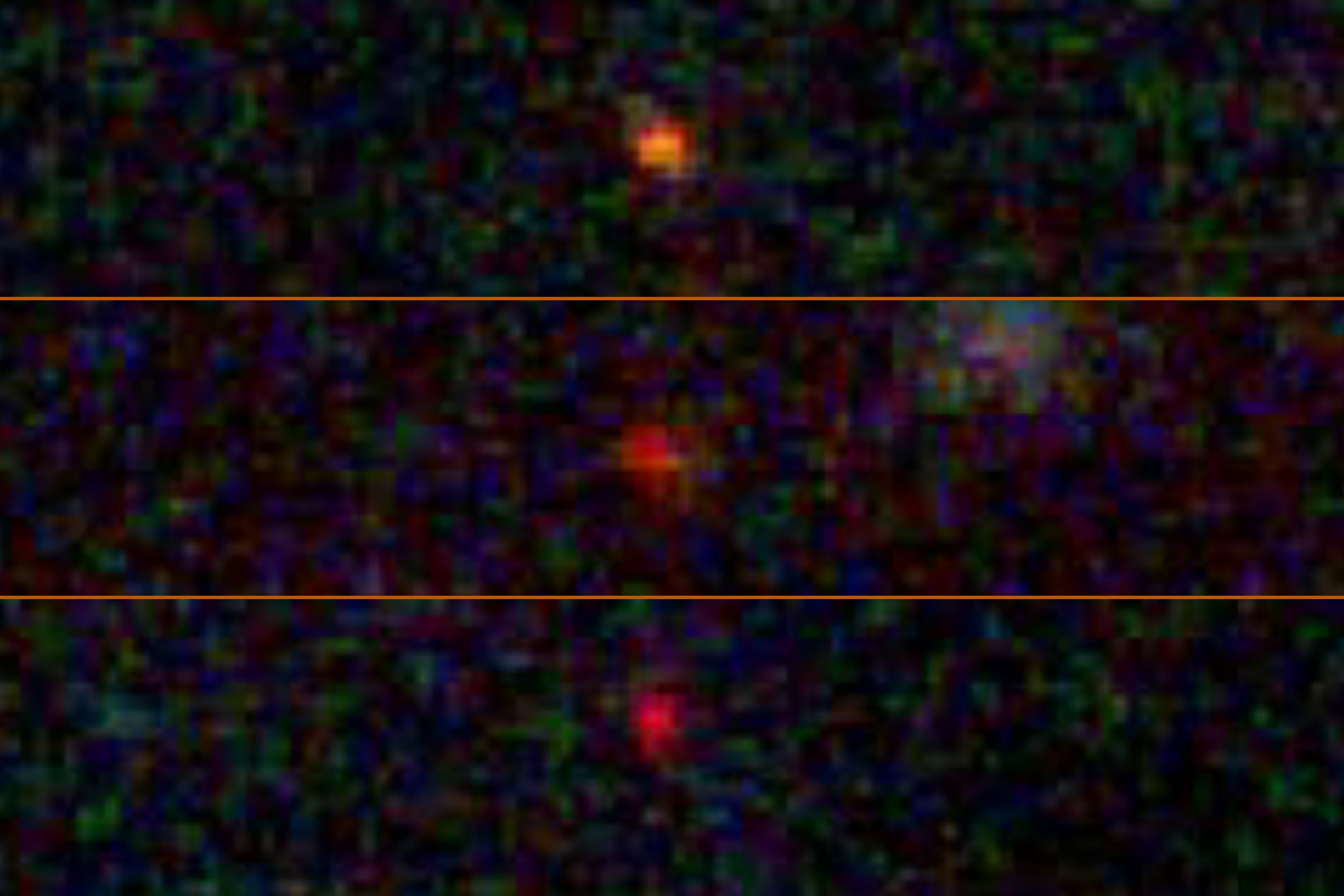
In 2023, Freese, Cosmin Ilie and Jillian Paulin compared supermassive dark-star spectra with three compact JADES objects: JADES-GS-z11-0, JADES-GS-z12-0 and JADES-GS-z13-0. Their light comes from roughly 320 million to 400 million years after the Big Bang. The models could fit the photometry, and one dark star could in principle produce enough light to be mistaken for a small galaxy.
Follow-up work used Webb’s NIRSpec spectra rather than broad photometric colours alone. A 2025 spectroscopic analysis found several sources remained consistent with dark-star models and discussed helium absorption as a potentially discriminating signature.
“Consistent with” is doing necessary work. A distant point source can admit competing fits involving stars, nebular gas, an accreting black hole or combinations of them. Webb is not photographing the physical surface of a bloated star. It is measuring a tiny source’s brightness across wavelengths and asking which theoretical spectrum best reproduces it.
There is a naming trap as well. A dark star powered by annihilation is not the same as a “black hole star”, the recent label for a feeding black hole embedded in a thick gas envelope. Both may look compact and unusual in Webb data, but one is a pre-collapse stellar object and the other already contains a black hole.
The dead stars may leave a gravitational-wave census
A new route to testing the idea does not require seeing the stars themselves. In a Physical Review D paper published on 17 August 2026, Sohan Ghodla and Cosmin Ilie modelled the later mergers of supermassive black holes descended from heavy seeds.
Pulsar timing arrays have detected a background of nanohertz gravitational waves, most naturally produced by a cosmic population of supermassive black-hole binaries. The study found that dark-star-seeded black holes, at a modelled comoving seed density of roughly one per thousand cubic megaparsecs, could make a dominant contribution to that background. The direct-collapse population considered in the same model contributed less because those seeds were rarer.
That result is not a detection of dark stars and does not establish that the measured background originated with them. It links a proposed early population to an observed modern signal. If a model creates too many massive seeds, their descendants can eventually produce too much gravitational-wave power. Better pulsar timing, black-hole demographics and galaxy-merger models can therefore restrict how abundant the seeds were allowed to be.
A hypothesis with several ways to fail
The dark-star story is appealing because one mechanism could connect particle physics, the structure of the first luminous objects and the early appearance of massive black holes. That economy is not evidence by itself.
The required dark-matter particle may not exist. Real early haloes may fail to keep enough particles on star-crossing orbits. Accretion may become irregular, fragment the gas or be terminated by feedback not captured in one-dimensional stellar models. Candidate spectra may resolve into ordinary galaxies or accreting black holes as the data improve.
The hypothesis also makes it testable. A confirmed helium absorption pattern, an unresolved source with the right luminosity and spectrum, and consistency with gravitational-wave limits would strengthen the case together. Laboratory limits on annihilating dark matter, missing spectral features or impossible seed abundances could close parts of the model.
For now, a million-solar-mass dark star is neither an observed object nor an arbitrary fantasy. It is a calculated consequence of specific particle and astrophysical assumptions. Its importance lies in the sharp difference those assumptions create: the first fusion giants burn furiously, ionise their surroundings and die young, while a dark-matter-heated star remains bloated long enough for gravity to keep adding mass. If nature used that route even rarely, some of the universe’s earliest black holes may have been born enormous.