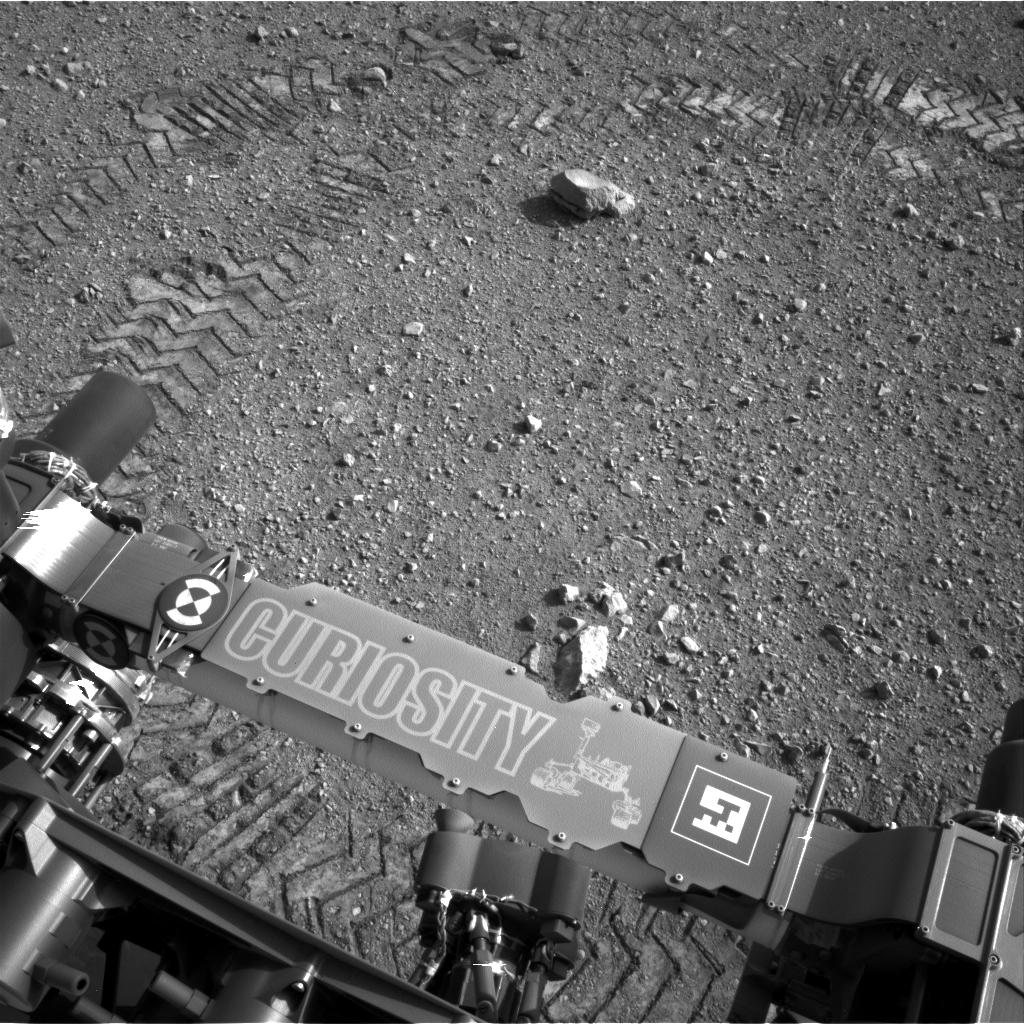
Curiosity has been pressing the same short message into Mars since its first test drive in August 2012. Each of the rover’s six aluminium wheels carries three groups of cut-outs: .— .–. .-... Read as Morse code, they spell JPL, for the Jet Propulsion Laboratory that built the rover and manages its mission.
The detail sounds like the sort of private joke engineers add to a machine before sending it to another planet. It is that, partly. But NASA’s description of Curiosity’s first wheel tracks explains that the pattern also gives the rover a recognisable visual reference. On fine, rather featureless ground, Curiosity can manufacture the landmarks it needs to check its own movement.
This is not a new discovery or a scientific result. It is a piece of engineering that has been visible in mission photographs from the beginning. What interested me was the economy of it: a signature, a ruler and a safety check occupy the same holes in a wheel.
What one wheel revolution leaves behind
Each wheel is about 50 centimetres in diameter and has a tread built around raised chevron-shaped grousers. Across one part of the wheel are straight bands carrying the Morse-code cut-outs. When that section meets soil soft enough to keep an impression, the usual zigzag tread is interrupted by a sequence of distinct bars.
The code is precise. J is dot-dash-dash-dash, P is dot-dash-dash-dot and L is dot-dash-dot-dot. Because the same feature appears on all six wheels, a readable version can recur with each complete revolution on suitable ground. Scientific American’s contemporary account described those bands as reference points that appear once per wheel revolution.
The title’s “every turn” needs that qualification. Bare rock cannot preserve a crisp stamp, and not every piece of a drive is photographed as an individual track. The feature is available whenever the surface and the rover’s navigation routine make it useful.
Wheel rotation is not the same as distance travelled
On firm, level ground, distance can be estimated from the number of wheel rotations. Mars does not reliably offer firm, level ground. A wheel can rotate while slipping in sand, or one part of the rover can move differently as the suspension crosses a rock or a slope. The commanded movement and the real movement then diverge.
That is where visual odometry enters. According to JPL’s account of Curiosity’s navigation software, the rover combines wheel-rotation measurements with information from gyroscopes and accelerometers. It also compares image pairs taken before and after a drive step, tracking how features in the scene shift between frames. From that change, the software estimates how the rover actually moved in six degrees of freedom.
If the wheels report one amount of travel but the images show less progress, the rover has evidence of slip. The mismatch matters on steep ground and in sand, where continuing to turn the wheels without making the expected progress can worsen a difficult situation.
Why write a landmark into the soil?
Visual odometry works well when the scene contains rocks, shadows and other stable details for the software to follow. A relatively smooth bed of fine material may offer fewer distinct points. The track pattern gives the cameras an artificial feature whose scale and spacing are already known.
The Morse code is not a separate sensor and it does not replace the rest of the navigation system. It is one helpful shape among the terrain features the software can track. NASA flight director Bobak Ferdowsi explained the basic idea soon after landing: the team knew how many wheel cycles had been commanded, while the marks on the ground helped reveal whether the rover had actually advanced by the corresponding amount.
I have written before about JPL teams working on Mars time. The wheel code is another reminder that operating a rover from Earth is full of indirect measurements. Nobody watches Curiosity move in real time. The machine has to leave evidence of its motion, examine that evidence and report back.
The wheels are lighter and thinner than they look
Curiosity is a car-sized rover, but mass was unforgiving during launch and landing. A 2022 engineering paper on its wheel damage describes wheels 50 centimetres across and 40 centimetres wide, with aluminium skin only 0.75 millimetres thick. The paper labels the Morse pattern plainly as an odometry feature.
Those thin skins later accumulated punctures and tears from sharp Martian rocks, prompting changes to route planning, traction control and wheel monitoring. That history makes the cheerful hidden signature look slightly different. The holes were not decoration cut into a heavy, expendable tyre. They were integrated into a structure designed under severe mass limits, then asked to serve as landing gear and survive years of rock, sand and slopes.
A joke that still had to earn its place
The Planetary Society describes the code as a playful way of putting JPL’s mark on Mars. That interpretation is hard to resist. The first clear tracks did, after all, write the builders’ initials on another world.
Yet the part I like is that the joke was made useful. Spacecraft carry strict limits on mass, power, complexity and risk. A flourish is easier to defend when it also gives navigation software a known pattern on otherwise bland ground.
Curiosity does not need Morse code to know what JPL means. It needs contrast, spacing and a feature that can be found again in an image. Humans supplied the letters. The rover uses the geometry. In the same marks, one side of the mission left a signature and the other found a way to measure whether six turning wheels were truly carrying it forward.