

There are two very different numbers at the heart of the latest result from CERN’s LHCb experiment.
The proton-collision data collected between 2011 and 2018 encompassed roughly 650 billion B mesons. The particular decay under examination occurs only about once in every million B-meson decays of all kinds. After the detector, trigger, reconstruction and selection had done their work, the analysis was based on thousands of usable signal events, not 650 billion rare decays inspected one by one.
That distinction is worth making before anything else. The enormous first number explains how physicists can study such an improbable transformation at all. The much smaller second number explains why the answer, although unusually persistent, is still a hint rather than a discovery.
The LHCb Collaboration’s peer-reviewed paper, published in Physical Review Letters on 8 July 2026, reports the most comprehensive measurement yet of the decay written B0 → K*0μ+μ−. For more than a decade, aspects of this transformation have refused to sit comfortably on top of Standard Model predictions. In the larger and more careful analysis, that tension remains.
It may be one of the strongest surviving experimental hints of particles or interactions beyond the Standard Model. It is not evidence that a particular new particle has been found.
What is transforming into what
A neutral B meson is a short-lived composite particle containing a bottom, or beauty, antiquark paired with a lighter down quark. It survives for only a tiny fraction of a second before decaying.
In the channel studied by LHCb, the B0 becomes an excited neutral kaon, K*0, plus a positively charged muon and a negatively charged antimuon. The K*0 then decays into a positive kaon and a negative pion. What reaches the detector is therefore a four-particle final state: K+, π−, μ+ and μ−.
Underneath that bookkeeping is a rarer change. The bottom quark becomes a strange quark while emitting the muon pair. This is known as a flavour-changing neutral-current transition. The Standard Model does not allow it to happen through the simplest kind of direct interaction.
Instead, the transition must take a quantum detour through a higher-order loop. Particle physicists call the relevant family of sketches penguin diagrams, a name whose informality has survived because the diagrams are genuinely useful. Inside the calculation, known particles appear as virtual intermediate states before leaving behind the four measurable decay products.
Why one decay in a million can be unusually revealing
A process does not have to create a particle directly to feel its influence. If an undiscovered particle is too heavy for the LHC to produce as a free object, quantum mechanics can still allow it to contribute virtually within a loop. Its presence could slightly alter how often the decay occurs or the angles at which the final particles emerge.
The ordinary Standard Model route is already strongly suppressed. That makes the rare decay a comparatively quiet place to look for a small extra contribution. In a common decay dominated by known physics, the same effect might be lost. Here, a modest shift can become visible.
This is why “one in a million” does not mean unimportant. It means the channel is both difficult to collect and sensitive to influences that more common transformations could hide.
The other scale in the title needs equal care. Reporting on the analysis has estimated that the collision sample encompassed around 650 billion B mesons. That does not mean LHCb stored and manually classified 650 billion clean B-meson decays. The data correspond to 8.4 inverse femtobarns of proton-proton collisions taken in 2011, 2012 and from 2016 through 2018. An American Physical Society overview describes roughly 17,000 selected signal events in the final analysis.
The anomaly lives in shapes, rates and angles
LHCb does not simply count how many target decays appear. It reconstructs the energies and directions of the kaon, pion and two muons. Those measurements reveal a set of angular patterns that can be compared with calculations.
One key variable is q2, the squared invariant mass of the muon pair. Rather than compressing the result into a single average, the collaboration measures the decay in bins of q2. This shows whether a mismatch is concentrated in a particular energy region.
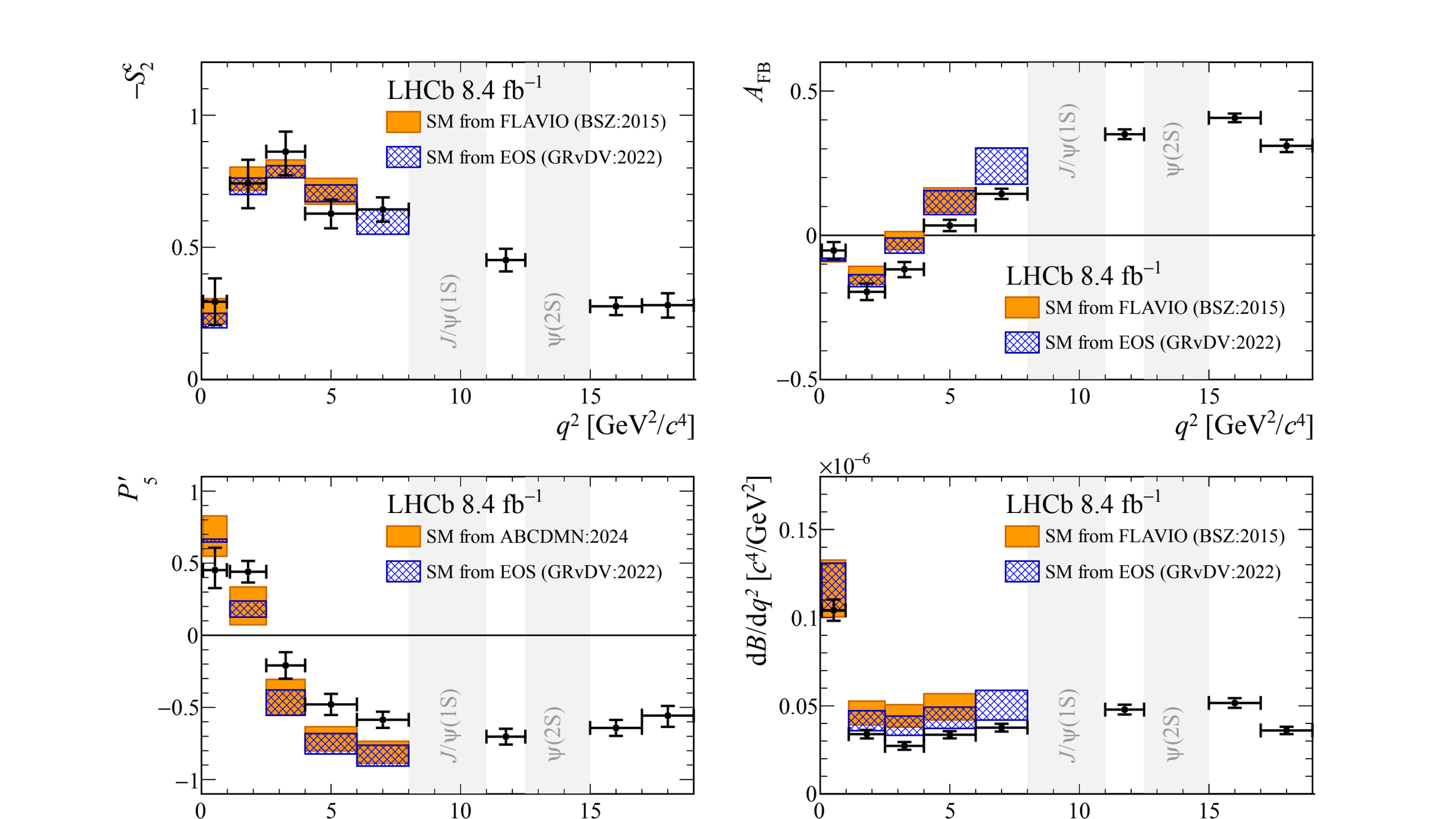
The differential branching fraction measures the decay rate across those bins. In the relevant region, it has tended to sit below Standard Model predictions. The new paper finds that this pattern continues.
Another observable, P5′, is constructed from the directions of the four final particles. It was designed to cancel some of the leading uncertainties associated with the strong interaction. P5′ again departs from predictions in the same q2 region where previous LHCb analyses found tension.
The forward-backward asymmetry, AFB, asks whether the muons prefer particular directions relative to the B meson’s motion. It now adds discrepancies of its own. In the collaboration’s plot, the black measurements and the coloured Standard Model ranges do not produce one dramatic break. They show several smaller disagreements that lean in a common direction.
Just as important is what did not disagree. The analysis also compared B0 decays with the corresponding antimatter decays. Those CP-asymmetry observables showed no significant departure from zero. The Standard Model is not missing every feature of the data.
The result is not one clean four-sigma number
Some accounts describe the combined anomaly as being close to four standard deviations, often shortened to four sigma. That is a useful summary of particular global fits, but it can sound more definitive than the underlying situation.
Individual measurements depart from particular Standard Model calculations by smaller amounts. For example, the paper reports local P5′ tensions around two to three sigma in several bins, with the precise value changing when a different theoretical prediction is used. When multiple angular observables are combined and interpreted as one common shift in an effective coupling, some fits produce a stronger overall discrepancy.
The treatment of theoretical uncertainty matters. The APS assessment therefore describes the combined tension as being at the level of a few standard deviations, depending especially on how hadronic effects are handled.
Five sigma is the conventional threshold for announcing a particle-physics discovery, but even that convention is not a substitute for replication and a coherent explanation. Four sigma does not mean there is a simple one-in-a-fixed-number probability that the Standard Model is false. It measures how difficult the observed pattern is to obtain within a specified model of the data and its uncertainties.
The ordinary-physics explanation has a charming name
The most important alternative does not require a new particle at all. B mesons and kaons are built from quarks, which means the strong interaction complicates the clean electroweak picture. In particular, long-distance processes involving charm quarks can feed into the same final state.
These contributions are sometimes called charming penguins. The phrase sounds like an aside, but the calculation is one of the central difficulties in interpreting the anomaly. A charm-anticharm pair can appear within an intermediate process and distort the measured rate and angular distributions. The effect belongs to the Standard Model, yet it is hard to calculate precisely from first principles.
LHCb performed a detailed amplitude analysis in 2024 to look for these nonlocal contributions. It found no evidence that the charm effects were enhanced enough to remove the discrepancy. That is a meaningful constraint. It is not the same as proving that every residual hadronic uncertainty is too small.
The honest position remains two-branched. A new interaction could be shifting the decay. Or the strong-interaction contribution may still be modelled imperfectly. More data help with the first problem, while improved theory and complementary measurements are needed for the second.
Why this hint has outlived several others
The P5′ anomaly first drew serious attention in 2013. As SpaceDaily reported in 2018, related beauty-meson discrepancies had persisted even after physicists tried to include troublesome long-distance effects. The interest did not rest on one day’s measurement.
But the recent history of flavour physics also supplies a warning. A different set of B-meson measurements appeared to suggest that nature treated muons and electrons unequally. SpaceDaily’s 2021 report on that lepton-universality result described a 3.1-sigma departure that generated considerable interest.
In December 2022, a more comprehensive LHCb analysis improved the handling of backgrounds in the electron channels. The replacement measurements agreed with the Standard Model and superseded the earlier result.
That reversal is not an embarrassment to be edited out of the story. It is a demonstration of what the experimental process is for. A suggestive anomaly prompted scrutiny; the scrutiny identified weaknesses; the conclusion changed.
The present angular anomaly is called “surviving” because it has remained through larger samples and a more elaborate analysis while several neighbours faded. Survival increases its interest. It does not grant immunity from the same process of correction.
What a new particle would have to do
Particle physicists often describe this result through an effective coupling called C9. The parameter packages the strength of an interaction linking the bottom-to-strange transition with the muon pair. Across several measurements, the data tend to prefer a lower effective contribution than the Standard Model calculation provides.
An additional heavy Z′ boson could shift that coupling. A leptoquark, a hypothetical particle able to connect quarks with leptons, could also contribute. There are other possible models, each bringing further predictions and constraints from experiments that have found no corresponding signal.
None of those names identifies what LHCb has detected. The experiment has not observed a Z′ decay, measured a leptoquark mass or established a fifth fundamental force. It has measured known decay products and found that their distribution is easier to fit if an extra contribution is allowed.
“Influencing matter from behind the scenes” is therefore a description of virtual quantum effects. If a new particle is involved, it has left an indirect fingerprint in a loop, not a track announcing itself in the detector.
Why the 2026 analysis is more than a bigger count
The collaboration’s progress is methodological as well as statistical. The final kaon and pion can occupy more than one angular configuration. The dominant P-wave contribution passes through the K*0 resonance, while a broader S-wave component can reach the same final state and interfere with it.
The new analysis includes the kaon-pion invariant mass directly in the fit and examines a wider mass range, giving better control over that interference. It also incorporates corrections from the finite mass of the muon. Those corrections are especially relevant at low q2, which is also an important region for sensitivity to new physics.
The paper presents the full set of CP-averaged and CP-asymmetric angular observables, the differential branching fraction and, for the first time in this treatment, the complete S-wave observable set. Two independently developed analysis frameworks were used as a cross-check.
These details make the persistence more consequential than a simple rerun of an old calculation. They also explain why a careful summary from CERN stops short of a discovery claim: the tension is confirmed, while larger Run 3 samples and better theoretical calculations are still required to identify its source.
What happens next
LHCb has not yet folded its much larger Run 3 dataset into this measurement. The upgraded detector and new data should reduce the statistical uncertainty and test whether the same angular pattern sharpens, stays put or recedes.
Independent measurements matter just as much. CMS has studied the same decay with different detector geometry and analysis choices, finding a broadly compatible pattern but with larger uncertainties. ATLAS provides another collider check. Belle II in Japan produces B mesons in electron-positron collisions, a cleaner environment with different backgrounds and systematic limits.
If the discrepancy is new physics, related decay channels and experiments should eventually form a consistent network. A proposed Z′ or leptoquark must also survive direct searches and measurements elsewhere. If the discrepancy comes from hadronic modelling, improved calculations should explain why particular observables and q2 bins shifted together.
For now, the result sits in the narrow territory between curiosity and conclusion. It is too persistent to wave away, too dependent on difficult theory to call decisive and too informative to ignore. The experiment has not found a hidden force. It has found one of the clearest remaining places to test whether such a force could be there.