A bathroom mould is not going to spread across the Moon. There is no rain, no breathable air and no stable liquid water on the lunar surface. Yet spores carried from Earth may not die as quickly as that setting suggests.
A NASA-led study published in August 2026 mapped small niches near the lunar south pole where human-associated microbes could remain viable. The most persistent candidate was Aspergillus niger, a darkly pigmented fungus common in warm, damp buildings and repeatedly detected in spacecraft environments, including the International Space Station.
Its advantage was specific. Among the organisms considered, A. niger had the highest measured resistance to ultraviolet radiation, surpassing even Deinococcus radiodurans, a bacterium so resistant to radiation and desiccation that it is routinely used as a benchmark for biological toughness.
The new work did not place living mould on the Moon. It combined existing laboratory survival measurements with detailed models of sunlight, temperature and terrain. What emerged was a map of where dormant microbial cells might endure for days, not where they could grow into a lunar ecosystem.
This was a survival model, not a petri dish on the Moon
The study in Science Advances was led by planetary scientist Prabal Saxena of NASA’s Goddard Space Flight Center. Its question was practical: if astronauts and spacecraft deliver Earth microbes to the lunar south pole, which patches of ground might fail to kill them immediately?
The team analysed three regions being considered for human exploration: Nobile Rim, Connecting Ridge and De Gerlache Rim. The researchers combined topographic and temperature information from NASA’s Lunar Reconnaissance Orbiter with a model of how solar ultraviolet radiation strikes the surface.
They then brought in survival limits reported by earlier microbiology experiments. Each organism’s tolerance profile was compared with the maximum temperature and accumulated ultraviolet dose predicted for each mapped location. This produced potential survival zones at several spatial scales.
No organism in the study was physically exposed at those lunar sites. The maps are predictions based on remote sensing, illumination modelling and laboratory measurements obtained under particular conditions. Real lunar dust, vacuum, radiation, temperature cycles and the way cells clump or hide inside materials could change the outcome.
The comparison included ordinary microbes and a famous survivor
The researchers selected organisms associated with humans, indoor spacecraft environments or earlier exposure studies. They included the bacteria Bacillus subtilis, Staphylococcus aureus and Deinococcus radiodurans, along with Aspergillus niger and several species of the fungus Fusarium.
D. radiodurans was the obvious heavyweight. It can repair severe DNA damage and withstand doses of ionising radiation that kill most life. Aggregates of related Deinococcus cells have survived years of exposure outside the ISS, reinforcing the bacterium’s reputation as one of Earth’s most radiation-resistant organisms.
A. niger comes from a more familiar world. As NASA’s account of the new research explains, it thrives in warm, damp settings such as bathrooms and heating, ventilation and air-conditioning systems. It has been sampled inside the ISS, and earlier experiments found fungal spores capable of surviving beyond the station’s protective walls.
That does not mean the exact spores modelled here were scraped from an orbital wall or a bathroom tile. The study compared species-level resistance information. The connection matters because A. niger is a plausible human or spacecraft stowaway, not because every strain is identical.
The fungus won a contest in ultraviolet resistance
The fungus owes much of its durability to its spores. They have thick cell walls, dark pigment and low metabolic activity, all of which help them remain intact through drying and other stresses. Their black colour gives A. niger its name.
In a 2020 laboratory study of space-radiation resistance, researchers exposed wild-type A. niger spores and several mutants to X-rays, helium and iron ions, and UV-C light. The UV-C dose required to inactivate 90 per cent of wild-type spores, known as the LD90, was 1,038 joules per square metre.
The corresponding published LD90 used for D. radiodurans was 660 joules per square metre. For B. subtilis spores it was 100. That comparison supplied the striking hierarchy in the lunar model: against this form of ultraviolet exposure, the household fungus was the toughest of the set.
This is not a declaration that A. niger is tougher than D. radiodurans in every sense. UV-C is only one part of the radiation environment, and resistance changes with wavelength, dose rate, hydration, shielding and how cells are prepared. D. radiodurans remains exceptionally resistant to ionising radiation. On the lunar surface, however, solar ultraviolet light was the dominant microbial killer in the conditions the new study modelled.
A low Sun turns tiny shadows into shelters
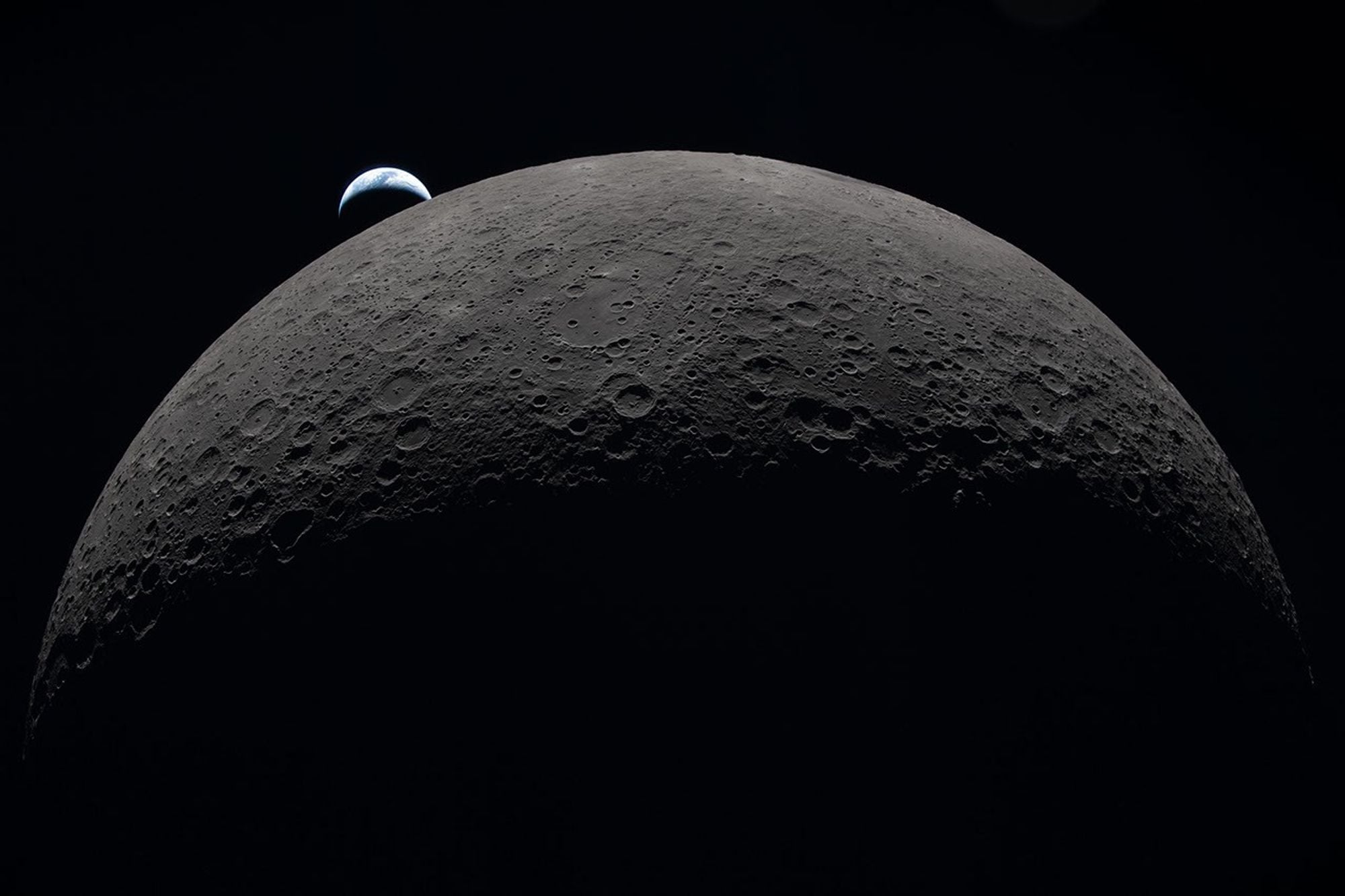
The Moon’s axis is tilted by only about 1.5 degrees, so the Sun stays close to the horizon at the poles. Ridges and crater walls cast long shadows. Even small bumps, rocks, rover tracks or boot prints could reduce the direct ultraviolet dose reaching the ground behind them.
To capture that geometry, the researchers used ray tracing, a technique better known for modelling the paths of light in computer graphics. Combined with laser-altimeter topography, it allowed the team to estimate direct and scattered ultraviolet exposure around the candidate south-polar regions.
The results were unexpectedly patchy. A University of Maryland summary reports that Aspergillus could potentially survive in 15 to 30 per cent of areas receiving some sunlight during lunar winter. It persisted across about 3 per cent of the mapped landscape for at least seven days.
Every microbial type found potential survival areas in all three regions. When scattered ultraviolet light was included, all five could persist in portions of the permanently shadowed terrain at De Gerlache Rim. The niches ranged from wide crater floors to shadows that could fit inside a footprint.
Survival does not mean growth, feeding or reproduction
A living spore can be metabolically quiet. In the study’s context, survival means remaining viable for at least one Earth day, and in some modelled locations up to a week. It does not mean the microbe is active.
The likely state is cryptobiosis, a form of suspended activity in which an organism endures until conditions improve. If a surviving spore were later brought into a warm, moist habitat, it might be capable of germinating. Left on exposed lunar ground, it has no demonstrated route to growth.
The Moon lacks a substantial atmosphere and stable surface liquid water. Temperatures swing severely outside the most sheltered regions, while energetic particles continue to arrive. The researchers found no evidence that the surface supplies the ingredients required for these microbes to reproduce.
Calling a mapped patch a “survivable niche” therefore does not make it habitable in the everyday astrobiological sense. It means the predicted ultraviolet and heat exposure may remain below a measured lethal threshold for a particular length of time.
The risk is corrupted science, not a lunar mould outbreak
Humans shed microbes continuously. Suits, airlocks, habitats, tools and rovers will carry biological material even under careful contamination control. Robotic spacecraft can be baked or treated aggressively, but hardware designed around living crews cannot be sterilised to the same standard.
If cells or biological fragments persist in cold shadows, later instruments might detect material brought from Earth and mistake it for something older. The south pole is scientifically valuable partly because permanently shadowed ice may preserve a record of water, organic chemistry and impacts reaching deep into lunar history.
Planetary protection is often discussed in relation to worlds that might host liquid water. SpaceDaily previously examined why Cassini was deliberately sent into Saturn to protect Enceladus from an accidental impact. The Moon is not treated like that ocean-bearing moon, but contamination can still damage the evidence researchers hope to read.
A 2025 model of permanently shadowed lunar regions had already suggested that terrestrial microbes might persist inside the coldest polar traps. The new study adds finer terrain, scattered illumination and resistance profiles for several human-associated organisms near candidate exploration zones.
The most useful experiment may happen in a controlled footprint
The authors want higher-resolution topography, more detailed illumination models and laboratory data that combine multiple lunar stresses rather than treating them separately. A cell’s tolerance to UV in one experiment may change when vacuum, dust, cold and energetic particles act together.
They also see the Moon as a natural laboratory. A carefully documented deposit in a shaded location could test how long selected microbes remain viable under genuine lunar conditions. Baseline measurements would be essential, as would containment and a clear record of everything introduced.
The result does not turn the south pole into a microbial habitat. It changes the expected time between arrival and death. In a landscape where the Sun scrapes the horizon, the difference between immediate sterilisation and days of suspended survival may be nothing larger than a ridge, a wheel track or the shadow inside an astronaut’s boot print.