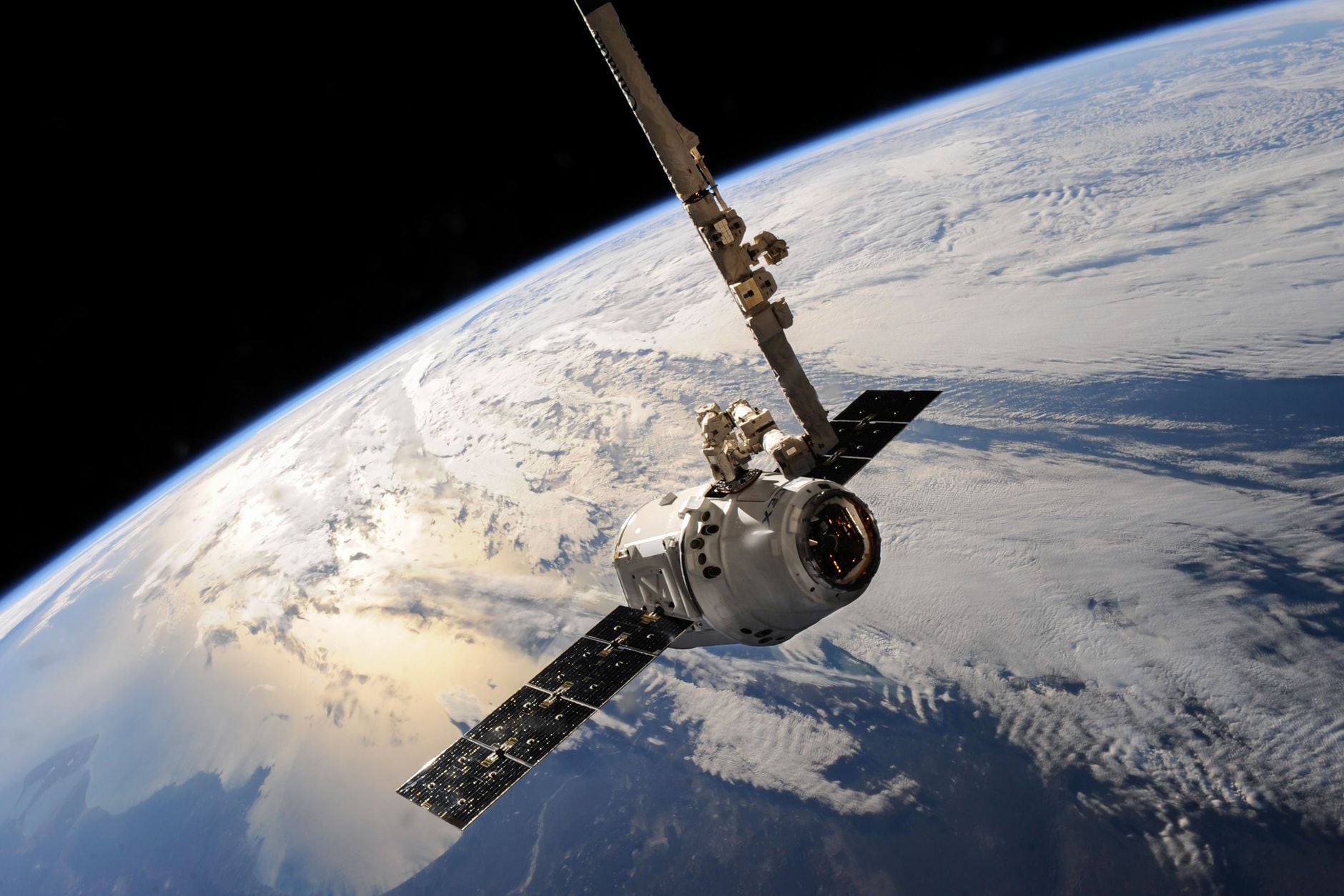
At 224 kilometres above Earth, ESA’s GOCE satellite was close enough to feel the upper atmosphere as a constant force. If its drag-control system stopped working, mission controllers could have as little as two days to recover it before the orbit became dangerously low.
That detail has stayed with me because it strips away the tidy line we draw between atmosphere and space. Very low Earth orbit, usually shortened to VLEO, is not quite the empty arena many of us picture. It is a place where a spacecraft can orbit the planet while still being slowed, weathered and ultimately pulled home by traces of air.
The same atmosphere that makes VLEO difficult is also part of its appeal. Flying closer can improve the detail in Earth-observation images, shorten a communications link and ensure that a failed satellite does not remain aloft for generations. The trade is simple to describe and hard to engineer: lower orbit brings the ground nearer, but it also makes survival an active task.
Very low is still orbit
There is no single boundary used by every organisation, but the European Space Agency describes VLEO as the region below 450 kilometres. A satellite there is still moving sideways fast enough to keep falling around Earth rather than straight into it.
I recently wrote about why reaching orbit is mainly a problem of sideways speed. VLEO adds an awkward complication to that picture. The spacecraft is falling around Earth, but the thin atmosphere steadily takes energy from its motion. Without repeated or continuous thrust, its altitude falls.
GOCE showed that this can be managed. ESA launched the gravity-mapping spacecraft in 2009 and operated it at about 254 kilometres before lowering it to 224 kilometres in 2013. Its slim five-metre body reduced drag, while an ion engine continuously adjusted its thrust to counter the atmosphere.
Being so close helped GOCE measure small variations in Earth’s gravity field. It also narrowed the margin for error. ESA’s operations history says that once the spacecraft exhausted its xenon propellant, atmospheric drag would bring it back within roughly two to three weeks. GOCE re-entered in November 2013 after more than four years in orbit.
Why engineers want to go back down
For an imaging satellite, distance matters. A camera closer to Earth can obtain finer ground detail with the same optics, or potentially deliver a similar result with a smaller instrument. Communications signals also have less distance to cover, reducing propagation delay. Launching to a lower altitude can require less energy, although the cost of maintaining the orbit complicates any simple claim that lower automatically means cheaper.
Then there is debris. When I looked at the roughly 46,000 objects currently tracked around Earth, the unsettling part was how long abandoned hardware can remain in useful orbital regions. A non-functioning VLEO satellite should lose altitude naturally much faster.
That is a genuine advantage, but I would not turn it into a claim that VLEO is debris-free. Satellites can still collide while operating, fragments can still create hazards, and re-entry has to be considered in the spacecraft design. The lower orbit mainly changes how long the leftovers persist.
The atmosphere is both brake and fuel supply
Drag is not steady. Upper-atmosphere density changes with altitude, solar activity and space weather, so a propulsion system needs margin for conditions that are difficult to predict perfectly. Spacecraft surfaces also encounter atomic oxygen, a reactive form of oxygen that can erode polymers, coatings and other materials.
This is why VLEO designs tend to look less like ordinary satellites moved a little lower and more like vehicles shaped for a different environment. They need low-drag forms, resistant materials, enough electrical power and propulsion able to operate for long periods.
One proposed answer is atmosphere-breathing electric propulsion. Instead of carrying all its propellant from launch, a spacecraft would collect the sparse nitrogen and oxygen molecules ahead of it, ionise them and accelerate them backwards to produce thrust. In effect, the material causing the drag becomes part of the response to it.
An ESA-led team demonstrated the basic concept in a ground test in 2018, using a chamber that simulated conditions around 200 kilometres. That was an important proof of concept, not a demonstration of years-long operation in orbit.
A 2024 paper in the Journal of Electric Propulsion sets out what remains: collecting and compressing enough atmospheric gas, generating sufficient thrust without exceeding available power, sustaining a plasma at very low pressure and protecting materials from reactive particles. These are connected constraints, not separate boxes that can be solved in isolation.
A useful orbit because it refuses to be passive
I can see why VLEO attracts grand promises. It offers a persuasive combination of closer observation, lower communication delay and more rapid natural disposal. Yet GOCE suggests a more grounded way to think about it.
Very low Earth orbit is useful precisely because the atmosphere still matters there. It improves some missions, limits their lifetime, cleans up failed hardware and demands that a spacecraft keep working to stay aloft. The opportunity and the difficulty are the same physical fact viewed from opposite sides.