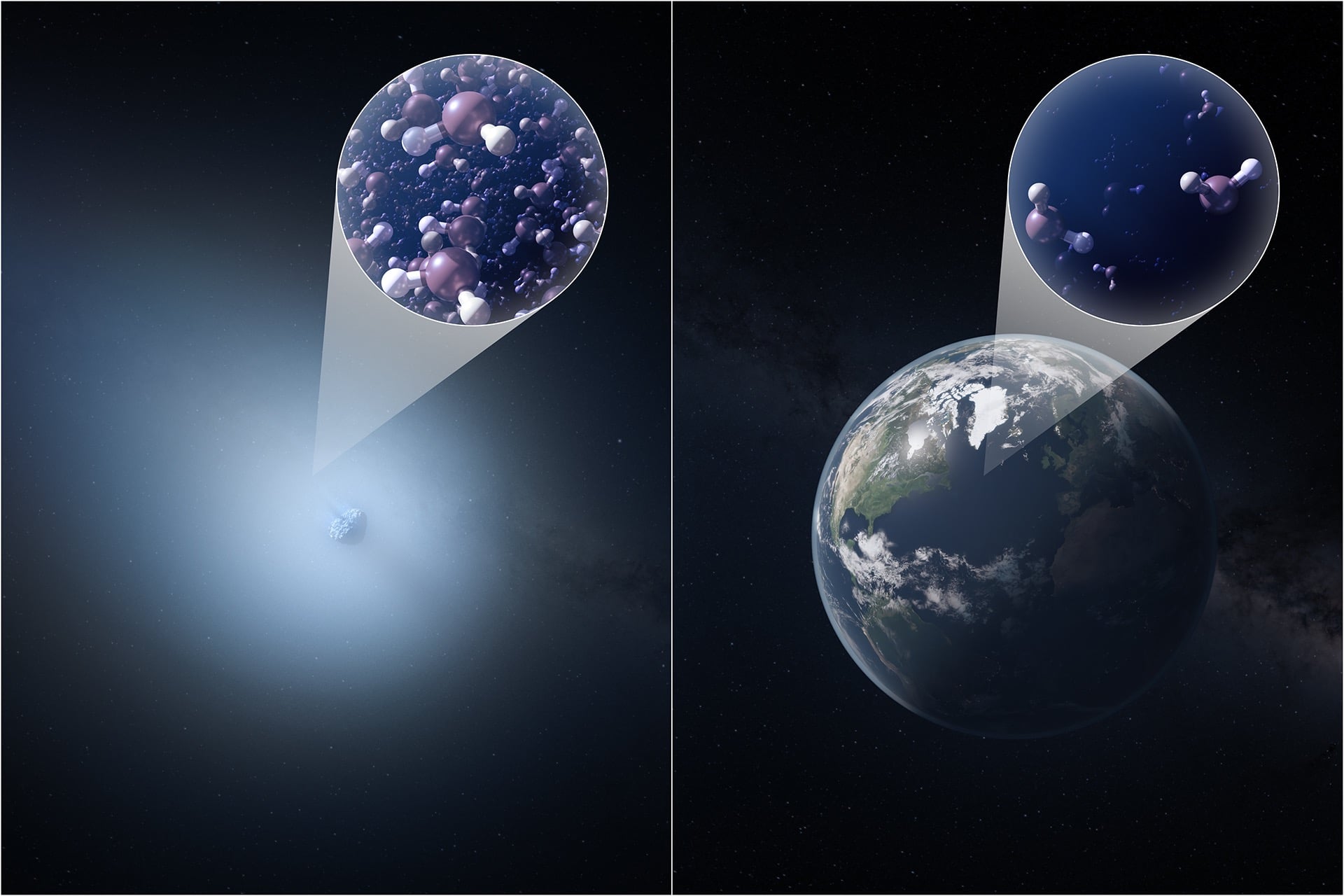
For most of its existence, 3I/ATLAS was an invisible piece of ice moving between the stars. Then its hyperbolic path carried it through the Solar System, sunlight warmed its surface, and gas escaping from the nucleus gave astronomers a chemical sample of material made around another star.
The strongest clue was not simply water, but the balance between two kinds of hydrogen inside it. A 2026 Nature Astronomy analysis found that the water in 3I/ATLAS was enriched in deuterium, or heavy hydrogen, by more than 30 times compared with the typical value for Solar System comets. Later observations with the James Webb Space Telescope independently measured the ratio at 0.98 plus or minus 0.06 percent.
That chemical imbalance points to ice formed at temperatures below roughly 30 kelvin, then spared enough warmth and mixing to preserve its original isotope record. It does not reveal a specific home star or exactly how long the comet wandered. The chemistry remembers conditions that its orbit can no longer reconstruct.
A visitor on a path that could never close around the Sun
The NASA-funded ATLAS survey telescope at Rio Hurtado in Chile reported the object on 1 July 2025. Astronomers quickly established that its orbit was hyperbolic: it was moving too fast to be bound to the Sun in a repeating ellipse. As NASA’s 3I/ATLAS overview explains, it was only the third confirmed object known to arrive from interstellar space, after 1I/‘Oumuamua and 2I/Borisov.
Unlike the apparently inactive ‘Oumuamua, 3I/ATLAS developed a bright gaseous coma. It was the second interstellar visitor with clearly resolved outgassing after Borisov. That coma mattered because molecules released from the ice could be separated by their spectral fingerprints. The solid nucleus remained unresolved, but its gas turned into a remote sample of an extrasolar planet-forming reservoir.
The comet reached perihelion on 29 October 2025 at about 1.36 astronomical units from the Sun, just inside Mars’s orbit. It never threatened Earth. SpaceDaily previously followed the sharpest Hubble view of its compact nucleus and surrounding dust. After its single passage, 3I/ATLAS will return to the dark between stars.
“Thirty times more” means an isotope ratio, not thirty times the water
Ordinary hydrogen has one proton in its nucleus. Deuterium has one proton plus a neutron, making the atom about twice as massive. Ordinary water is H2O. Replace one hydrogen atom with deuterium and the molecule becomes HDO, commonly called semi-heavy water. Astronomers compare the number of deuterium atoms with the number of hydrogen atoms and report the deuterium-to-hydrogen, or D/H, ratio.
The headline figure describes that ratio inside the water. It does not mean the comet contains 30 times as much total water, nor that one molecule in 30 is pure heavy water. A synthesis of Solar System comet measurements places ordinary cometary water around a D/H value of 0.029 percent on average, with object-to-object variation. Earth’s ocean water sits lower, at about 0.0156 percent.
The first ALMA analysis placed 3I/ATLAS above 0.66 percent under its conservative assumptions. Webb later measured 0.98 percent, roughly 34 times the Solar System comet mean and about 63 times the ocean value. Reports sometimes say “30 times” and sometimes “more than 40 times” because they use different ALMA limits and compare them with different reference values. The central point survives every comparison: no known comet from the Solar System approaches it.
ALMA heard HDO even while ordinary water stayed silent
On 4 November 2025, six days after perihelion, the Atacama Compact Array observed 3I/ATLAS in two ALMA radio bands. One spectral window targeted an ordinary-water transition at 183.310 gigahertz. Another targeted HDO at 241.561 gigahertz. The array detected HDO and multiple methanol lines, but the ordinary H2O line remained below its formal detection threshold.
That result was the first detection of deuterated water in an interstellar object. The observing opportunity was unusually narrow. As the ALMA team described, radio telescopes could point near the Sun just as the comet emerged after perihelion, when water outgassing was strong. Most optical observatories could not make the same geometry work.
Water had already been established by other methods. SpaceDaily reported the earlier Swift detection of hydroxyl, a product of water broken apart by sunlight. The ALMA problem was narrower: to calculate HDO/H2O at one epoch, the researchers needed to estimate the ordinary-water production rate even though its chosen water line was missing.
A non-detection turned the first answer into a lower limit
The team used a radiative-transfer model called SUBLIME to fit the HDO, H2O and methanol spectral regions together. Different methanol transitions respond to the temperature and density of the expanding coma. Their excitation therefore constrained the collision rate and total gas production, which the model used to infer a water production rate of about 1.6 × 1029 molecules per second.
Under the nominal model, the water D/H ratio exceeded 0.46 percent. In a more conservative scenario, the researchers used the highest water production still permitted by the non-detection. More ordinary water makes the isotope fraction smaller, so this produced a lower limit of 0.66 percent. Relative to the error-weighted mean for Solar System comets, those two limits imply enrichments of more than about 20 and 30 times, respectively.
The calculation carries stated assumptions. It treats ordinary water as the main collision partner in the coma and uses an averaged description of molecule-to-molecule collision rates. Carbon dioxide had dominated the coma farther from the Sun, although water rose sharply near perihelion. The result was deliberately framed as a constraint, not a direct count of every H2O molecule.
Webb later measured the ratio by a different route
On 22 and 23 December 2025, when the comet had moved outward to about 2.4 astronomical units from the Sun, Webb’s NIRSpec instrument observed infrared bands from H2O, HDO, carbon dioxide and carbon monoxide. A separate study published in Nature derived a D/H value of 0.98 plus or minus 0.06 percent. Its spectrum also revealed unusually high ratios of carbon-12 to carbon-13.
The Webb measurement matters because it did not depend on the same methanol-excitation route used by ALMA. Different instrument, wavelength, date and coma model converged on extreme deuterium enrichment. Agreement does not erase every modelling uncertainty, but it makes a transient instrumental artefact or a single fragile assumption a much poorer explanation.
The carbon ratios added a second clock of sorts. Models of how successive stellar generations enrich the Galaxy in carbon-13 suggest the comet’s material may have accreted 11 to 12 billion years ago in a relatively metal-poor environment. That estimate depends on Galactic chemical-evolution models; it is not a direct radiometric age.
Cold chemistry tips the balance toward heavy hydrogen
Deuterium itself was made during the first minutes after the Big Bang, but ordinary variations in the Milky Way’s bulk hydrogen isotope abundance are much too small to explain 3I/ATLAS. The large water signal comes from chemical fractionation. At very low temperatures, slight energy differences favour reaction pathways that transfer deuterium into ions and then into molecules. Atomic deuterium becomes disproportionately available and can be locked into water ice growing on dust grains.
The effect becomes efficient below roughly 20 to 30 kelvin, around minus 253 to minus 243 degrees Celsius. Later warmth can weaken the signature. Ice may sublimate, molecules may exchange isotopes, and warm inner-disk water can mix outward before freezing again. A D/H ratio near one percent says that much of 3I/ATLAS’s water avoided this kind of thermal and isotopic reset.
Cold is the firm conclusion; the exact setting is less certain. The water could have formed in a prestellar molecular core before the parent star existed, then entered its disk as inherited ice. It could also have been processed in the disk’s distant outer region, perhaps beyond the carbon-dioxide snowline. Radiation and cosmic rays supply ionization that can drive deuterating chemistry, so the ratio alone does not specify one radiation field, formation radius or sequence.
The isotope clock is clearer than the comet’s travel diary
Motion-based studies have placed 3I/ATLAS in a broad kinematic age range of about three to 11 billion years. The carbon-isotope interpretation extends a possible formation age to 11 or 12 billion years. SpaceDaily previously examined the evidence that the comet may predate the Sun by billions of years.
Formation age is not the same as time spent alone between stars. A planetesimal may remain in its home system before a giant planet, passing star or other disturbance ejects it. Once ejected, its Galactic trajectory is perturbed repeatedly. The Webb team noted that tracing the orbit backward beyond about ten million years becomes difficult because gravitational encounters in the Galaxy are chaotic and incompletely known.
It is therefore reasonable to say the comet drifted interstellar space for millions or possibly billions of years, but not to assign a precise journey. Its parent star cannot be identified reliably. The water preserves a cold birthplace more faithfully than the present velocity preserves an address.
One alien comet cannot define all alien comets
3I/ATLAS proves that water ice in another planetary system can retain an isotope composition far outside the range sampled by familiar comets. It also demonstrates why interstellar objects are chemically richer than distant exocomet detections: when one crosses the Sun’s neighbourhood and begins to outgas, astronomers can analyse matter made around another star molecule by molecule.
It does not show that D-rich water is common across the Galaxy. Humanity has confirmed only three interstellar objects, and nothing comparable was measured for ‘Oumuamua or Borisov. A sample of one cannot tell whether our comets are unusual, whether 3I/ATLAS is an extreme survivor, or whether several families of extrasolar ice exist.
Future wide-field surveys should discover more unbound visitors early enough for ALMA, Webb and other observatories to coordinate. Each isotope ratio will add one point to a map of planetary birth conditions that cannot yet be drawn. For now, faint lines from ordinary and semi-heavy water have done what the comet’s lost route cannot: they carry the temperature history of an alien planetary system into our own.