
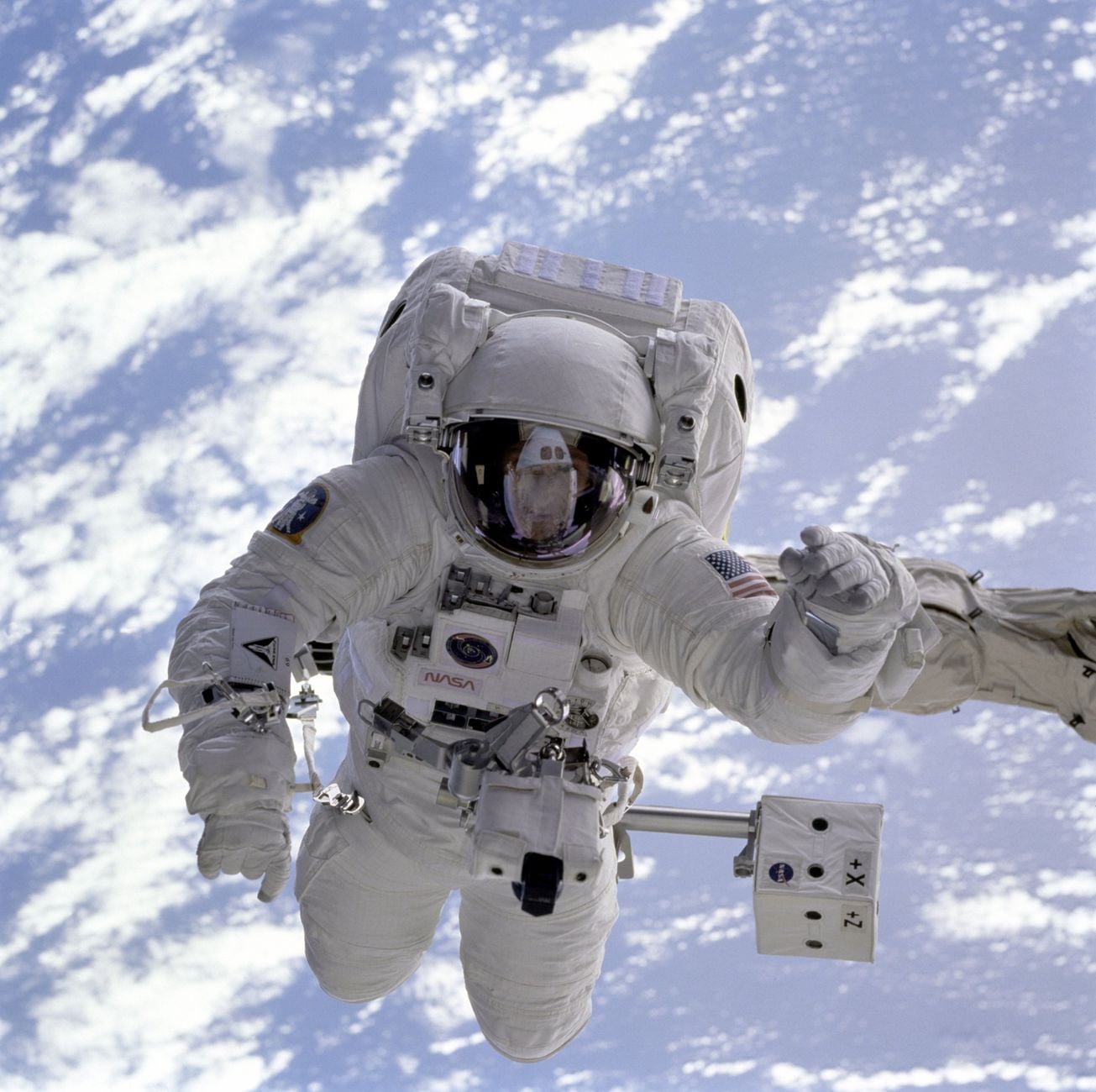
Astronauts have repeatedly described a strange odour after spacewalks: metallic, burnt, faintly meaty, and unlike the ordinary smell inside a spacecraft. The important qualifier is that nobody is smelling space while outside. In vacuum, there is no breathable air carrying scent molecules to the nose.
The smell is noticed after the spacewalk, when astronauts return through an airlock, repressurise the compartment, remove helmets, and bring suits, gloves, tools, and exterior surfaces back into breathable air. At that point, the equipment that has been exposed to vacuum can produce a brief, distinctive odour.
That is why the common shorthand, “space smells like seared steak and hot metal,” is both vivid and slightly misleading. The more careful statement is that astronauts have reported a burnt-metal, welding-fume, ozone-like smell on hardware that has just been outside.
What astronauts have reported
The descriptions have been consistent enough to survive as one of the better-known sensory details of spaceflight. In a 2012 Atlantic article, Megan Garber collected astronaut accounts that compared the smell after spacewalks to seared steak, hot metal, and welding fumes. The piece also cited former NASA astronaut Don Pettit’s own account from Expedition 6, in which he noticed the smell after repressurising the airlock.
Pettit’s description is useful because it locates the smell where it was actually encountered. He reported that the odour was present on suits, helmets, gloves, and tools, and that it was more noticeable on fabric than on metal or plastic surfaces. He compared it to a sweet metallic sensation and to welding fumes.
A separate Space.com report from March 2009 captured similar accounts during shuttle mission STS-119. Discovery pilot Dominic “Tony” Antonelli said the smell appeared when the hatch was opened after a spacewalk. Former NASA astronaut Thomas Jones, who had carried out three spacewalks, described a faint acrid odour similar to ozone, burnt gunpowder, or electrical equipment.
Those accounts do not make the smell universal in a strict scientific sense. They do show that multiple astronauts, across different missions, noticed a similar sensory pattern when vacuum-exposed equipment came back inside.
Why the airlock matters
The airlock is the key part of the story. During a spacewalk, an astronaut inside a suit is separated from vacuum by the suit’s pressure garment and life-support system. The astronaut is breathing the suit atmosphere, not sampling the exterior environment.
After the EVA, the crew returns to the airlock. The outer hatch closes, the compartment is repressurised, and the inner hatch opens to the spacecraft or station. Only then can crew members smell anything from the exterior surfaces.
This makes the odour a boundary phenomenon. It is not the smell of empty space itself. It is the smell produced when materials exposed to vacuum, solar radiation, atomic oxygen, and spacecraft operations meet a pressurised atmosphere again.
That is a less tidy story than the popular version, but it is the physically honest one.
The chemistry is still partly inferred
Several explanations have been proposed. Jones suggested to Space.com that atomic oxygen might be involved. In low Earth orbit, oxygen atoms split by solar ultraviolet radiation can interact with spacecraft materials, especially exterior surfaces exposed during an EVA.
Another possibility is that high-energy radiation and vacuum exposure alter surface chemistry on suits and tools, with reactive species or adsorbed compounds released when those surfaces return to air. Ozone-like descriptions fit that broad idea, though they do not by themselves identify a single molecule.
There may also be ordinary spacecraft material effects mixed into the account: plastics, fabrics, lubricants, metals, residues from tools, and the way smell concentrates in the confined volume of an airlock. A human nose is sensitive, but it is not a mass spectrometer.
That distinction matters. The astronaut reports are credible observations. They are not, on their own, a complete chemical analysis.
Why NASA cared about the smell
One reason the odour has attracted attention is practical. Spacecraft are closed environments where unusual smells matter. A new burnt or metallic smell can point to hardware trouble, electrical heating, material outgassing, or contamination. Astronauts are trained to notice sensory changes because the cabin is small and the margin for ignoring anomalies is limited.
The Atlantic reported that NASA had previously discussed recreating the smell for training, including contact in 2008 with scent chemist Steve Pearce. The practical logic was straightforward: if an odour is expected after spacewalks, crews should not mistake it for an immediate emergency inside the vehicle.
That does not make the smell trivial. It makes it operationally useful. A familiar smell after a spacewalk can be filed as part of EVA recovery. An unfamiliar smell in another context may need investigation.
The useful lesson is precision
The popular version of the story is easy to remember because it gives space a smell: steak, metal, welding fumes, gunpowder. It also risks making vacuum sound like an atmosphere with a flavour.
The better version is stranger and more precise. Space itself cannot be sniffed by an astronaut on a spacewalk. But the surfaces that have spent hours outside can carry chemical traces back into a pressurised compartment, and those traces can be vivid enough for experienced crew members to recognise.
That makes the smell less like a tourist detail and more like a small human measurement at the boundary between spacecraft engineering and the environment around it. The nose notices what the suit brings home.
