
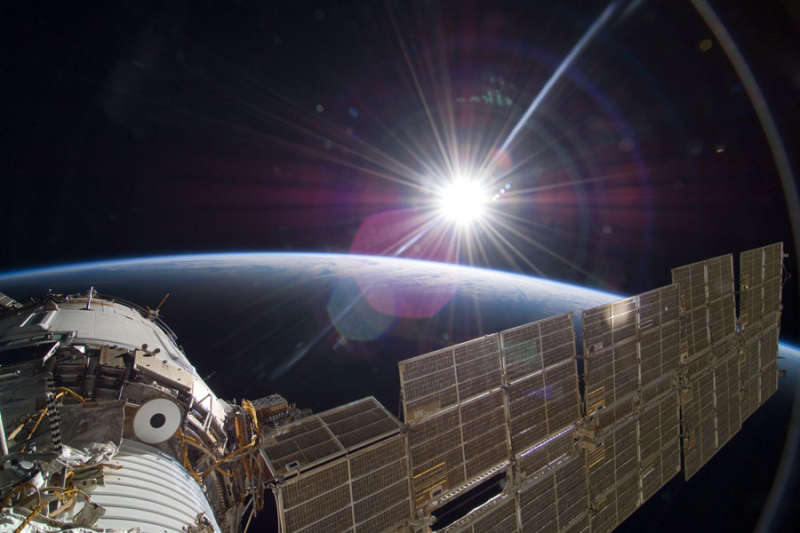
The Sun looks so naturally yellow from Earth that the colour feels like a fact rather than a local effect. Children draw it that way. Weather icons make it that way. Even many adults carry a mental picture of a golden disc, as if yellow were the Sun’s own colour.
The Apollo view was different. On the Moon, astronauts stood in direct sunlight beneath a black sky. There was no blue dome overhead, no hazy daylight filling the air, and no thick atmosphere between their eyes and the solar beam. In that setting, the Sun was not being filtered through the same atmospheric theatre that surrounds every daytime view from Earth.
The Sun’s visible light is essentially white to human eyes. A useful Stanford Solar Center explanation puts it plainly: the Sun is all visible colours mixed together, and those colours appear white. The familiar yellow Sun is not a simple property of the star alone. It is partly the result of Earth getting involved before the light reaches us.
There is a safety note hidden in this subject: the Sun is dangerous to look at directly from Earth, from orbit, or from the Moon without proper protection. The colour question is about physics and perception, not an invitation to stare at it.
What the Moon removes
The Moon does have an extremely thin exosphere, a trace population of atoms and molecules around it. NASA describes it as very thin and tenuous, and not breathable. For the purposes of sky colour, it is effectively airless. It has nothing like Earth’s dense blanket of nitrogen, oxygen, aerosols, water vapour, and dust.
That absence changes everything. On Earth, sunlight enters the atmosphere and meets molecules far smaller than the wavelengths of visible light. Those molecules scatter the shorter wavelengths, especially blue and violet, more strongly than the longer red and orange wavelengths. This is Rayleigh scattering, the same basic physics that NASA Space Place uses to explain why a clear daytime sky looks blue.
On the Moon, there is no comparable sea of air molecules above the observer. Sunlight travels straight to the surface. The sky remains black even during lunar daytime because there is no atmosphere thick enough to scatter sunlight in all directions and make the sky glow.
That is why the lunar scene looks so strange to Earth-trained eyes: bright ground, hard shadows, and black overhead space at the same time. Daylight exists, but a daytime sky does not.
Why Earth’s Sun turns yellow
The yellow Sun seen from Earth is a product of subtraction. Sunlight starts out containing a broad mixture of visible wavelengths. As it passes through the atmosphere, some of the shorter blue wavelengths are scattered sideways out of the direct beam. That scattered light reaches us from across the sky, which is why the sky itself appears blue.
The direct light that continues along the line from the Sun to your eye has lost a little of that blue component. The change is not enormous when the Sun is high in a clear sky, but it is enough for the disc to look slightly warmer than pure white to many observers.
At sunrise and sunset, the effect becomes much stronger because sunlight travels through a longer path in the atmosphere. More blue and green light are scattered out of the direct beam, leaving a redder or orange Sun near the horizon. That is not the Sun changing colour during the day. It is the path through the air changing.
Clouds, pollution, dust, smoke, volcanic aerosols, humidity, and camera exposure can all complicate the colour further. The Sun can look white, yellow, orange, red, or even oddly muted depending on conditions. But the key point remains: Earth’s atmosphere edits the light before human vision interprets it.
White is not a simple word
Saying the Sun is “really white” is useful, but it should not be treated as if the Sun were a painted object with a fixed chip of colour on a chart. The Sun emits a spectrum, not a single colour. Its visible output includes red, orange, yellow, green, blue, and violet light, with different intensities across wavelengths.
Human colour vision then turns that spectrum into a perception. Our eyes and brain do not measure the Sun like a scientific instrument. They compare signals from colour-sensitive cells and interpret them under changing conditions of brightness, contrast, adaptation, and surrounding colour.
That is why the same physical source can seem different depending on where the observer is. From Earth, the Sun is seen through air. From the Moon, it is seen through almost no air at all. From a spacecraft, camera sensors, filters, exposure settings, and image processing may further affect what a viewer sees in a photograph.
The Moon strips away one major variable. Without an Earth-like atmosphere, there is no blue sky and no atmospheric yellowing of the direct solar disc. The Sun is still intensely bright, still physically the same star, but the optical theatre around it has changed.
The sky is painted sideways
The title image of blue wavelengths being scattered sideways is not just poetic. It is close to what happens. Rayleigh scattering sends short-wavelength light in many directions. Some of that light reaches your eyes from parts of the sky away from the Sun. That is why the sky itself becomes a source of blue light.
When you look toward the Sun from Earth’s surface, you are looking at the direct beam after the atmosphere has scattered some short wavelengths away from that line of sight. When you look at the blue sky, you are seeing some of the light that was diverted.
This means Earth’s atmosphere does two things at once. It makes the sky blue by adding scattered blue light to every direction overhead. It also makes the direct Sun look warmer by reducing some of the blue in the beam that continues straight to the observer.
The Moon has no comparable blue scattering field. There is no blue sky to look into. There is no broad dome of diverted sunlight. There is only the Sun, the surface, the astronaut, and space.
A local lesson in perception
The white Sun on the Moon is a reminder that seeing is not only receiving light. It is receiving light after a world has altered it. Earth’s atmosphere is not just a protective layer or a weather system. It is also an optical instrument, one that filters, scatters, softens, and colours the view.
That is why a fact learned on the Moon can make Earth feel stranger. The yellow Sun of ordinary life is not wrong exactly. It is a real perception produced under real atmospheric conditions. But it is local. It belongs to a planet with air.
Step outside that air, and the familiar icon changes. The sky goes black. The shadows sharpen. The Sun loses the colour Earth paints onto it and returns, to human eyes, to something much closer to white.
