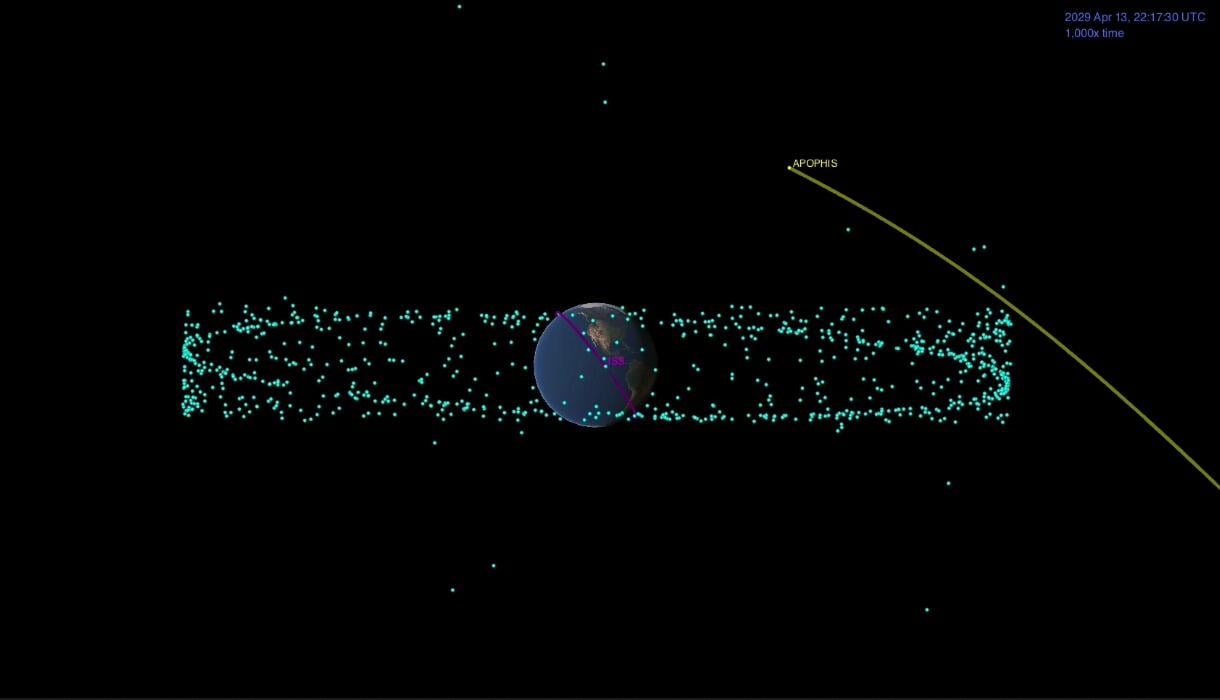
On 13 April 2029, asteroid 99942 Apophis will pass Earth at a distance that sounds uncomfortably small: about 32,000 kilometres above the surface.
Geostationary satellites operate at an altitude of roughly 35,786 kilometres, so Apophis will briefly be closer to Earth than that orbital height. It will not hit the planet, and NASA has ruled out an impact for at least the next century.
The real drama will happen to the asteroid. Earth’s gravity will bend its orbit, alter its rotation and may disturb loose material across its surface. NASA’s OSIRIS-APEX spacecraft will watch the encounter from a distance, then catch up for a detailed inspection of whatever changed.
Inside geostationary altitude does not mean inside a satellite lane
Apophis has a mean diameter of about 340 metres. At closest approach it will pass less than one tenth of the average Earth-Moon distance away, making this the closest known approach by an asteroid of its size that scientists have predicted well in advance.
The satellite comparison is accurate, but easy to picture incorrectly. Apophis will not travel along the equatorial ring occupied by geostationary spacecraft. The comparison concerns altitude, not a flight through a crowded satellite lane. NASA says the encounter presents no danger to Earth, astronauts or satellites.
I recently wrote about how Apophis may become visible to much of the world’s population as a moving point of light. That global spectacle is only half the event. For planetary scientists, Earth itself will become the experimental apparatus.
Earth will change the asteroid without breaking it apart
Apophis is not expected to be torn apart. It will, however, experience a rapidly changing gravitational pull as it approaches and recedes.
That pull will move Apophis from an orbit that takes slightly less than one Earth year around the Sun to one that takes slightly more. Its classification will change from an Aten asteroid to an Apollo asteroid as a result.
The subtler effects may be more revealing. Apophis tumbles rather than rotating neatly around a single axis. Earth’s gravity is expected to change that spin state. The encounter may also produce seismic shaking, shift boulders, expose less-weathered material or trigger small landslides.
Those surface changes are predictions, not guaranteed outcomes. A quiet-looking asteroid after the encounter would still place useful limits on its internal structure and the strength of its surface.
OSIRIS-APEX will witness the flyby before catching up
The spacecraft will not be hovering beside Apophis at closest approach. NASA’s current technical plan says it should begin observing the asteroid as a point of light on 2 April 2029, when the two are about five million kilometres apart.
During the 13 April encounter, OSIRIS-APEX is expected to observe from roughly 50,000 kilometres away. About an hour after Apophis passes Earth, the spacecraft will make its own Earth gravity assist. That manoeuvre will place it on a trajectory closely resembling the asteroid’s.
Orbital mechanics prevent an earlier rendezvous. The mission’s 2025 technical overview places the start of detailed study on 5 June 2029. NASA’s public mission page lists the rendezvous more generally as June 2029.
This distinction matters. OSIRIS-APEX can record the encounter in real time from afar, but its close maps will mostly show the aftermath. Scientists will compare those observations with radar, telescope data and images collected before the flyby.
The spacecraft already completed one asteroid mission
OSIRIS-APEX began life as OSIRIS-REx. It orbited the carbon-rich asteroid Bennu, collected rocks and dust in 2020, and delivered a capsule containing that material to Earth in September 2023.
The main spacecraft remained healthy and retained about a quarter of its fuel. NASA redirected it towards Apophis and changed the final word in its name from Regolith Explorer to Apophis Explorer.
The second mission is not a sample return. Over roughly 18 months near Apophis, the spacecraft will use cameras, spectrometers and a laser altimeter to map the asteroid’s shape, composition and surface in detail.
Near the end, it is planned to descend to within about five metres and fire its thrusters towards the ground. The exhaust should lift dust and small rocks, exposing material beneath the space-weathered surface. NASA describes this as a reprise of the Bennu sampling manoeuvre, but without collecting a sample.
A natural planetary-defence experiment
Apophis is often called potentially hazardous because of its size and the way its orbit approaches Earth’s. That label describes a category, not a prediction of impact. Its 2029 path is known well enough that intervention would be unnecessary and inappropriate.
What the flyby offers is a chance to improve the physical models that would matter for a genuinely dangerous asteroid. Many small worlds are rubble piles, loose assemblies of rock held together by weak gravity. Their response to an attempted deflection depends partly on their density, internal structure and surface strength.
Earth will apply a known gravitational stress to Apophis. Telescopes will measure the change in orbit and spin, while OSIRIS-APEX will look for rearranged boulders, fresh patches, cracks or missing material.
No single observation will reveal the asteroid’s complete interior. Yet the before-and-after comparison should show how a 340-metre stony body responds when a planet pulls hard on it.
I like the economy of this mission. The spacecraft already returned its sample. The asteroid is already coming. Earth provides the force, and an experienced probe follows behind to read the result.