
On 13 April 2029, asteroid 99942 Apophis will pass roughly 32,000 kilometres above Earth’s surface. For a few hours it will be closer than satellites in geostationary orbit, bright enough to see without a telescope, and moving fast enough for its progress against the stars to become apparent.
The encounter is safe. NASA and ESA have ruled out an Apophis impact for at least the next century. A newer question is how much of humanity could stand outside and watch it happen.
Visibility maps presented in June 2026 put the potential audience as high as 7.6 billion people, close to 90 per cent of the world’s population. It describes people living somewhere inside the cumulative viewing region, not those sharing one clear view at the same moment.
The estimate came from a workshop presentation
Astrocartographer Michael Zeiler and astronomer Richard Tresch Fienberg presented the work at the Apophis T-3 Years workshop at the University of Padua on 18 and 19 June 2026. It was a conference presentation, not a peer-reviewed paper. The meeting covered modelling, missions, observations and public communication.
The maps begin with Apophis’s calculated trajectory. For each moment, the geometry determines where the asteroid is above the local horizon, whether the Sun is far enough below it and whether Apophis should be bright enough for unaided vision. A population layer then estimates how many people live in those changing regions.
According to reporting on Zeiler and Fienberg’s presentation, about 7.6 billion people fall somewhere within the cumulative footprint. The window lasts roughly seven hours, beginning near Australia and Asia around 15:00 UTC and ending over the North Atlantic near 22:00 UTC.
Cumulative does a great deal of work here. Australia, Asia, Africa, Europe and parts of eastern South America enter the useful viewing geometry at different times. The calculation does not put 90 per cent of humanity under the same night sky simultaneously, and North America is poorly placed for an unaided view.
Geometry is not a guarantee of clear skies
The calculation says where seeing Apophis should be possible. It cannot forecast local cloud, haze or how much city lighting will wash out the stars. Buildings, trees and terrain will remove more sightlines. Many people will simply not be looking.
Even under good conditions, Apophis will not resemble a meteor. It will not enter the atmosphere or trail fire. To the naked eye it should look like a modest star moving steadily across the background.
Fienberg’s observing preview for Sky & Telescope puts its peak near magnitude 2.8, comparable to an ordinary visible star. At that time, it may cross about 30 degrees of sky per hour, rising above 45 degrees per hour near closest approach. The Moon will be new, so moonlight should not interfere.
Peak brightness is expected around 20:35 UTC. Closest approach comes about an hour later. Those moments differ because the fraction of Apophis’s sunlit side facing Earth changes as it passes, so decreasing distance does not keep making it brighter.
Why Apophis has more than one quoted size
ESA calls Apophis roughly 375 metres across. NASA lists a mean diameter of about 340 metres and a long axis of at least 450 metres. The figures are not evidence that the asteroid has grown or that its size is unknown by a hundred metres. Apophis is elongated and irregular, so a mean diameter, an approximate overall size and its longest dimension answer slightly different questions.
The distance comparison also needs care. Geostationary satellites orbit about 35,786 kilometres above the equator. Apophis will come closer to the surface than that, but many other satellites fly hundreds or thousands of kilometres up and will remain far beneath it.
Nor is the asteroid travelling around the equatorial geostationary ring. It cuts across near-Earth space on a different path. NASA’s current overview says the flyby poses no danger to satellites, astronauts or anyone on Earth. “Closer than some satellites” describes altitude; it does not describe a collision course through a belt of spacecraft.
The same radar that removed the danger enabled the map
When Apophis was discovered in 2004, limited observations briefly left Earth inside part of the possible-orbit region. Further telescope data removed the 2029 impact route, but a small possibility in 2068 persisted because the close encounter will substantially alter the asteroid’s orbit.
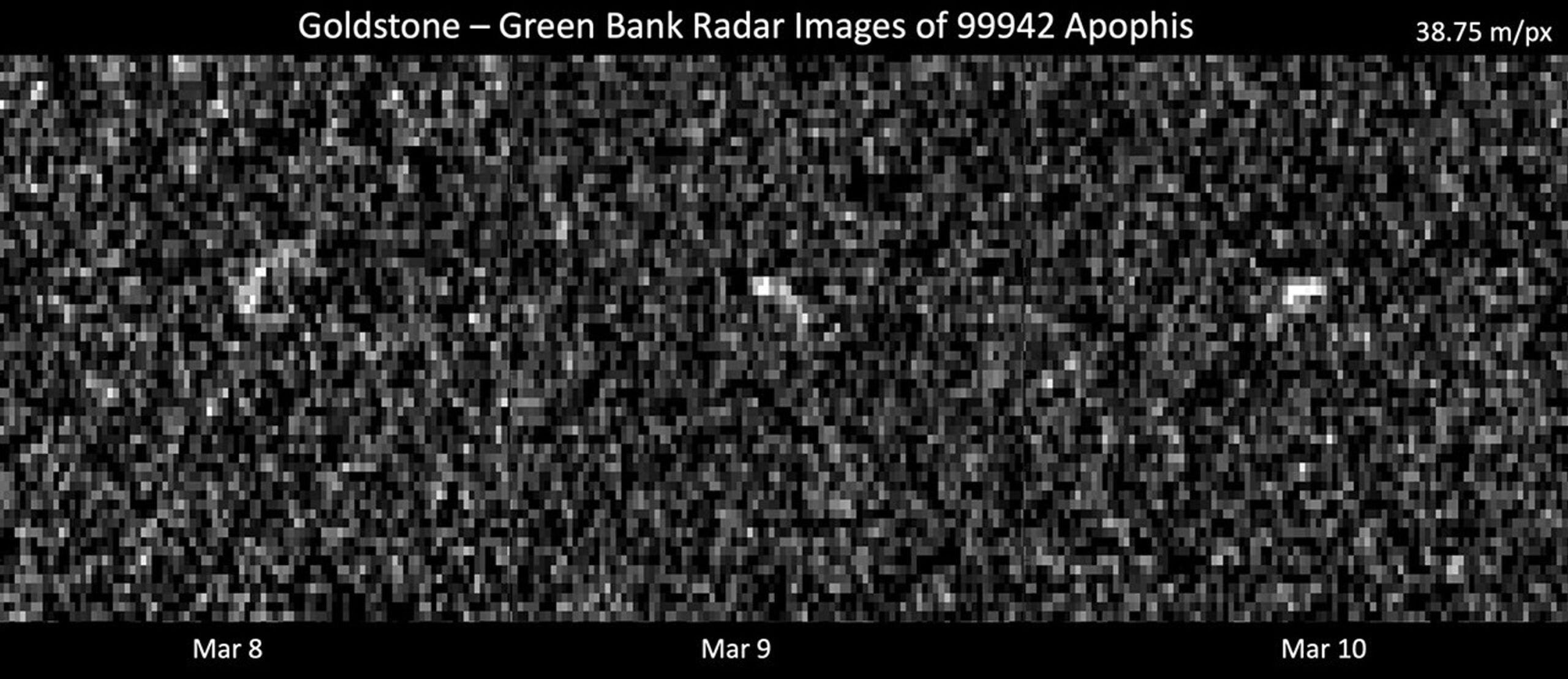
That residual concern ended after Goldstone and Green Bank radar observations in March 2021. The radar images themselves are only a few bright pixels, recorded when Apophis was 17 million kilometres away. Precise echo timing mattered more than visual detail: it tightened the orbit enough for NASA to rule out impact for at least 100 years and remove Apophis from the Sentry risk table.
SpaceDaily recently told the longer story of that changing risk and the spacecraft preparing for 2029. The visibility work rests on the same achievement. The orbit is now constrained well enough to map not merely a safe miss, but the movement of a naked-eye point of light across local horizons.
What 90 per cent should mean by 2029
The maps will improve as new observations refine the trajectory and local viewing predictions. Weather forecasts will not become useful until much closer to the date. By then, city-specific charts should show where and when to look, while binoculars may rescue the view where light pollution makes naked-eye detection difficult.
The eventual audience will be smaller than 7.6 billion. The 90 per cent figure describes access in principle, subject to darkness, altitude, cloud, artificial light and attention. It is not a forecast of participation.
That distinction does not make the event ordinary. A safely passing asteroid a few hundred metres wide will move through naked-eye range over some of Earth’s most populated regions. The calculation tells us how widely nature is offering the view. Conditions on the ground, and whether people remember to look up, will decide how many accept it.