
When Apollo 11 splashed down in the Pacific on 24 July 1969, Neil Armstrong, Buzz Aldrin and Michael Collins were home, but they were not yet allowed to go home. NASA had no evidence that the Moon carried life. It also had no evidence strong enough to dismiss the possibility completely.
The agency therefore placed the astronauts, the command module Columbia and 49 pounds of lunar material inside a system of biological barriers. The quarantine clock ran for 21 days from the crew’s first exposure to lunar material, not for 21 days after splashdown. Before it ended, Armstrong turned 39 inside the Lunar Receiving Laboratory while his family watched through glass.
The uncertainty began before Apollo 11 launched
By 1969, few researchers expected to find dangerous organisms on the Moon. Its airless surface was exposed to radiation, severe temperature changes and vacuum. But expecting a lifeless world was not the same as proving one, particularly before scientists had examined material returned directly from its surface.
NASA treated that remaining uncertainty as a planetary-protection problem called back contamination: the possibility that astronauts or samples might carry something harmful to Earth. The agency built the Lunar Receiving Laboratory in Houston to contain the crew, Columbia and the samples while doctors and scientists looked for evidence of lunar biology.
The facility had separate areas for people, spacecraft and rocks. Air-control systems were designed to prevent material from escaping, while vacuum gloveboxes also protected the Moon samples from contamination by Earth’s atmosphere. The same barrier served two purposes: protect Earth from the samples and protect the samples from Earth.
Quarantine began in the Pacific
The barrier could not begin in Houston because the astronauts landed thousands of kilometres away. After splashdown, a Navy swimmer provided Biological Isolation Garments before the crew left Columbia. The suits covered their bodies and filtered exhaled air.
Armstrong, Aldrin and Collins were then taken by helicopter to the USS Hornet and moved into a converted 35-foot Airstream trailer known as the Mobile Quarantine Facility. A flight surgeon and an engineer joined them. President Richard Nixon welcomed the crew through the trailer’s window, an early image of the odd distance imposed on three men who had just completed the first lunar landing.
The sealed trailer travelled with them from the recovery ship to Houston. As NASA’s history of the mobile facility explains, it could be moved by ship, aircraft and road before docking directly to the Lunar Receiving Laboratory without breaking isolation.
The rocks and spacecraft entered their own sealed areas
The first Moon-rock containers reached Houston on 25 July, a day after splashdown. Technicians opened the first box inside a glovebox about 48 hours after the landing. Scientists examined the samples while portions were exposed to plants, animals and other biological systems as part of the search for possible hazards.
The astronauts arrived in the early hours of 27 July. Columbia came last, reaching the laboratory’s spacecraft area on 31 July. The three elements named in the quarantine plan were therefore not sitting together in one chamber. They occupied connected but distinct controlled spaces behind the laboratory’s biological barrier.
Doctors checked the astronauts each day for signs of infection. The crew also inspected Columbia, wrote reports and conducted technical debriefings. Those meetings took place in a glass-walled conference room, with the astronauts on one side and colleagues on the other.
Armstrong turned 39 inside the barrier
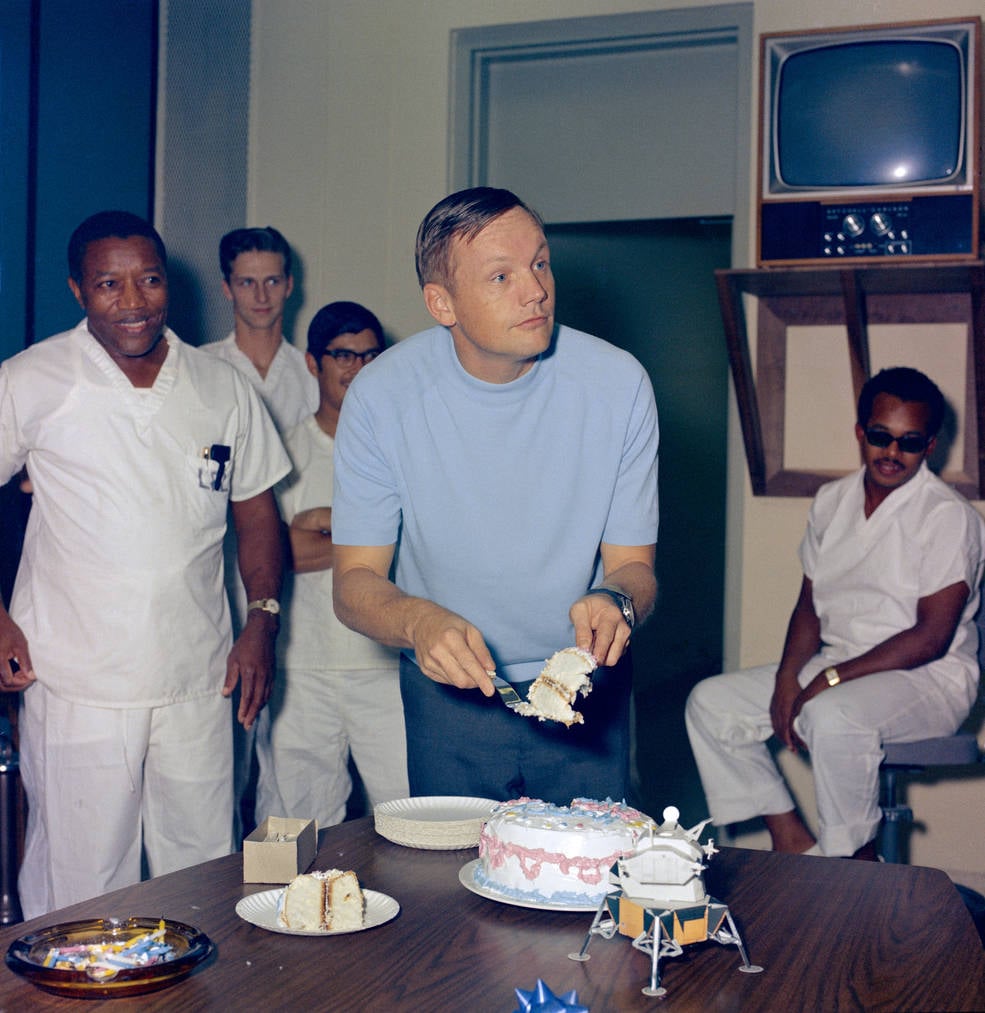
On 5 August, staff interrupted the routine with a surprise birthday party for Armstrong. The kitchen produced a decorated cake with candles. Armstrong blew them out, sliced the cake and distributed pieces to people quarantined with him.
His wife, Janet, and other family members remained outside the glass partition. NASA’s account of the celebration records that Armstrong jokingly pretended to pass slices through the glass. It was an ordinary family gesture made impossible by a precaution against organisms no one had ever detected.
The scene also shows what quarantine meant in practice. It was not 21 days of inactivity. The crew worked through debriefings and medical examinations while technicians processed samples nearby. The glass allowed information, conversation and photographs to pass while maintaining the physical separation NASA had promised.
The barrier came down after the evidence stayed quiet
On 10 August, doctors cleared Armstrong, Aldrin and Collins to leave. No lunar infection had appeared in the crew or the other quarantined personnel. Tests of the samples likewise produced no evidence of harmful microorganisms.
Apollo 12 and Apollo 14 crews went through the same 21-day process. Apollo 13 did not land, and NASA ended the requirement before Apollo 15 after the earlier missions found no biological hazard. The Apollo 11 quarantine ended without an alarm, which can make it look excessive in hindsight.
That calm outcome was the point of the system. NASA was bringing material from another world into Earth’s biosphere for the first time and could not reverse the exposure once it occurred. The agency built a chain of containment around a low-probability risk until samples, people and time supplied the evidence needed to open the door.
