
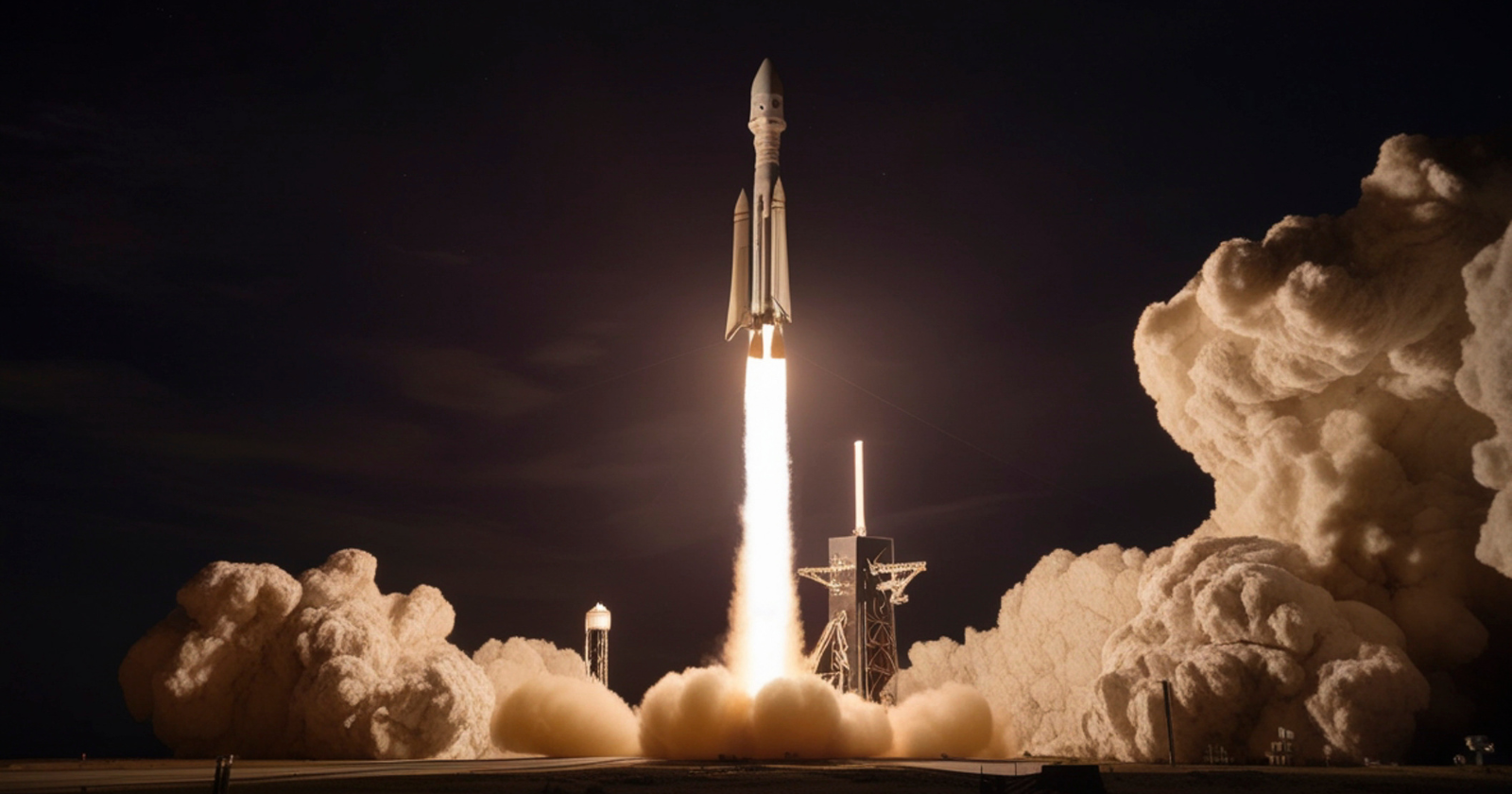
The core of this story holds up. On 14 November 1969, the Saturn V carrying Apollo 12 was struck by lightning twice in its first minute of flight, the spacecraft’s telemetry dissolved into nonsense, and a flight controller named John Aaron salvaged the situation by recognising a fault pattern almost no one else knew and calling for a switch almost no one else understood.
Aaron was on shift that morning as the mission’s EECOM, the controller responsible for the electrical, environmental, and communications systems of the spacecraft. He was young, a few years into his time at NASA, and not a senior figure in the room. That detail matters to the story, because the recovery turned on something he happened to know rather than on rank.
What the two strikes actually did
NASA’s launch records put the first strike at 36.5 seconds after lift-off, with the vehicle at roughly 6,000 feet, and a second discharge at about 52 seconds. The rocket itself, rising through a charged weather system on a column of ionised exhaust, most likely created the conductive path that triggered the lightning. It was not struck by a storm so much as it completed a circuit.
The effect inside the spacecraft was immediate. Three fuel cells dropped offline, the command module’s instrument panel lit up with warning lights, the guidance platform lost its reference, and the telemetry stream reaching Houston turned to garbage. As NASA’s account of the incident records, commander Pete Conrad reported after the second strike, “OK, we just lost the platform, gang. I don’t know what happened here; we had everything in the world drop out.” Flight director Gerry Griffin, reading the same scrambled data on the ground, expected he would have to call an abort.
Why Aaron recognised the pattern
What separated Aaron from everyone else looking at those numbers was a piece of curiosity from about a year before the flight.
During a test at Kennedy Space Center, Aaron had noticed an odd set of telemetry readings and, on his own initiative, traced them back to an instrumentation unit called the signal conditioning equipment, or SCE. The SCE took raw sensor data and converted it into the voltages the telemetry system could transmit. Aaron had learned that under low-voltage conditions it produced a particular signature of nonsense, distinctive enough to recognise again.
So when Apollo 12’s telemetry collapsed, Aaron was not looking at random failure. He was looking at a pattern he had seen once and understood. The lightning had caused a voltage drop, the SCE was misbehaving in the way low voltage made it misbehave, and the data was not lost so much as miscoded.
The switch the room did not know
Aaron’s recommendation to the flight director was four words: “Try SCE to auxiliary.” The auxiliary setting kept the unit working even at low voltage, which would restore usable telemetry and let controllers see what state the spacecraft was actually in.
Almost no one recognised the instruction. Griffin did not know the switch. The capsule communicator, astronaut Gerald Carr, asked Aaron to repeat it, then said on the loop, “What the hell’s that?” He relayed it to the crew anyway. Aboard the spacecraft, lunar module pilot Alan Bean knew where the obscure switch was, found it, and flipped it. Telemetry came back. From there the fuel cells could be brought back online, and controllers could begin assessing the rest. The episode is the origin of the NASA honorific Aaron earned afterward, “steely-eyed missile man.” NASA’s own Apollo Flight Journal retrospective examines the strike and recovery in detail, fifty years on.
What the clean version leaves out
The story is usually told as one switch saving one mission, and the compression is worth noticing, because the actual sequence was longer.
Restoring telemetry did not by itself fix the spacecraft. It restored the ability to see. The fuel cells still had to be brought back manually, and the guidance platform, which had lost its orientation reference, had to be realigned, a step the crew carried out later once Apollo 12 was in Earth orbit. The decision to commit to the Moon was not made in the sixty seconds at Aaron’s console. It came once the vehicle had reached orbit and its systems had been checked, when the crew received the “Go for TLI” call to head for the Moon. Aaron’s call was the hinge the rest depended on, but “kept going only because of one switch” telescopes a chain of recoveries into a single moment.
It is also worth noting that recognition alone saves nothing. Aaron’s pattern recognition mattered because Bean knew the switch and acted on it. A correct call that no one in the spacecraft could execute would have changed nothing.
The lasting institutional result was not the catchphrase. In February 1970, the Apollo 12 anomaly investigation concluded that the vehicle and its exhaust plume had probably triggered the strikes by forming a conduction path through the weather system, a possibility not previously considered. NASA tightened its launch weather rules accordingly, barring launches through cumulonimbus formations and within set distances of thunderstorm clouds. That change, rather than the switch itself, is what kept the next flight from depending on someone in the room having been curious a year earlier.
