
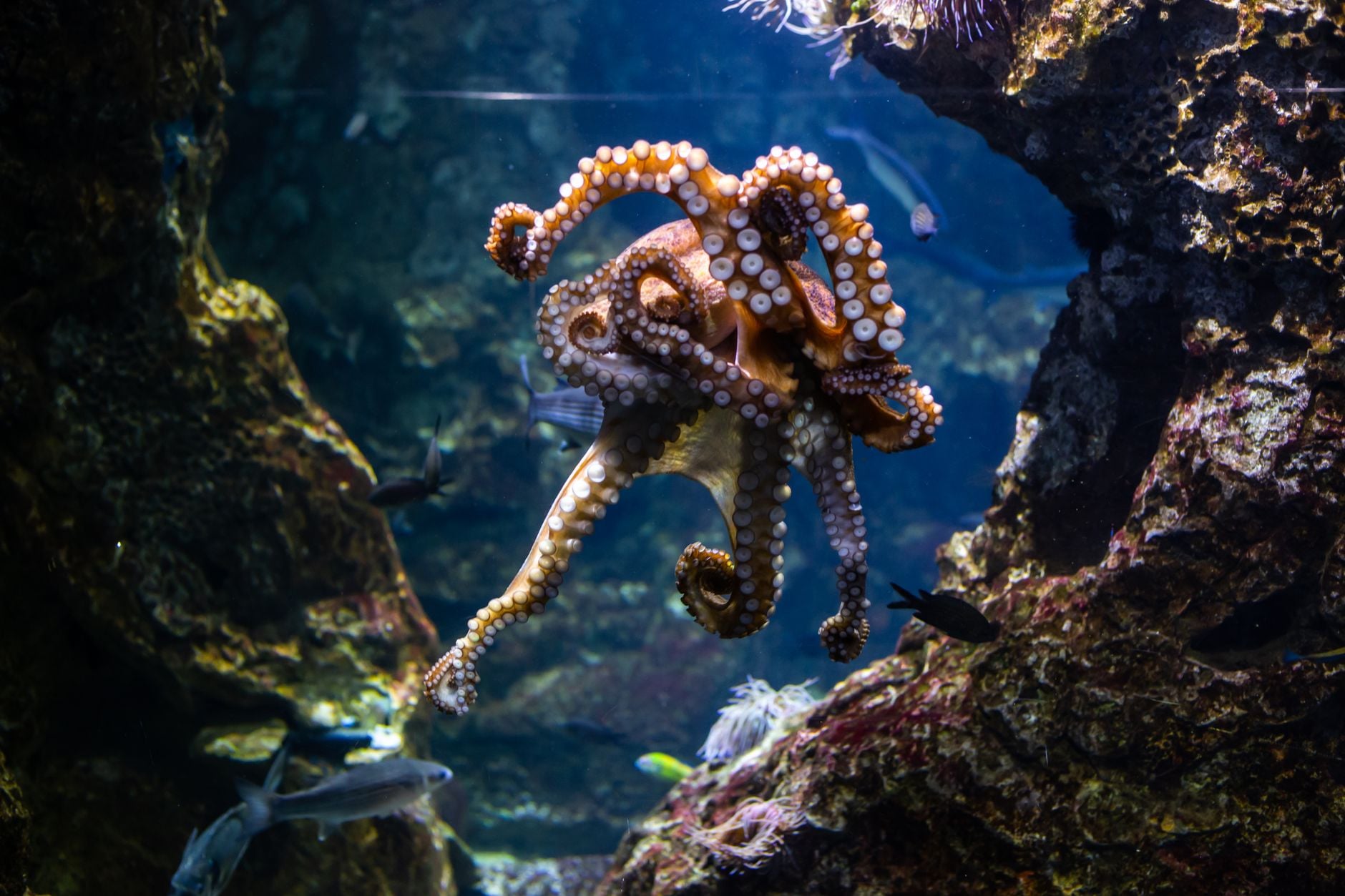
An octopus looks like one animal, but its nervous system is arranged more like a living network. The head matters. The brain matters. But a large part of what makes an octopus so difficult to compare with familiar animals is distributed through the arms themselves.
The basic anatomy already sounds strange enough. Octopuses have three hearts and copper-based blue blood. They have no bones, no rigid joints and no fixed arm positions. They can squeeze, stretch, taste, grip, crawl, hunt and disappear into places that would trap an animal built around a skeleton.
The nervous system is the deeper surprise. In a 2012 Current Biology review, Binyamin Hochner described the octopus as an animal whose control system cannot be understood as a brain simply issuing commands to passive limbs. The octopus has roughly half a billion neurons, and most of that neural machinery is not in the central brain.
That is the fact behind the shorthand that each arm can almost think for itself. It is not quite a separate mind. But each arm has dense local nervous circuitry, a continuous axial nerve cord, muscles that can bend in almost any direction, and suckers that gather chemical and tactile information from whatever they touch.
Three hearts and blue blood
The three-heart arrangement is a circulatory solution to a demanding body plan. Two branchial hearts pump blood through the gills. A larger systemic heart then sends oxygenated blood through the rest of the body. The system has to serve arms, mantle, brain, skin, muscles and organs in an animal that can suddenly jet away or creep slowly over a reef.
The blue colour comes from hemocyanin, the oxygen-carrying protein in octopus blood. Hemoglobin, the oxygen carrier in human blood, uses iron. Hemocyanin uses copper. When oxygenated, that copper-based chemistry gives the blood a bluish tone.
This is not just decorative biology. Hemocyanin is useful in cold or low-oxygen marine environments, though it is not simply a superior version of hemoglobin. It is part of a very different physiological bargain, one that works for an animal whose life is spent in seawater rather than air.
A nervous system spread through the arms
The headline number is usually given as about 500 million neurons. That makes the octopus one of the most neurologically complex invertebrates. But the distribution matters more than the total. A large share of those neurons sits outside the central brain, especially in the arms.
For vertebrates, the natural picture is a central brain that maps the body and directs limbs through a spinal cord. The octopus does not fit that model neatly. Its arms are soft muscular hydrostats, meaning they use muscle structure and internal pressure rather than bones and joints to create movement. A human elbow can bend in a limited set of ways. An octopus arm can bend, shorten, lengthen, twist and stiffen along much of its length.
That flexibility would be difficult to control by micromanagement from the head. The arm itself handles much of the local work. Earlier work on octopus arm extension, including a 2001 Science paper by German Sumbre and colleagues, showed how the arm can use peripheral motor programs to produce reaching movements. In plain terms, some of the control is built into the limb.
The suckers that taste the world
Octopus arms do not merely move. They sample the world. Each arm carries rows of suckers that can grip surfaces and gather sensory information. A 2020 Cell paper by Lena van Giesen and colleagues identified molecular machinery behind chemotactile sensation in octopus suckers, helping explain how octopuses can taste by touching.
That ability is central to how an octopus hunts. An arm can probe a crevice, feel the surface, sense chemical traces, reject something unhelpful or tighten around prey. The head does not need to receive a full report before every tiny adjustment. The arm has enough local information to act quickly.
This is where the phrase “decide” needs care. An octopus arm is not making reflective decisions in the way a person might. It is doing something more biological and more immediate: integrating touch, chemical signals and motor control locally, then sending information back into the wider animal. The result looks like autonomy because, at one level, it is autonomy.
One animal, many control loops
The octopus brain still coordinates the animal. Learning, vision, memory, choice and overall behaviour do not disappear into the arms. But the relationship between centre and limb is less like a commander and eight obedient ropes than a negotiation among many control loops.
That helps explain why octopuses seem so fluid in situations that would defeat a rigid body plan. One arm can explore while another anchors. A third can manipulate an object. A fourth can brace against the seafloor. The animal does not have to calculate every joint angle because there are no joints in the usual sense, and much of the sensing and adjustment happens where the contact occurs.
Roboticists study this for obvious reasons. A soft arm that can bend anywhere, sense locally and adjust without constant central instruction would be useful in environments where rigid machines struggle. Octopuses have been solving that problem for much longer than engineers have been building soft robots.
A different path to intelligence
The comparison with human intelligence can mislead. Octopuses did not evolve down a vertebrate road and stop at a different station. They are molluscs, closer in the broad tree of life to clams and snails than to mammals. Their intelligence emerged from a body with no skeleton, eight flexible arms, short lifespans and intense pressure to hunt and avoid being eaten.
That is why the octopus feels so unusual. Its biology separates abilities humans often assume must belong together. It can solve problems without a vertebrate brain. It can manipulate objects without bones. It can taste without a tongue. It can coordinate eight arms without using a body map that looks like ours.
The three hearts and blue blood are memorable because they sound like facts from another planet. The nervous system is stranger still because it shows how many ways an animal can be organised and still become capable, flexible and alert. An octopus is not a head with eight tools attached. It is a body-wide intelligence, with much of the conversation happening in the arms.
