
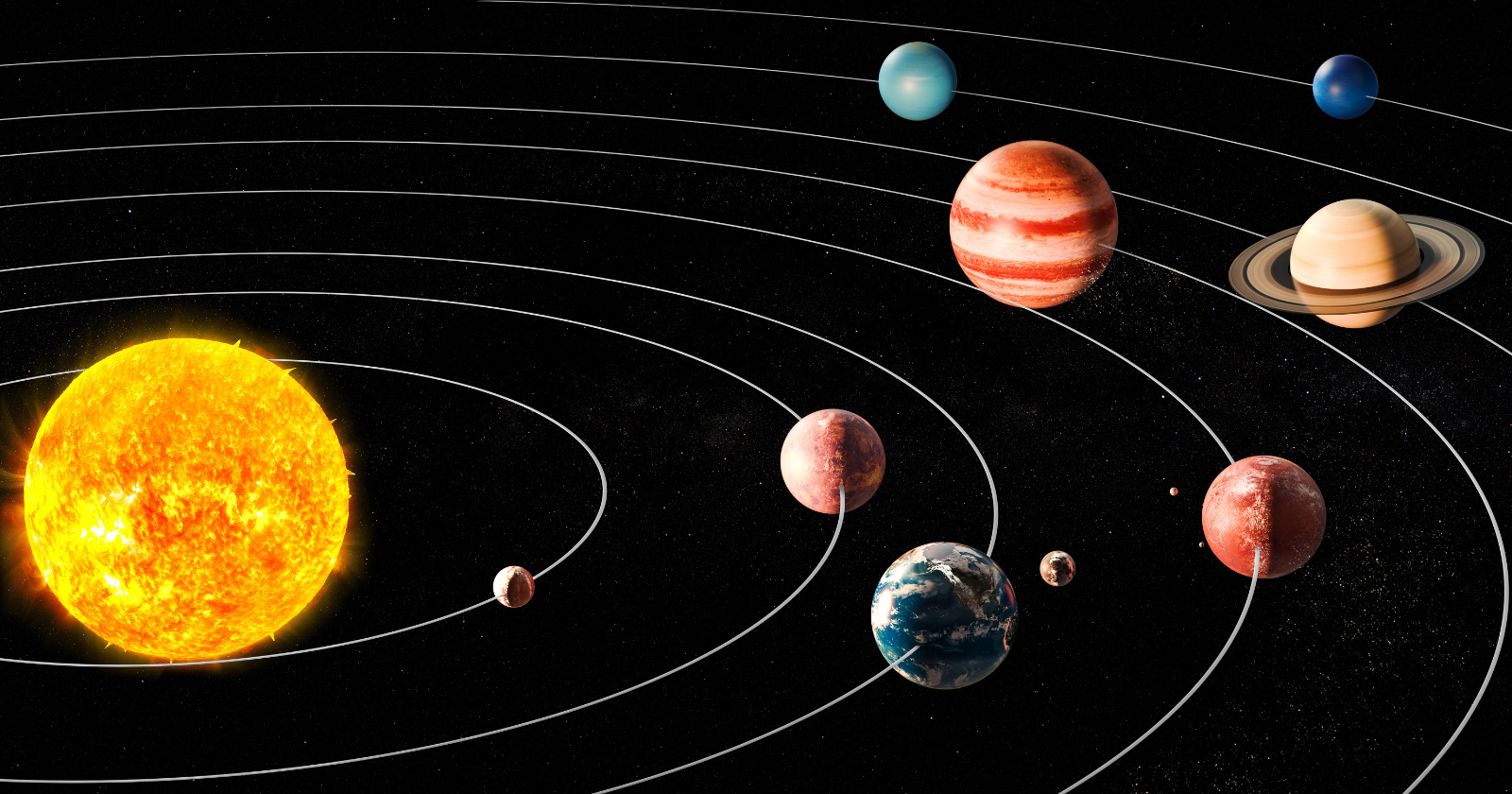
Most people would say Venus is Earth’s nearest planetary neighbour. Averaged across its orbit, though, the planet that stays closest to Earth is Mercury. The claim comes from a 2019 commentary in Physics Today by Tom Stockman, Gabriel Monroe and Samuel Cordner, and it has a tidy, faintly irritating quality: it is correct, and it is mostly a point about what the word “closest” is being asked to do.
The usual answer is not wrong so much as it is answering a different question.
Why people say Venus
Venus is the planet whose orbit runs nearest to Earth’s, and the one that makes the closest single approach. When Venus passes between Earth and the Sun, the gap between them can fall to about 38 million kilometres, closer than any other planet comes. Venus is also the planet most similar to Earth in size. So calling it our closest neighbour is reasonable, as long as “closest” means “comes nearest at its nearest.”
The authors point out that even NASA’s own materials have described Venus as our closest planetary neighbour. By the closest-approach measure, that holds.
What the calculation actually shows
The trouble starts with how the average distance between two planets is usually worked out. The common shortcut is to take each planet’s average distance from the Sun and subtract one from the other. For Earth and Venus that gives a small number, and Venus comes out closest on average.
That shortcut quietly assumes the two planets sit on the same side of the Sun. They rarely do. Most of the time the planets are scattered around their orbits, often on opposite sides of the Sun from each other, and the subtraction ignores all of that.
Stockman and his colleagues used two approaches instead. One was a formula they called the point-circle method, which averages the distance across every position each planet can occupy. The other was a simulation that placed the planets in their orbits and stepped forward every 24 hours for 10,000 years, recording which planet was nearest Earth at each step. Over that run, Mercury was Earth’s closest planet about 47 per cent of the time, Venus about 36 per cent, and Mars about 17 per cent.
The part that surprises people
The same calculation produces a stranger result. By this averaging, Mercury is not only Earth’s closest planet on average. It is the closest planet, on average, to every other planet in the solar system, the outer giants included.
The reason is that Mercury hugs the Sun. It never strays far from the centre of the system, so it never gets very far from anything else. A planet on a wide outer orbit spends long stretches on the far side of the Sun from any given neighbour. Mercury, kept close in, avoids those long absences. It wins on consistency rather than on any single close pass.
What it does and does not mean
It does not mean the order of the planets has changed. Mercury is still the innermost planet, and Venus’s orbit is still the one that runs closest to Earth’s. It does not mean Mercury ever comes physically closer to Earth than Venus does at its nearest. Venus still holds the record for the closest approach.
What changed is the answer to one specific question: averaged over a long span of time, which planet is nearest. Not everyone accepts that this is the most useful sense of “closest neighbour,” and the disagreement is mostly about the definition rather than the arithmetic, which is not really in dispute.
There is a practical version of the question too, and it has not changed. For anyone planning a spacecraft, the time-averaged distance is not the figure that matters. What matters is the geometry at launch and the close approaches that open transfer windows, and by that measure Venus and Mars are still the near targets they have always been.
The Mercury result rearranges a piece of trivia. It does not rearrange the solar system.
