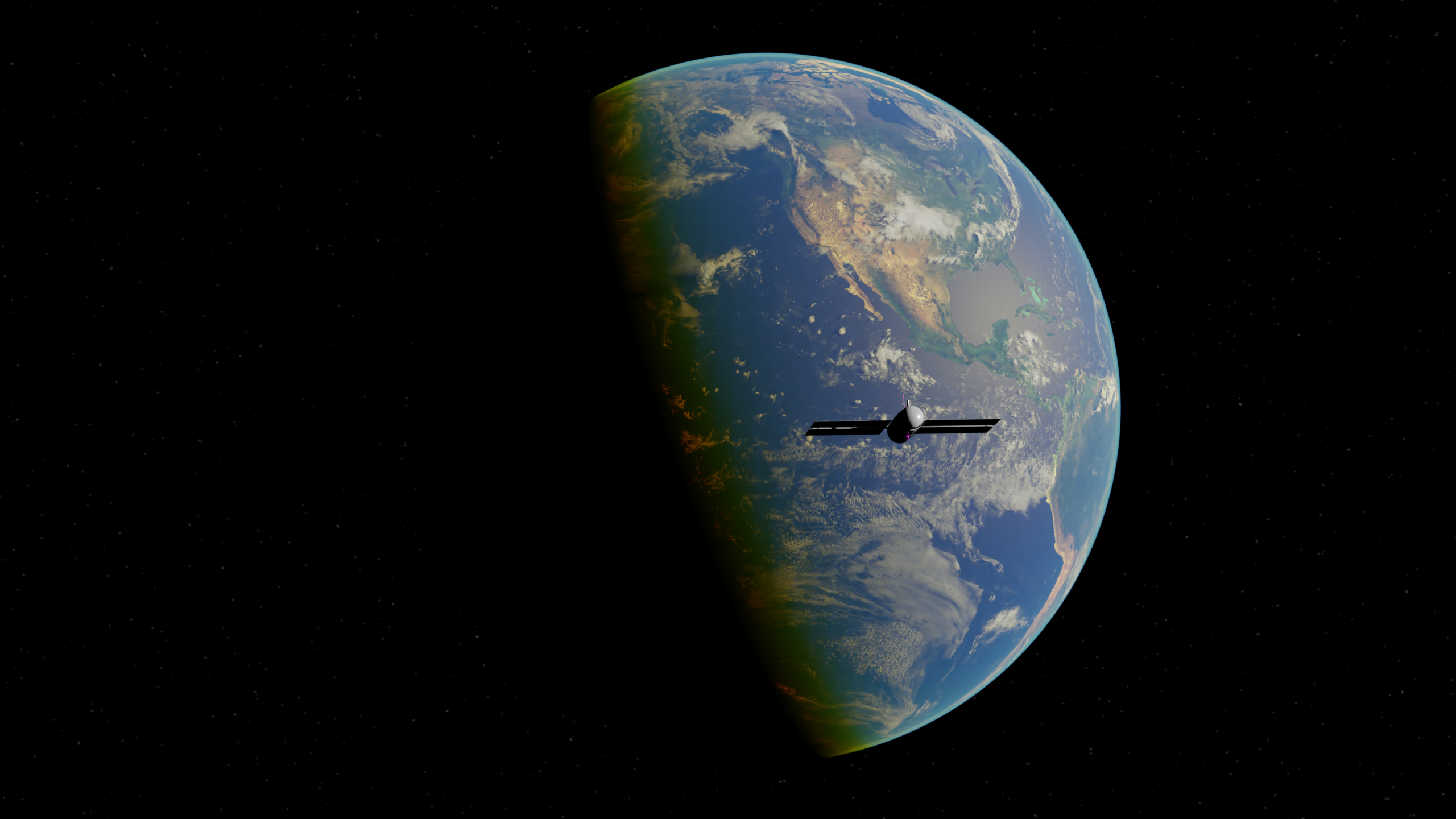
I’ve spent the last few days reading through how AI actually gets used on spacecraft, as opposed to how it gets talked about, and the honest version of the story turns out to be less dramatic and more interesting than the headlines around it. Almost none of what’s flying today looks like a spacecraft making judgment calls the way a person would. What it looks like, again and again, is engineers using a narrow, carefully bounded piece of software to solve one very specific problem: there usually isn’t time to wait for Earth to weigh in, or there isn’t enough bandwidth to send everything home, or there are simply too many spacecraft now for people to watch all of them at once.
That framing matters more than the word “AI” does, I think. Once you see these systems as answers to a physical constraint rather than a demonstration of cleverness for its own sake, the actual examples make a lot more sense.
The problem AI is actually solving
Start with the constraint that shows up most often: distance. A radio signal from Earth takes on the order of four to twenty four minutes to reach Mars, one way, depending on where the two planets are in their orbits. That means there’s no such thing as joysticking a rover on Mars in real time. Every command a rover receives is really a plan, written and checked by people on Earth the previous day, uploaded, and then carried out on its own the following Martian day, or sol.
That gap is where the first genuinely interesting piece of onboard autonomy earns its place.
A rover deciding for itself what’s worth zapping
Since May 2016, NASA’s Curiosity rover has carried software called AEGIS, short for Autonomous Exploration for Gathering Increased Science, which does something narrow but real: it looks at the rover’s own navigation camera images, picks out rocks or terrain features that match criteria scientists back on Earth have specified in advance, and points the ChemCam laser spectrometer at the best match, all without waiting for a command from home.
Across its first four years of use, AEGIS hit the kind of material scientists actually wanted more than 93 percent of the time, compared with about 24 percent when the rover’s team had to guess in advance without seeing the terrain. That’s not a subtle improvement. It’s the difference between a system that mostly wastes its shots and one that mostly doesn’t, and the gap exists purely because the software gets to look at the ground the rover is actually standing on, on the same day, instead of relying on a plan made two days and one long light delay earlier. NASA later extended the same approach to SuperCam on the Perseverance rover, which is doing more or less the same job at a newer site.
I find something quietly appealing about how unglamorous the actual mechanism is. AEGIS isn’t reasoning about geology in any deep sense. It’s matching simple visual criteria, brightness, texture, shape, against a shortlist scientists already wrote down, and choosing the closest match. The intelligence, such as it is, was mostly supplied in advance by geologists. What AEGIS adds is timing: it gets to act on information a human controller wouldn’t see for another day or more.
The same idea, shrunk down to a shoebox
A different constraint produces a similar answer at the other end of the size scale. Small Earth observation satellites, some no bigger than a shoebox, have limited power, limited onboard storage, and a limited window each orbit to actually talk to a ground station. A camera pointed at Earth captures plenty of images that turn out to be mostly cloud, and a cloudy image is close to useless for most Earth observation purposes while still costing the same power and downlink time as a clear one.
In 2020, ESA’s Φ-Sat-1 mission became the first satellite to run a deep neural network directly on a dedicated onboard AI accelerator, using it to spot cloud cover in its own images and discard the unusable ones before they ever ate into the satellite’s downlink budget. ESA had already been testing the same instinct on a CubeSat called OPS-SAT, built specifically as a flying laboratory where engineers could try out mission control software cheaply enough that a bug wouldn’t threaten an expensive satellite. The first AI experiment run on it, called SmartCam, started as a fix for a mundane problem: the satellite’s camera kept sending back a disproportionate number of unusable images, black space, overexposed frames, blur, because its attitude control couldn’t always point precisely enough. One member of the flight team built an image classifier to catch and discard the bad frames before downlink, using an off the shelf machine learning framework chosen partly because it was small enough to uplink easily. It reached about 95 percent accuracy, and a single engineer took less than two weeks to propose, build, test and fly it, after which it went straight into routine use. The same JPL summary that documents SmartCam also records a separate OPS-SAT experiment by Airbus Defence and Space, which used reinforcement learning running continuously onboard to improve a satellite’s attitude control performance and adapt it to conditions as they changed, rather than relying on a fixed control model written in advance.
What strikes me about this example is how unglamorous the actual mechanism is, and how small the team behind it can be. Nobody needed a research lab or a large budget to get real, working AI into orbit. They needed a specific, boring problem, too many bad photos eating into a limited downlink, and enough access to a satellite willing to let them try something new on it.
When there are simply too many spacecraft to watch
A third version of the same underlying pattern shows up not in a single spacecraft but in the sheer number of them. I wrote recently about how roughly 46,000 objects are now tracked in Earth orbit, and how a single collision between two of them can multiply into thousands of fragments almost instantly. Large satellite constellations exist inside that same crowded environment, and no operations team, however large, can individually review every close pass a satellite might have with debris or with another satellite, every single day, for a fleet numbering in the thousands.
The practical answer has been to automate the routine decision and keep a human in charge of the exceptions. Modern large constellations run collision avoidance software that ingests tracking data continuously and nudges a satellite’s orbit on its own when a conjunction crosses a set risk threshold, without waiting for someone to review each case individually. It’s a genuinely different kind of problem from either of the previous two examples, not a light delay and not a bandwidth limit, just sheer volume, more decisions than any team of people could review one at a time and still keep up.
What I make of this
None of these three examples involve anything close to a spacecraft reasoning generally about its situation the way a person would, and I think that’s worth saying plainly rather than letting the word AI imply more than these systems actually do. Each one is a tightly scoped piece of software solving a specific bottleneck: not enough time to wait for a command, not enough bandwidth to send everything home, not enough people to review every routine decision. That’s a less thrilling story than the one AI headlines usually tell, but it’s the one that’s actually true of what’s flying right now, and I’d rather report that version than a more exciting one that isn’t quite accurate. The interesting question, to me, isn’t whether spacecraft are becoming intelligent. It’s how many more of these specific, unglamorous bottlenecks are still waiting for someone to notice they could be handled the same way.