
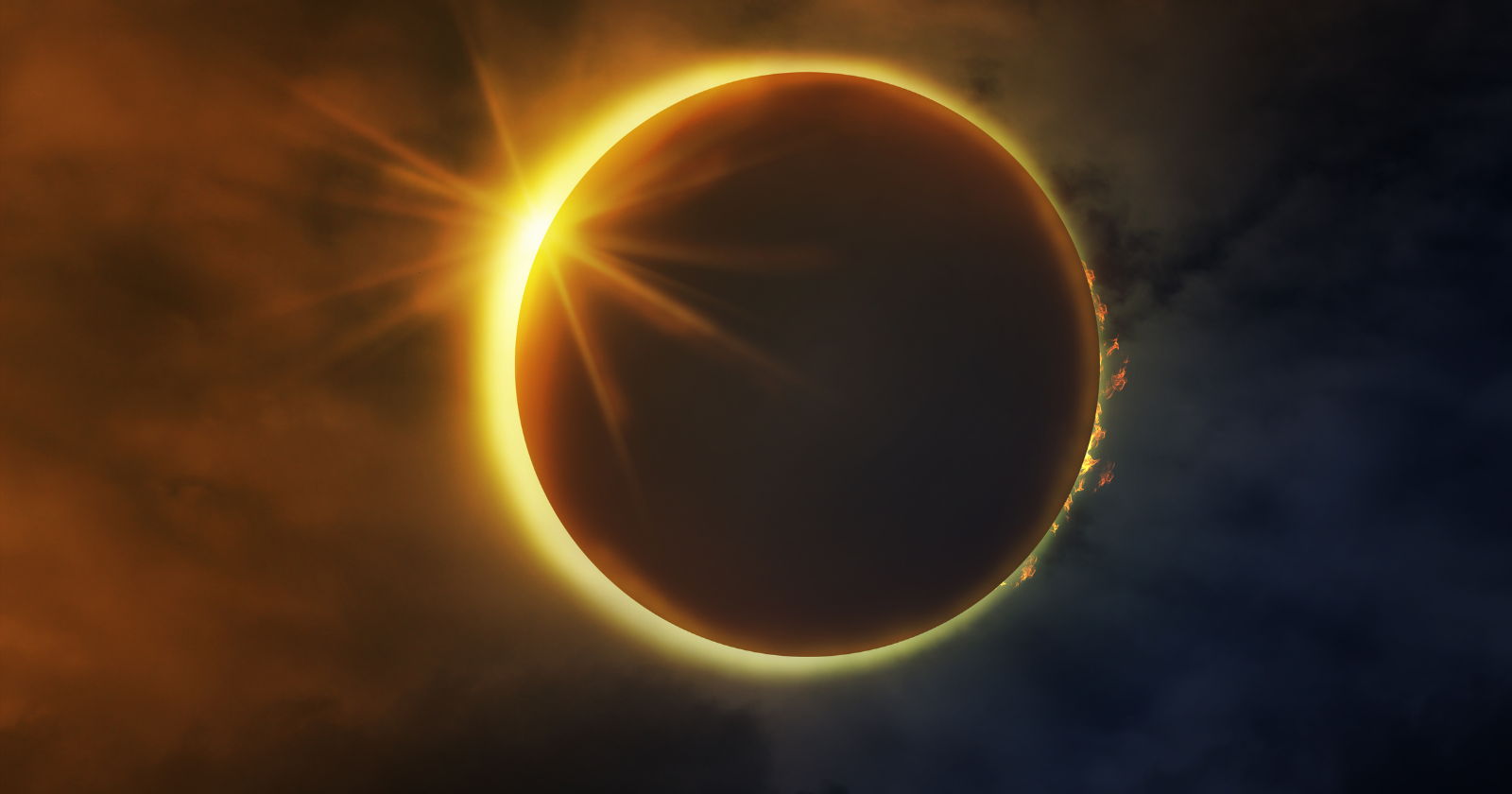
A total solar eclipse rests on a coincidence that is simple to state and still hard to quite accept. The Sun is roughly 400 times wider than the Moon. At present it also sits roughly 400 times further away. The two therefore appear almost the same size from the ground, which is why the Moon can cover the Sun’s disc closely enough that the faint corona becomes visible for a few minutes. Nothing in physics requires this match. It follows from where the Moon happens to sit in a slow outward drift, and that drift is carrying the coincidence towards its end.
The Moon is moving away from Earth at about 3.8 centimetres a year. The figure comes from lunar laser ranging. The Apollo crews left retroreflectors on the surface, and observatories have spent decades bouncing laser pulses off them and timing the return to within a few centimetres. NASA’s account of that work, on the Goddard eclipse pages, puts the recession at about 3.8 centimetres a year, the result of tidal friction between the two bodies.
That rate sounds trivial, and over a human lifetime it is. Across hundreds of millions of years it is not.
What the recession does to an eclipse
As the Moon retreats, its apparent size in the sky shrinks. The geometry that lets the lunar disc cover the Sun completely is already marginal, and it already fails on a regular basis. The Moon’s orbit is an ellipse, so its distance, and therefore its apparent size, changes over the course of a month. When the Moon is near the far end of its orbit, it appears slightly smaller than the Sun. An alignment at that point produces an annular eclipse: the Moon sits in front of the Sun but leaves a bright ring of sunlight around its edge. Totality does not happen.
This is the part the headline version tends to skip. Total eclipses are not a fixed feature of the present that will one day switch off. They already occur only when the Moon is close enough on a given pass. The recession does not introduce a new failure mode so much as it tilts the existing balance, year by year, towards the annular case. The share of alignments that yield a total eclipse falls. The share that yield an annular one rises.
The 600 million year figure, and why it is not a date
The number usually quoted is about 600 million years. It traces to a 2017 NASA statement, in which Goddard lunar scientist Richard Vondrak said that Earth would see its last total solar eclipse in roughly 600 million years. As an order of magnitude that holds up. As a date it does not, and the more careful sources are clear about why.
Sky & Telescope, working through the geometry, frames it as a question about the Moon’s closest approach. For totality to become impossible even under the most favourable conditions, the Moon’s perigee distance has to grow by about 23,000 kilometres, which at the current rate takes more than 600 million years. But the same answer cites the Belgian astronomer Jean Meeus, whose book More Mathematical Astronomy Morsels points out that orbital perturbations complicate the picture considerably. On Meeus’s account the system does not stop cleanly. Total eclipses become erratic from around 620 million years out, occurring less and less often, with the genuine last one perhaps not arriving until something closer to 1.2 billion years from now. A separate NASA analysis has been cited for an earlier endpoint of about 563 million years.
Two further things keep the figure soft. The recession rate has not been constant over geological time and is not guaranteed to stay fixed: it depends partly on the arrangement of Earth’s oceans and how they resonate with the tides. And the Sun itself is slowly growing as it fuses hydrogen into helium, which enlarges its apparent disc and works in the same direction as the Moon’s retreat. So the honest reading is a range that runs from somewhere over half a billion years to more than a billion, with a long tapering rather than a switch.
What the window means
It is worth being precise about what is and is not remarkable here. The coincidence of apparent sizes is real and, as far as anyone can tell, we happen to be alive during a stretch when it is close to exact. That stretch is long by any human measure. It is short only against the age of the Earth and Moon, which formed together about 4.5 billion years ago.
The claim sometimes made alongside this, that such a match must be rare or unique in the galaxy, is harder to stand behind. We do not have the survey data on other planet and moon systems to say so. It is a reasonable guess, not an established fact, and it sits outside what the eclipse measurements themselves can support.
The more grounded point is that the transition is already underway. Annular eclipses are not a future development; they happen now, several times a decade, for exactly the reason that will eventually make totality impossible. The drift that ends the total eclipse is the same drift that is, very slowly, lengthening our days. The endpoint is hundreds of millions of years off and its exact timing is genuinely unsettled. What is settled is the direction, and the fact that it is visible, in small print, every time the Moon passes in front of the Sun and leaves a ring of light behind.
