
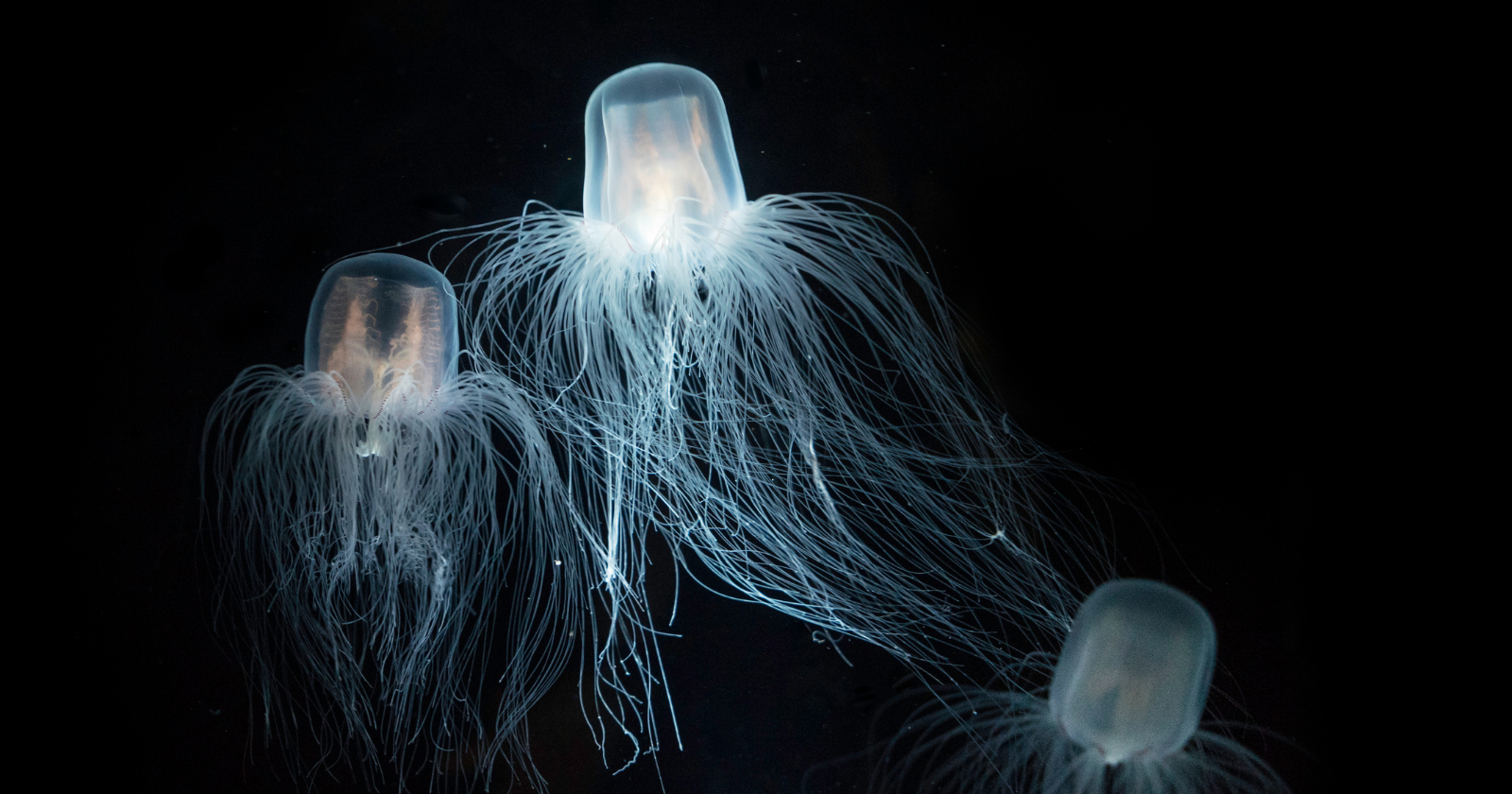
Most animals develop in one direction. An egg becomes a juvenile, a juvenile becomes an adult, the adult ages, and at some point it dies. The sequence does not run in reverse. One small jellyfish is the most famous exception.
Turritopsis dohrnii is a hydrozoan jellyfish about 4.5 millimetres across, roughly the size of a little fingernail. Under stress, when it is injured, starved, or subjected to adverse conditions, the adult medusa does not simply die. It contracts, reabsorbs its tentacles, loses the ability to swim, and settles on the seafloor as a featureless blob of cells called a cyst. Over the following day or two, that cyst reorganises into a polyp, the earlier life stage from which adult medusae normally bud. The animal has, in effect, gone back a step.
The comparison often used is a butterfly that, rather than dying, turns back into a caterpillar, and then in time becomes a butterfly again. From the new polyp, fresh medusae bud off, genetically identical to the one that reverted. As reporting on the research describes, the reversal can happen more than once.
The mechanism, as far as it is understood
The process behind this is called transdifferentiation. It is a change in which a fully specialised, mature cell switches into a different specialised cell type. Medusa tissue and polyp tissue are not the same; some cell types occur only in one stage. For the animal to move from medusa to polyp, cells committed to one role have to be reassigned to another.
It is worth being careful about how settled this is. Transdifferentiation has long been the leading explanation for what Turritopsis dohrnii does, supported by electron microscopy and patterns of DNA replication in the reverting tissue. But at least one recent genomic study has noted that cell tracking and single-cell transcriptomics, the methods that would confirm the cell-by-cell story directly, have not yet been carried out. The capability is not in doubt. The full account of the cellular mechanism is still being assembled.
One detail does seem clear. Not every cell survives the transition. Research has indicated that only medusae with an intact outer layer and parts of their circulatory canal system can complete the reversion. The animal does not rebuild from nothing. It rebuilds from what is left.
What the genome study found
In 2022, a research team led by Carlos López-Otín at the University of Oviedo, with Maria Pascual-Torner as lead author, published a comparative genome study in the journal PNAS. The team sequenced the genome of Turritopsis dohrnii and compared it against a closely related jellyfish, Turritopsis rubra, which does not have the same capacity for repeated rejuvenation.
The comparison, described in the PNAS paper, identified variants and expansions in genes associated with DNA repair, telomere maintenance, the cell’s handling of damaging molecules, and stem cell populations. During the reversal itself, the team found a particular pattern of genes being switched off and on, which they proposed as part of how the animal reprograms its cells.
What the researchers did not claim is a single switch for immortality. Jan Karlseder of the Salk Institute, commenting on the work, made the point that the interest lies in the combination: not one pathway but many, acting together. The genes involved are not exotic. Many have counterparts in other animals, including humans. That is part of why the animal is studied. It is not that it holds a secret molecule. It is that it runs familiar machinery in an unfamiliar way.
Why “immortal” is the wrong word, almost
Turritopsis dohrnii is widely called the immortal jellyfish, and the name needs heavy qualification.
The animal does not escape death. In the ocean it is eaten by predators, killed by disease, and lost to the ordinary hazards of being a small soft-bodied creature in a crowded environment. A given medusa is not guaranteed to last. What the species appears to escape, under the right conditions, is death specifically from ageing. The reproductive adult stage, which in almost every other animal is a one-way commitment that ends in senescence and death, is for this jellyfish a stage it can step back out of.
So the precise claim is narrower than the popular one, and more interesting for being narrow. This is not an animal that cannot die. It is an animal for which the usual ageing endpoint is not fixed.
What it is and is not evidence for
The temptation with an animal like this is to read it as a clue to extending human life. That is not what the research supports, and the researchers have been measured about it.
A jellyfish is separated from a human by a great evolutionary distance and an enormous difference in body plan and complexity. No one working on Turritopsis dohrnii is suggesting that people might one day revert to an earlier stage of life. What the animal does offer is a working example that the machinery governing cell identity is more flexible than the standard one-way model of development assumes, and that the genes involved are old and shared widely across animals.
For now, the practical value of the immortal jellyfish is as a model organism. It is a case where reverse development can be triggered and observed in a laboratory, which makes it useful for studying ageing, regeneration, and cell plasticity. The open questions are still open. What the jellyfish has done is show that they are worth asking.
