
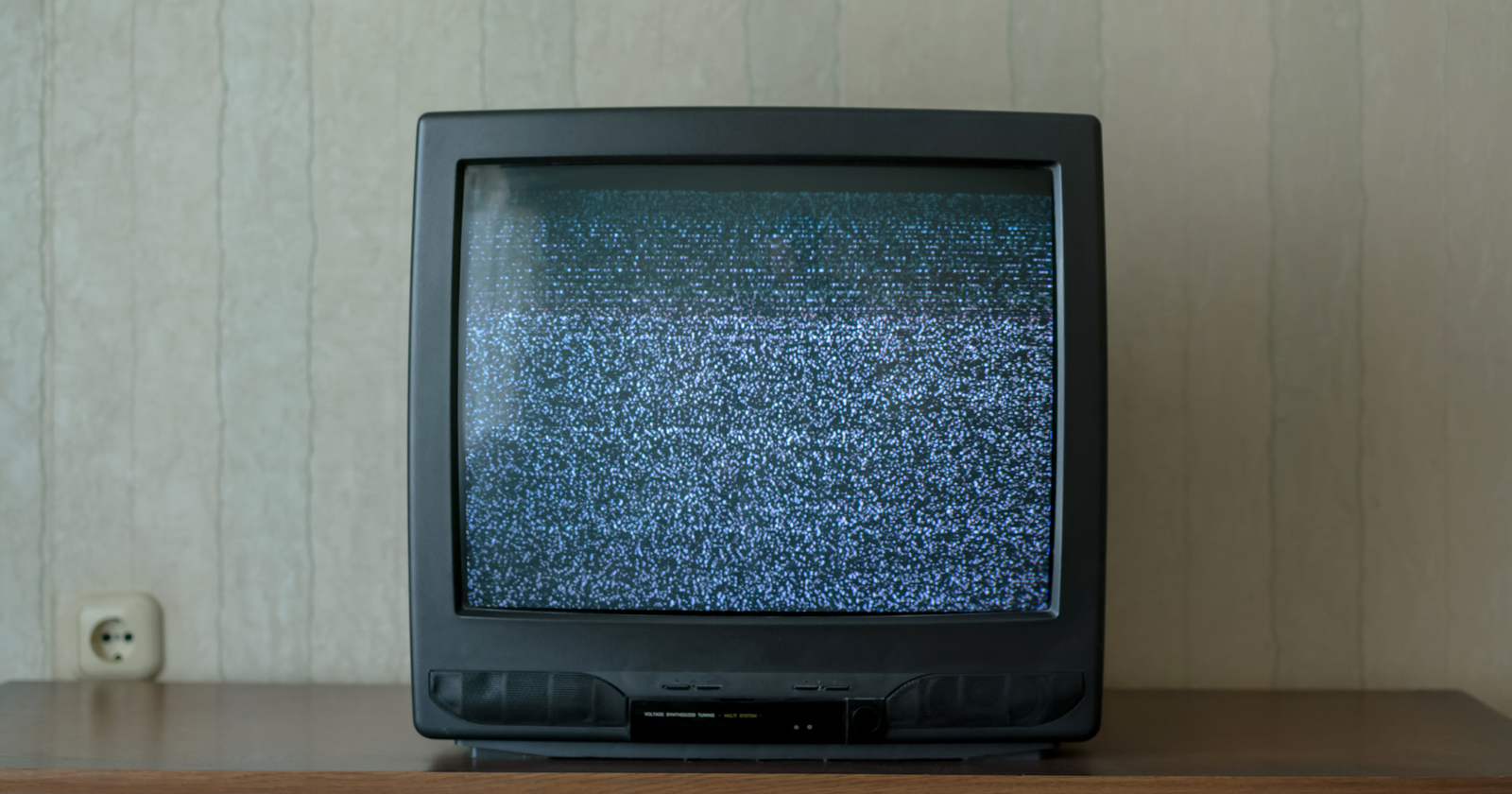
The claim is true, though the version of it that gets repeated most often is softer than it sounds. When an analog television was tuned to a channel with nothing broadcasting on it, the snow on the screen and the hiss from the speaker were built from several sources of noise at once. One of those sources was the cosmic microwave background, the faint radiation left over from the hot, dense early universe. A part of the static really was ancient light.
What gets handled less carefully is the figure. Popular accounts, including Bill Bryson’s A Short History of Nearly Everything, tell readers that about 1 percent of analog television static came from the cosmic microwave background. Other tellings say a few percent, and some put the number higher. The spread itself is the point: the figure is an estimate passed between writers rather than a measured quantity, and the exact percentage depends on the receiver, the environment, and what is being counted as static. In our reading, it is worth holding loosely.
The physics underneath the claim, by contrast, is not in dispute.
What Penzias and Wilson actually had to do
The cosmic microwave background was identified in 1964 and 1965 by Arno Penzias and Robert Wilson, two researchers at Bell Telephone Laboratories. They were not looking for it. They were working with a large horn-shaped antenna at Crawford Hill in Holmdel, New Jersey, an instrument built for Project Echo, an early satellite communications system. They wanted to use it as a radio telescope, and to do that they needed to account for every source of noise in the receiver.
They could not. A faint, steady signal remained after they had ruled out interference from New York City, from the Milky Way, from the receiver’s own electronics, and from a pair of pigeons that had nested in the antenna. The signal was the same in every direction and at every hour. According to the American Physical Society’s account of the discovery, they cooled the receiver with liquid helium and taped over riveted joints in the antenna, and still the noise would not go away.
In May 1965 they published the result in the Astrophysical Journal, under the deliberately plain title “A Measurement of Excess Antenna Temperature at 4080 Mc/s.” A companion paper from a Princeton group led by Robert Dicke supplied the interpretation: the excess was the relic radiation predicted by Big Bang cosmology. Penzias and Wilson shared the 1978 Nobel Prize in Physics for the measurement.
The detail we think worth keeping is how much work it took. Isolating the cosmic microwave background required a carefully calibrated instrument and more than a year of eliminating everything else. A domestic television could detect the same ambient radiation, in the sense that the photons reached its antenna, but it could never have separated that contribution from the rest of the noise. The signal was always there. Identifying it was the hard part.
What television snow was actually made of
Analog static had several contributors, and the cosmic microwave background was a minor one.
A large share of the snow came from the television set itself. Thermal motion of electrons inside the receiver’s own circuitry produces noise regardless of what the antenna picks up, and as Britannica’s entry on noise notes, that kind of electronic noise appears as static in radio and as snow in television. Beyond that, the antenna gathered terrestrial radio interference from other electronics, atmospheric noise, and radiation from the Sun and the galaxy. The cosmic microwave background sat among these as one ambient source, present everywhere but not dominant.
This is the part the “1 percent” shorthand tends to flatten. The figure, whatever its true value, describes a small slice of a noisy total, most of which had nothing to do with the early universe. A viewer watching snow was mostly watching the limitations of mid-century consumer electronics and the ordinary radio clutter of a populated planet. A fraction of it, and only a fraction, came from further away and longer ago than anything else on the screen.
What “the oldest light” means
The cosmic microwave background is often called the afterglow of the Big Bang. The phrase is reasonable, but the timing is specific. The radiation does not date from the beginning of the universe. It dates from roughly 380,000 years afterwards, an epoch cosmologists call recombination.
Before recombination, the universe was hot enough that matter existed as a plasma of free electrons and nuclei. Photons could not travel far without scattering off charged particles, so the early universe was opaque. As it expanded and cooled, electrons combined with nuclei to form neutral atoms, the scattering stopped, and light was free to move. The cosmic microwave background is that light, released when the universe first became transparent.
Calling it the oldest light we can observe is accurate, with one qualification. It is the oldest light. There may be older signals in principle, carried by neutrinos or gravitational waves, that do not involve light at all. But in terms of electromagnetic radiation, nothing predates the cosmic microwave background, because there was no free light to detect before recombination. When the radiation was released it corresponded to a temperature of around 3,000 kelvin. The expansion of the universe has stretched its wavelength over 13.8 billion years, cooling it to about 2.7 kelvin today, which places it in the microwave range.
Why the snow is now a historical object
The experience the title describes is already gone. In many countries, analog terrestrial broadcasting was switched off from the late 2000s through the 2010s, and digital sets usually respond to a missing signal with a blank screen or a “no signal” message rather than snow. The flickering noise that carried a trace of the early universe was a feature of a specific broadcasting technology, and that technology has been retired.
So the romantic version of the claim holds, within limits. For several decades, a great many people did have a small amount of cosmic microwave background radiation reaching the antennas of their televisions, mixed into the static, unrecognised. They were not looking at the Big Bang in any direct sense, and the snow was mostly other things. But the radiation was genuinely present, and it was genuinely the oldest light there is.
The radiation was always reaching those antennas. Recognising it for what it was took a dedicated instrument and a year of ruling everything else out, which is the part the romantic version of the story tends to leave out.
