
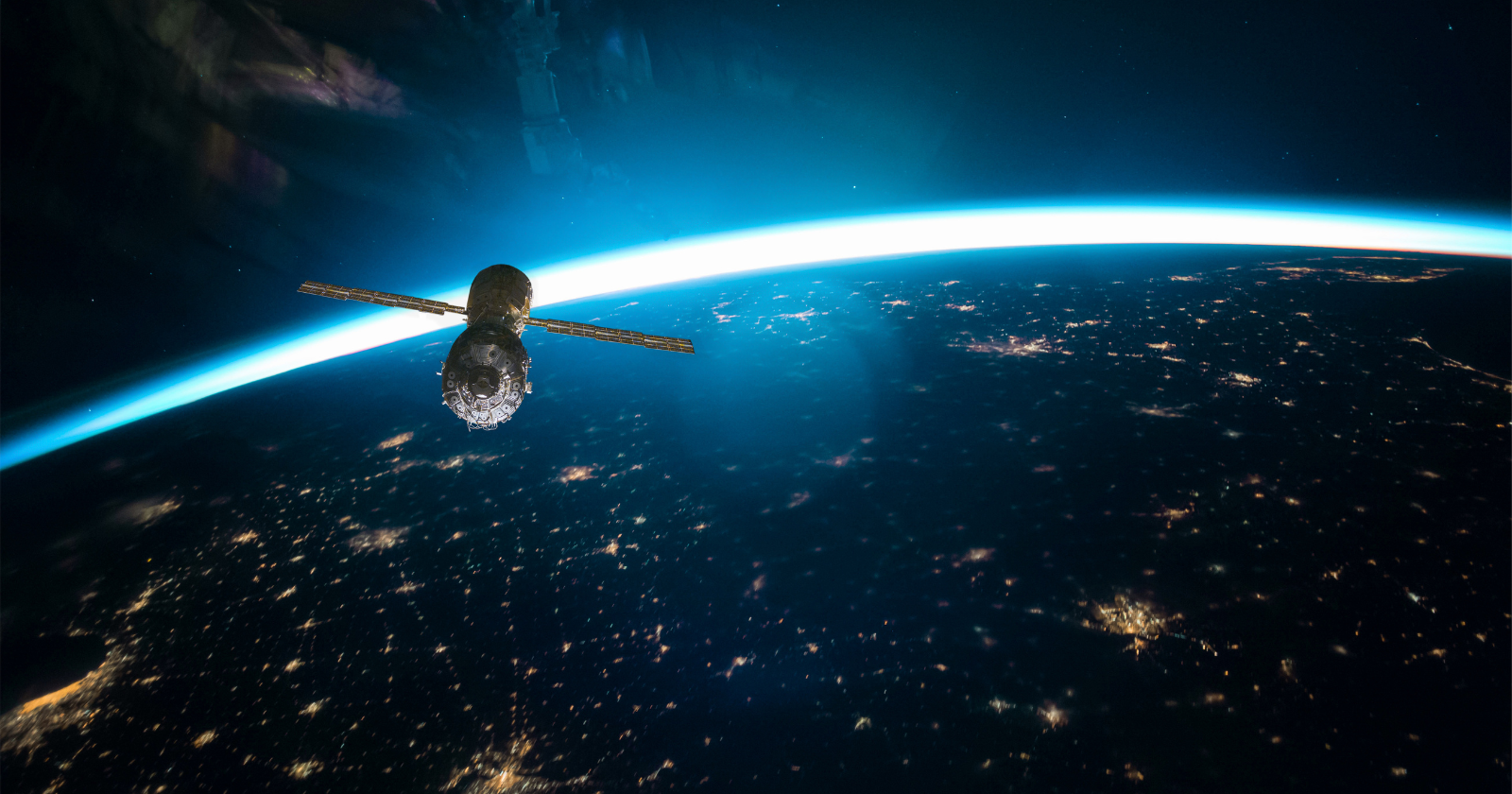
In the late 1960s, a set of United States satellites built to watch for clandestine nuclear weapons tests began recording brief flashes of gamma radiation that matched no bomb. The flashes came from beyond the solar system. Decades later, after a long argument about how far away they were, they were confirmed as among the most luminous explosions known, most of them billions of light-years from Earth.
The satellites were the Vela series, and the episode is often told as a Cold War accident in which the military sat on a discovery for years. The accident is real. The secrecy is not.
What Vela was built to do
The Vela programme grew out of the 1963 Partial Test Ban Treaty, which prohibited nuclear tests in the atmosphere, underwater, and in space. To check that the Soviet Union and others were keeping to it, the United States needed a way to spot a nuclear detonation in space from orbit. A bomb going off above the atmosphere would announce itself with a flash of X-rays, a burst of gamma rays, and a spray of neutrons. The Vela satellites carried detectors tuned to that combined signature.
On 2 July 1967, two of them, Vela 3 and Vela 4, registered a flash of gamma rays. It did not look like a bomb. There was no matching X-ray spike, no neutron signal, and the shape of the pulse over time was wrong. The team at Los Alamos responsible for the data, led by Ray Klebesadel, could not say what it was, and filed it away.
From a filed-away flash to sixteen events
The later satellites changed the picture. Vela 5, launched in May 1969, and Vela 6, launched in April 1970, carried more sensitive detectors and far better timing. Pairs of satellites were synchronised to within a fraction of a second and placed on opposite sides of their orbit, so the small difference in when a flash reached each one could be used to work out roughly which direction it had come from.
Klebesadel, with Ian Strong and Roy Olson, went back through the records. They found a set of events that lined up with no solar flare, no supernova, and no known source on the ground. The flashes were scattered across the sky with no preference for the Sun, the Earth, or the plane of the Milky Way.
Whatever they were, they were not coming from inside the solar system.
What “cosmic origin” did and did not mean
The team published the result on 1 June 1973 in The Astrophysical Journal Letters, in a paper titled “Observations of Gamma-Ray Bursts of Cosmic Origin.” It described sixteen bursts recorded between 1969 and 1972, set out the timing evidence, and stopped there. The authors did not claim to know what was exploding. You can read NASA’s own retrospective on fifty years of gamma-ray burst science for how cautiously the field began.
That restraint matters, because “cosmic origin” in 1973 carried a narrower meaning than it sounds. It meant the bursts were not terrestrial and not solar. It did not mean billions of light-years. The true distance to the sources was unknown, and would stay unknown for close to a quarter of a century.
The finding was confirmed quickly all the same. Tom Cline and Upendra Desai at NASA’s Goddard Space Flight Center matched several of the Vela events to signals from a detector on the IMP-6 satellite, which ruled out a fault on a single spacecraft.
The detail that was not classified
The popular version of this story holds that the military locked the discovery away. A later historical account by J. T. Bonnell of NASA Goddard and Klebesadel himself states plainly that neither the data nor the discovery were classified.
The gap between the 1967 flash and the 1973 paper was not secrecy. It was confirmation. The first event was a single ambiguous reading on instruments built for another job. Announcing a new class of astronomical object on that basis would have been reckless. The team waited until better satellites had logged enough events to rule out the ordinary explanations.
The distance argument, settled in 1997
Knowing the bursts came from outside the solar system left the hardest question open. If the sources sat in or near the Milky Way, their energy was large but manageable. If they sat in distant galaxies, the numbers became extreme. For roughly two decades this was one of the longest-running arguments in high-energy astrophysics, and theorists produced something close to a hundred competing models.
Two instruments resolved it. BATSE, flown on NASA’s Compton Gamma Ray Observatory from 1991, recorded bursts spread evenly across the whole sky rather than clustered along the galactic plane, which argued against a local origin. The Italian-Dutch satellite BeppoSAX, launched in 1996, could then fix a burst’s position accurately enough for other telescopes to chase it while it was still fading.
That was the turn. In 1997, BeppoSAX localised bursts precisely enough for ground-based telescopes to find their afterglows. The afterglow of GRB 970508, recorded on 8 May 1997, yielded a redshift, the first direct distance measurement for a gamma-ray burst. It placed the source several billion light-years away, at what astronomers call a cosmological distance, and ended the controversy over the distance scale.
Gamma-ray bursts are now detected routinely, by spacecraft such as NASA’s Swift and Fermi, and localised within seconds so telescopes on the ground can respond. The objects that began as an unexplained flash on a nuclear-monitoring satellite are among the best-studied transient events in the sky. What the Vela record shows, read back from here, is how long the distance between detecting something and understanding it can run. Sixteen flashes were on the books by 1973. How far away they were was not answered until 1997.
