

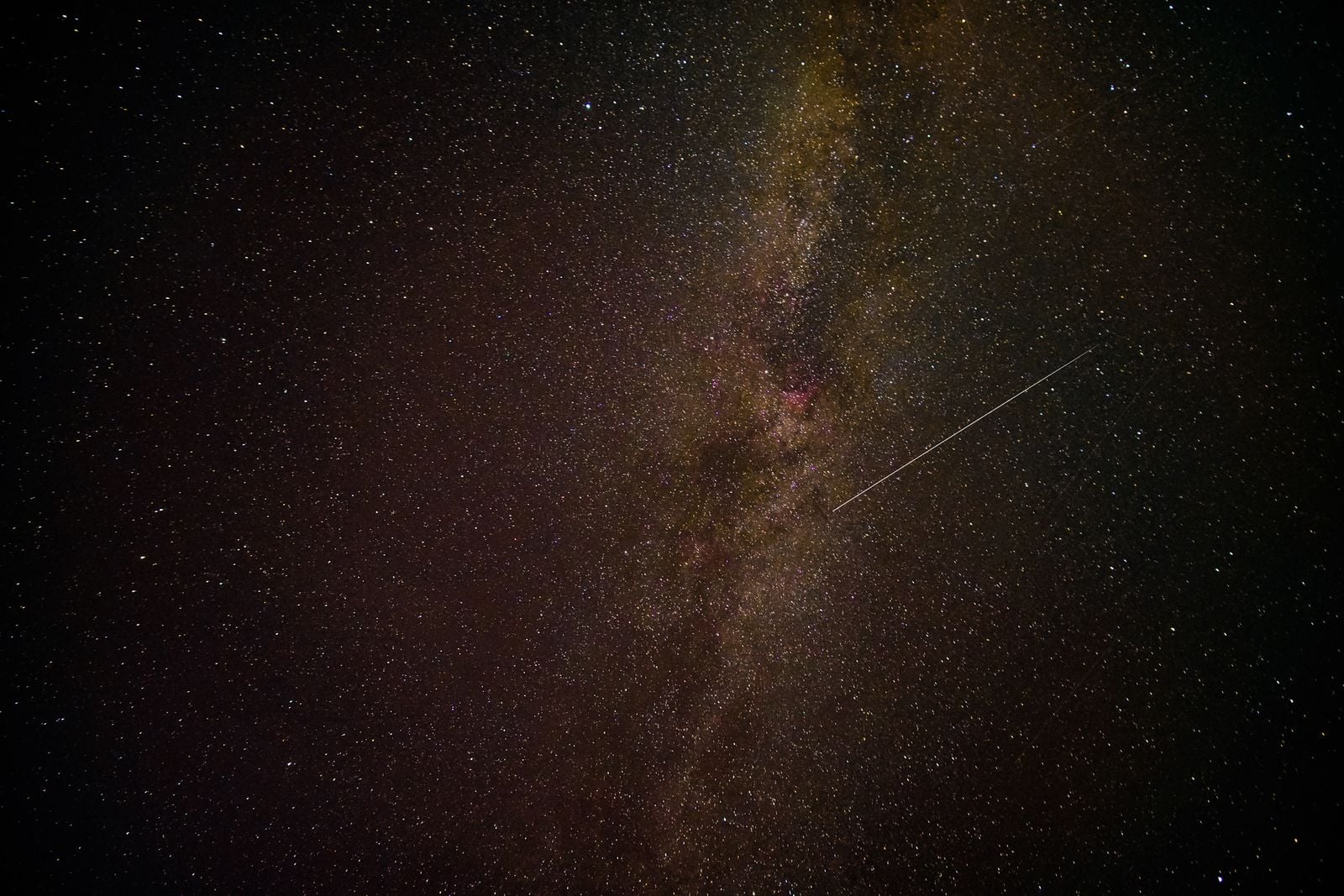
A silicon carbide grain the width of a bacterium, extracted from a rock that fell on a dairy farm outside Melbourne in 1969, condensed in the outflow of a dying star roughly seven billion years ago — more than two billion years before the Sun ignited. No older solid material has ever been identified on Earth.
The grain came out of the Murchison meteorite, and the age was published in January 2020 by a team led by cosmochemist Philipp Heck at the Field Museum in Chicago. To get there, researchers crushed a piece of the meteorite, dissolved almost everything away with acid, and read the neon isotopes trapped inside what was left.
What fell on Murchison
At 10:58 on the morning of 28 September 1969, residents of Murchison, a farming town about two hours north of Melbourne, heard a series of explosions in a clear sky. A sonic boom rattled windows and shook houses. A bright fireball broke into multiple fragments and left a smoke trail that hung in the air for at least two minutes, and the smell that followed was sharp and alcoholic, faintly like methylated spirits. Zolensky and colleagues reconstructed the fall in Meteoritics & Planetary Science, drawing on contemporaneous accounts; the ABC’s 50th-anniversary retrospective collected what locals remembered of the morning.
The stones came down in a shower extending from Wahring and Murchison East, across the township, and on toward the Waranga Basin. The strewn field measured at least 11 kilometres by 3 kilometres. A large piece punched through the roof of a hay shed. Farmers and schoolchildren walked the paddocks and picked up fragments by hand; two brothers, Peter and Kim Gillick, aged 10 and 11, recovered roughly a third of the total mass on their own.
The next day a local farmer, Arnold Brisbane, took samples to his local newspaper, which contacted the University of Melbourne. That single phone call is why the stones reached a laboratory while they were still fresh. The first scientist to examine them was probably the geologist John Lovering, who recognised the rock as a rare carbonaceous chondrite — the largest of its class ever recovered.
Timing helped as much as speed. Murchison fell just after clean laboratories had been assembled across the United States in anticipation of the Apollo lunar samples, which meant a contaminant-free environment was already waiting for an organic-rich meteorite nobody had expected. That accident of scheduling is why Murchison became one of the most-studied stones in scientific history.
If you enjoy our articles, check out our YouTube channel – we post videos on the most unusual aspects of the world and space.
Click here to check out our collection so far.
Why this rock is different
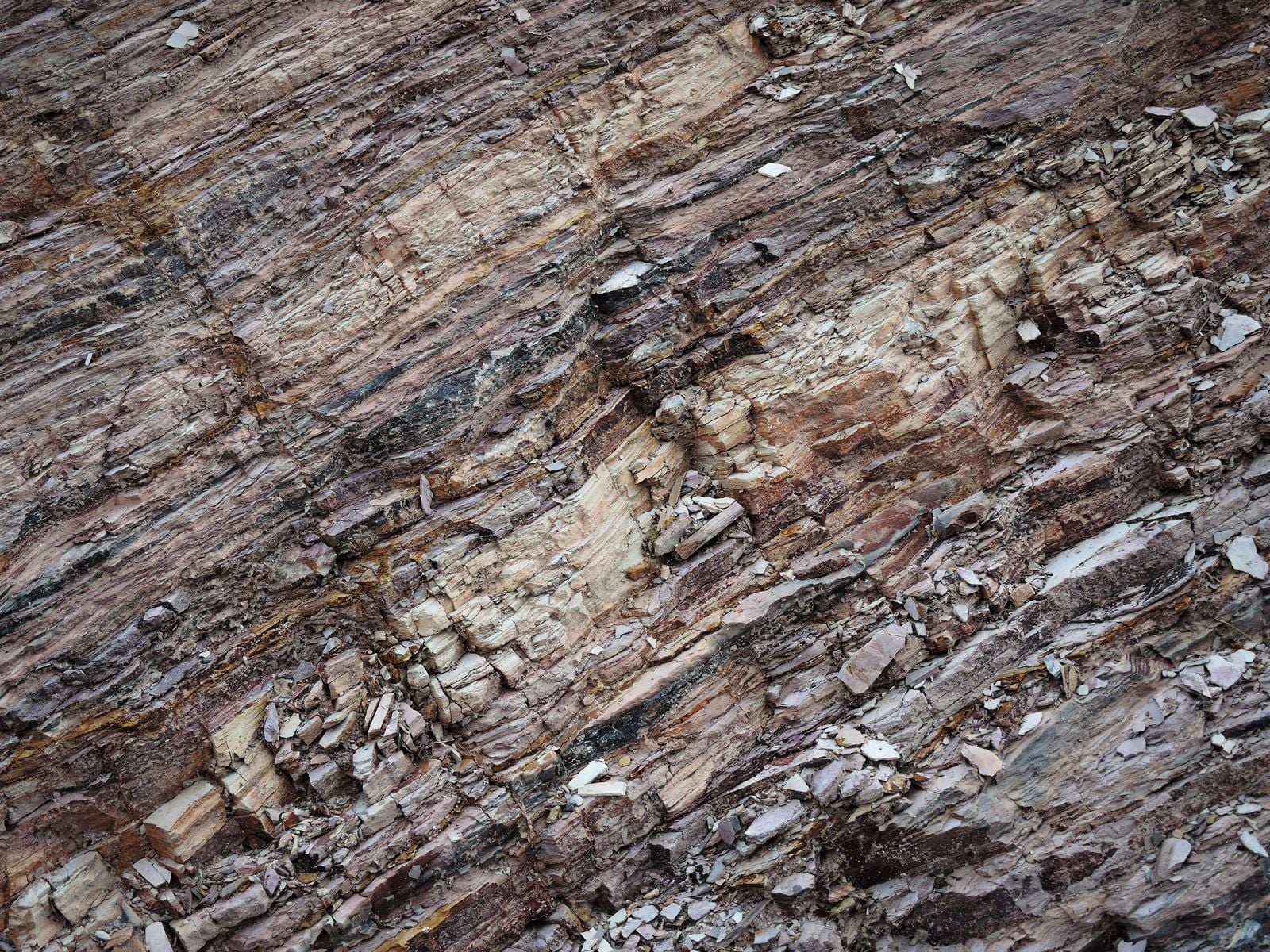
Murchison is a CM2 carbonaceous chondrite. Carbonaceous chondrites as a class account for only around 4 per cent of observed meteorite falls, and the CM group is a fraction of that again. It never melted. It never fully recrystallised. Its interior is a preserved sample of the early solar system’s dust and gas, mixed with clay minerals and water-bearing silicates, plus a scatter of much older material that got swept up when the Sun formed.
The meteorite as a whole is about 4.6 billion years old — roughly the age of the solar system itself. That in itself is not the record. Older mineral grains from Earth, the Jack Hills zircons in Western Australia, come in at around 4.4 billion years. The Sun is about 4.6 billion. The Earth, about 4.54 billion.
The seven-billion-year figure belongs to something smaller and stranger: individual grains of silicon carbide, most under a micrometre across, buried inside the meteorite’s matrix. Under a scanning electron microscope they look like flecks of soot. Several thousand could fit on the head of a pin. Their isotope ratios don’t match anything the Sun has ever produced. They match the atmospheres of stars.
How you date a piece of a dead star
The grains condensed in the cooling outflows of asymptotic giant branch stars — stars in the late, bloated stage before they shed their outer layers. When the parent star died, the dust drifted into interstellar space and stayed there. Then it drifted for a long time.
Cosmic rays, high-energy particles that pour through the galaxy, provided the clock. Every so often, one of them slams into a grain and chips atoms out of the crystal lattice, producing tiny amounts of new isotopes — most usefully, neon-21. The longer a grain floats exposed in interstellar space, the more neon-21 accumulates. Once the grain is swept into a molecular cloud and locked inside a forming solar system, the exposure stops.
Heck’s team, working with collaborators at ETH Zurich, the Australian National University, Washington University in St. Louis, and Lawrence Livermore National Laboratory, measured the neon in 40 large presolar silicon carbide grains. Their paper in PNAS reports exposure ages running from about 3.9 million years to roughly 3 billion years before the start of the solar system. A majority of the grains had interstellar lifetimes under 300 million years; a minority had ages above a billion. ETH Zurich, whose noble-gas laboratory ran part of the analysis, put the bulk of the sample at 4.6 to 4.9 billion years old, with the oldest material reaching five to seven billion.
The procedure is unforgiving. Researchers crush milligrams of Murchison, then bathe the powder in a sequence of acids strong enough to eat the silicates, leaving only the toughest material behind. What settles at the bottom of the beaker is, almost literally, stardust.
A burst of star formation, recorded in Victoria
The distribution was the surprise. If stars in this part of the Milky Way had been forming at a steady rate across galactic history, presolar grain ages should be spread evenly. They weren’t. The pattern pointed instead to an episode of enhanced star formation around seven billion years ago, in the neighbourhood of what would eventually become the Sun. Stars born in that surge swelled, shed dust into the interstellar medium, and left it drifting until something pushed it into the molecular cloud that collapsed about 4.6 billion years ago.
Astronomers had argued for decades about whether star formation in the galaxy is steady or bursty. The Murchison grains gave the burst side of that argument a physical sample to point at — a stone that fell on a dairy paddock in Victoria, carrying dust that recorded the surge directly rather than by inference from starlight.
The claim rests on one paper and one meteorite. It is not yet a consensus about the entire galaxy’s star-formation history. What it is, is a data point that biases the argument.
Seven billion years is difficult to hold in the head, and the comparisons only half help. The universe is approximately 13.8 billion years old, so a seven-billion-year-old grain has existed for roughly half of it. It was already ancient when the cloud that became the Sun had not yet started to collapse. It drifted alone in interstellar space for longer than complex multicellular life has existed on Earth. Space Daily has covered other very old things — Greenland sharks that were alive during the Napoleonic Wars, Wollemi pines whose lineage predates the Cretaceous extinction — but none of them come close.
Those are all Earth things. Living or fossilised, they belong to this planet’s history. The Murchison grains do not. They condensed around a star that no longer exists in any recognisable form, one whose remnant is now a white dwarf cooling somewhere in the Milky Way, possibly thousands of light-years from the Sun. The grain outlived the star that made it by billions of years.
What Murchison has produced, and what it has not
The presolar grains are only part of the story. Murchison is the meteorite that made the case that complex organic chemistry exists off-world. Within a year of the fall, a team including Keith Kvenvolden and Carleton Moore published the first convincing evidence of extraterrestrial amino acids in Nature — molecules central to terrestrial biology, delivered in a rock that had never touched living Earth.
The tally has grown. Scientists have since identified dozens of amino acids in Murchison, many of them not naturally produced on Earth. The rock also carries nucleobase components used in RNA, sugars including ribose, and a bewildering catalogue of insoluble organic matter. That concentration of organics is what produced the sharp methylated-spirits smell locals reported on the morning of the fall.
None of this proves life on Earth was seeded from space. What it does show is that the raw prebiotic ingredients are not unique to this planet. They can form in the cold chemistry of an asteroid parent body and survive an atmospheric entry.
A clarification worth keeping straight: the seven-billion-year age is not the age of the meteorite. The Murchison stone itself is about 4.6 billion years old, and its parent asteroid formed with the rest of the solar system. The figure applies only to a specific subset of individual presolar grains embedded in the matrix — grains that predate the solar system and were incorporated into the asteroid when it formed.
The dating also carries real uncertainty. The oldest exposure ages in the 2020 paper come with error bars of roughly plus or minus two billion years, and the whole method depends on assumptions about how cosmic rays behaved over galactic timescales. Seven billion is the extreme of a range, not a measured birthday.
And Murchison is no longer the only source. NASA’s OSIRIS-REx mission returned samples from the asteroid Bennu, and analyses published in Nature Astronomy in December 2025 found an unexpectedly high abundance of presolar grains in that material, including silicon carbide from stars that died before the Sun ignited. Space Daily’s earlier coverage explored how meteoritic stardust is being used to constrain the timing of supernova dust formation. The Bennu samples support the Murchison picture without duplicating it exactly.
Where the grains are now
Of the roughly 100 kilograms of Murchison meteorite recovered in 1969 and 1970, pieces sit in nearly every major cosmochemistry lab on Earth, plus museum collections in Melbourne, Sydney, Washington, and Chicago. The stones photographed on the floor of the Murchison post office that spring have since been distributed to collections all over the world.
The Field Museum’s stock is stored under nitrogen to slow weathering. When a researcher needs presolar grains, a small piece is ground down, dissolved in acid, and picked through under a microscope for the flecks that survive. Each analysis destroys the sample. The supply is finite, and there is no obvious way to get more — the shower ran west toward the Waranga Basin, and whatever came down in open water in 1969 has not been recovered since.
The Murchison stones in museum drawers look unremarkable. Black, pitted, sometimes crumbly at the edges. It is hard to reconcile the object with the claim, which is roughly the position Arnold Brisbane was in on the morning of 28 September 1969, holding a piece of black grit off a Victorian paddock a day before anyone told him what it was.
Inside those stones, wrapped in clay and water-bearing silicate, are grains that were already old when the molecular cloud that made the Sun began to collapse. They will still be there, in acid-resistant carbide, when the Sun has become a red giant and swallowed the inner planets — an event about five billion years away, less time than the grains have already existed.