
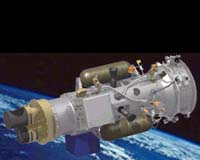
It’s small. It’s hardly noticeable. And in actuality, it hitches a ride on a larger rocket. Yet, a Swales Aerospace-designed secondary launch carrier known as SCONCE, is proving to be an essential link in demonstrating that autonomous space systems may be able to operate safely near other orbiting objects in space.
SCONCE, named because of its resemblance to a candlestick or wall mounted light fixture, successfully carried the first XSS-10 micro-satellite on an Air Force Delta II rocket launched from Cape Canaveral in late January.
Sixteen hours after launch, the XSS-10 was successfully ejected from the SCONCE, marking the first in a series of planned micro-satellite experiments.
These new satellites are now being flown under the XSS Micro-Satellite Demonstration Project managed by the Air Force Research Laboratory (AFRL), at Kirtland AFB, NM.
About the size of a Buick transmission and weighting only 62 pounds, the small XSS-10 spacecraft is “a very significant advancement in space research and development,” said Thom Davis, XSS-10 program manager at the AFRL.
Swales Aerospace was selected by the AFRL to design, develop, fabricate, assemble, test and integrate the micro-satellite carrier system with the XSS- 10. The first operational system was delivered to the Air Force in late 2001 after approximately one year of design and development.
“Basically, SCONCE is a straight forward and inexpensive launch carrier which enables smaller payloads to hitch a ride with larger payloads,” explained Tom Wilson, CEO of Swales Aerospace.
“We view this concept as a promising new business area for Swales as the industry constantly seeks new launch capability at realistic cost savings.”
After being ejected from the Delta II, the XSS-10 spent approximately eight hours flying a series of station keeping maneuvers with the help of a small television camera.
The micro-satellite flew within 100 meters of the second-stage booster of the Delta II rocket and transmitted images to the ground from a low-Earth orbital position 800 kilometers above the equator.
According to one industry observer, the successful XSS-10 mission clearly demonstrated that a small autonomous spacecraft can be operated in close proximity to other spacecraft in orbit, a fact which holds significant promise for the satellite industry as a whole.
