
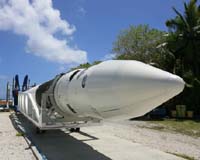
SpaceX said it plans to attempt a launch of its Falcon 1 this week. In a statement, Elon Musk, the company’s founder and chief executive officer, said the rocket has been removed from its hangar and erected on the launch pad. “All systems are currently go for a … launch between March 20 and 25,” Musk said.
The launch plan is to accelerate the two-stage Falcon 1 to Mach 25, or 17,000 miles per hour, in less than 10 minutes, powered by liquid oxygen and rocket-grade kerosene.
If successful, the flight will be the first privately developed, liquid fueled rocket to reach orbit and the world’s first all-new orbital rocket in over a decade. The main Merlin engine will be the first all-new U.S. hydrocarbon-powered engine for an orbital booster flown in 40 years, and only the second new U.S. booster engine of any kind in 25 years.
Falcon 1 is currently the only semi-reusable orbital rocket in the world, apart from NASA’s space shuttle. Priced at $6.7 million, Falcon 1 will provide the lowest cost per flight to orbit of any launch vehicle in the world.
The maiden flight will take place from the Kwajalein Atoll of the Marshall Islands. The customer for this mission is DARPA and the U.S. Air Force. The payload will be FalconSat-2, part of the Air Force Academy’s satellite program to measure space plasma, which can adversely affect space-based communications, including GPS and other civil and military communications.
The rocket’s target orbit is between 400 kilometers and 500 kilometers (250 miles to 300 miles), or just above the orbit of the International Space Station and at an inclination of 39 degrees.
